Imaginary interview with Sarah Winnemucca
by Charactorium · Sarah Winnemucca (1844 — 1891) · Politics · Literature · Society · 5 min read
Nevada, spring 1886. Under a Great Basin sky still speckled with snow, a woman in her forties welcomes us near Lovelock, within the earthen walls of her small school. She has put away the buckskin dress of the great Eastern stages; she speaks softly, but every word weighs like a stone long carried.
—What is your very first memory of white people?
I was not yet six years old. Back home, on the shores of Humboldt Lake, we kept repeating that these men from the east ate Indians, and this rumor ran from camp to camp like an ill wind. One day, we saw them approach. Our people laid us children down in hastily dug holes, up to our necks, and covered our faces with sagebrush so that no white eye would guess that the earth was breathing. I stayed there for hours, convinced that they would dig me up to devour me—these very people whom my grandfather Truckee loved so much. Fear, you see, is not buried with the child: it grows with her.
They covered our faces with sagebrush so that the earth would not betray that it was breathing.
—Do you remember the moment when that childhood fear turned into something else?
My grandfather Truckee had guided the Americans; he kept as a relic a letter given to him, his 'rag friend,' convinced that this paper could speak for him and tell everyone that he was their friend. As a child, I found that beautiful and a little mad. Then came 1865, the Mud Lake massacre: soldiers fell upon our people, and my mother was among the dead. That day, I understood that my grandfather's paper did not speak loudly enough, and that no letter of friendship stops a gun. I would have to learn, myself, to make other papers speak—and louder still.
No letter of friendship stops a gun.
—How did you come to ride for the U.S. Army in 1878?
It was the Bannock War. My father and others of our people were held prisoner among the combatants, and General Howard was looking for someone who spoke our language and knew the mountains. I said yes, not for his stripes, but for that old captive man. I rode more than a hundred miles on horseback, at night, through a country bristling with enemies, slipping into the camp to come out with my own. They call me scout, interpreter; I remember above all a pounding heart and a daughter going to fetch her father. I carried the army's messages, yes, but my true message that night was for him alone.
They call me scout; I, that night, was a daughter going to fetch her father.
—Serving that army which had killed your people—was that not a tearing conflict?
You touch the wound. The same army whose detachment had struck Mud Lake asked for my legs, my ears, my tongue. But between letting my people perish and using these men as a tool, I chose the tool. Interpreter, people forget, is not just translating words: it is standing between two fires and preventing a misunderstood phrase from causing one more death. I spoke Paiute, English, Spanish; I told myself that these three languages were better in my mouth than in that of a man who did not love my people. I was reproached for this choice on both sides. I would do it again.
—Let us talk about the stage. What did you feel, draped as 'Princess Sarah' before the Eastern audience?
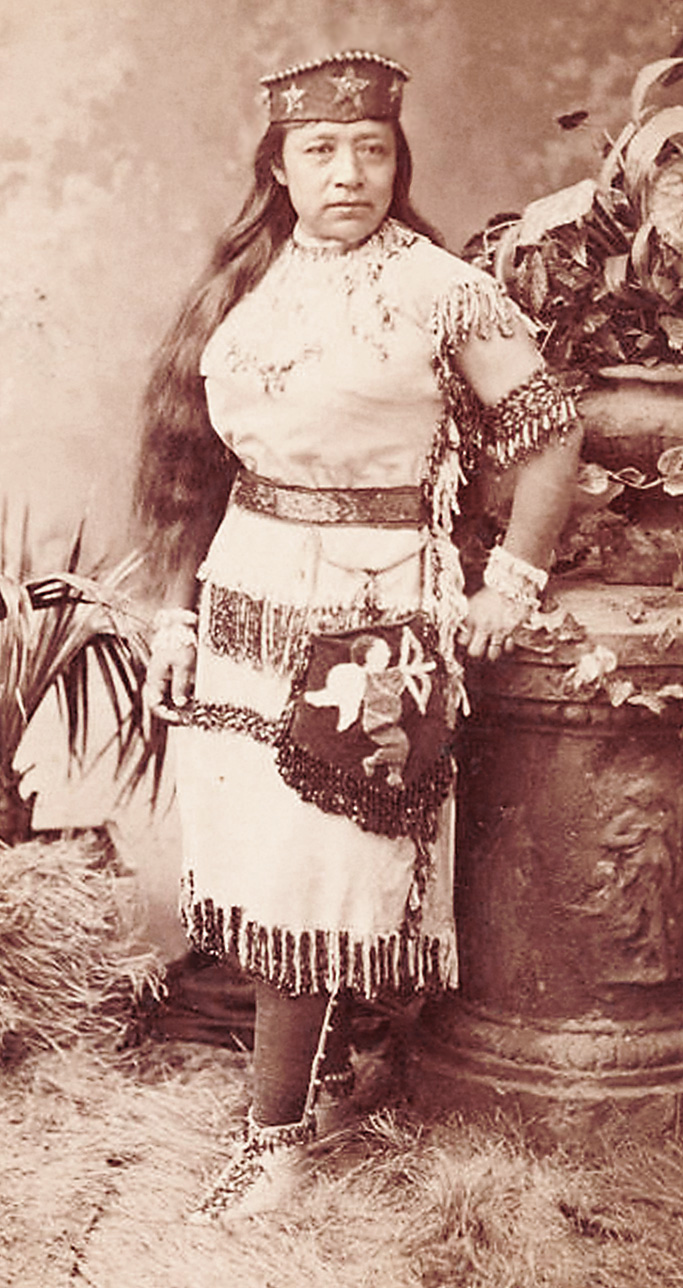
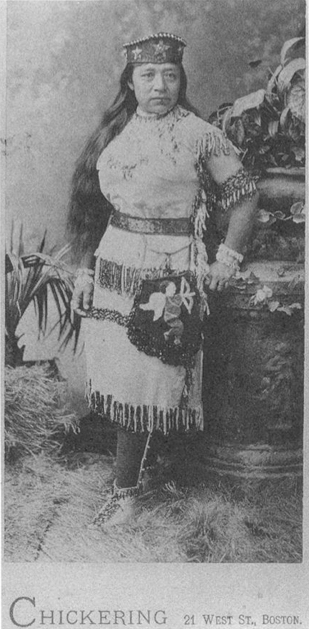
Nearly three hundred times I appeared before them, from San Francisco to Boston, in a fringed buckskin dress cut for me to look 'Indian.' I was announced as 'Princess Sarah,' a title our people never bore—we have no princesses, we have chiefs' daughters who work like the rest. But I had understood one thing: this audience wanted a costume before listening to a truth. So I gave them the costume, and through the door it opened, I let in the misery of the reservations, the hunger, the thieving agents. I played a bit at their dream of an Indian woman in order to then impose upon them the real Indian woman.
This audience wanted a costume before listening to a truth; so I gave them the costume.
—Were you not afraid of betraying your people by thus adopting their image of the 'Indian woman'?
Every evening I asked myself that as I undid the fringe of that dress. A corrupt Indian agent steals supplies in silence, and no one knows; I made noise, and noise, however costly in dignity, sometimes saved bellies. I saw halls full in Cambridge weep for our people after applauding me as one applauds a show. It hurt me and served me at the same time. I preferred to be a curiosity that is listened to than a justice that is ignored. The Princess was only a garment; underneath, there was Thocmetony, Shell Flower, who forgot nothing.
I preferred to be a curiosity that is listened to than a justice that is ignored.
—In 1883, you became the first woman of your people to publish a book in English. Why write?
Because the word of a stage flies away, but paper stays and travels. Life Among the Piutes was born of that patient rage. I wanted our people to stop being told by others, always by others. My friends Elizabeth Peabody and Mary Mann helped me carry the manuscript to the presses of Boston. I wrote there what I saw with my own eyes: the first Whites who came upon us like a lion, and who have hardly stopped roaring since. A book is a 'rag friend' that, this time, speaks loudly enough. My grandfather's paper defended only one man; mine pleads for an entire people.
A book is a rag friend that, this time, speaks loudly enough.
—What did you want an unknown reader to take away from those pages?
That a Paiute, a Numa, 'the People,' is not a beast or a backdrop, but a man, a woman, a child who is cold, who is hungry, who mourns their dead. I put in our willow huts, the karnee, the great harvests of pine nuts in autumn, the baskets woven by my mother—not to look pretty, but so that one sees a life, a real one, before seeing 'savages.' And I put in our wounds: the betrayed treaties, the barren reservations. If someone, one day, closes this book thinking that we deserve the land where our ancestors rest, then I will have written for something.
—In 1880, you were received in Washington. What remains of that summit meeting?
I was taken across the whole country to Washington, where I pleaded before President Hayes and Secretary Schurz that our people be given lands of their own. They listened with grave faces, they made promises sweet as honey. Then I left, and the honey turned to dust: nothing, or almost nothing, was kept. Later, in 1884, I brought to Congress a petition covered with thousands of signatures. They voted on a text, and that text remained a dead letter. I learned, in Washington, that the word of the powerful costs less than ours, and that a signature is not land.
They made promises sweet as honey; the honey turned to dust.
—After so many closed doors, why did you open a school here in Lovelock?
Because I stopped waiting for lands that were denied me, to give children what no Indian agent can steal: their own language and that of others. Here, at my Peabody Indian School, they learn in Paiute and English, side by side, without either crushing the other. Washington taught me that laws are torn up; I now believe that a child who can read the world in two languages is harder to deceive than an entire people of silent ones. I may not see the harvest. But if one day we are to be allowed to live, it will be through these little ones, standing tall, who will know how to answer—and not through princesses in buckskin dresses.
A child who can read the world in two languages is harder to deceive.
This imaginary interview was generated by artificial intelligence from sources documented in Sarah Winnemucca's profile. It dramatises what the figure might have said based on what we know about them, but does not constitute attested historical testimony. For primary sources and factual documentation, refer to the full profile.