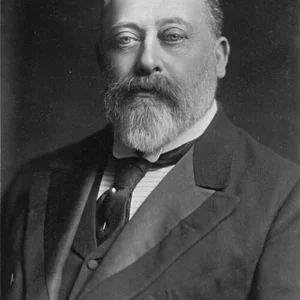

Son of Queen Victoria, Edward VII reigned over the United Kingdom and the Empire of India from 1901 to 1910. An emblematic figure of the Belle Époque, he played a decisive role in bringing France and Britain closer together through the Entente Cordiale of 1904.
Edward VII(1841 — 1910)
Edward VII
Royaume-Uni de Grande-Bretagne et d'Irlande
9 min read
Frequently asked questions
Key Facts
- Born on 9 November 1841 in London, son of Queen Victoria and Prince Albert
- Acceded to the throne on 22 January 1901 upon his mother's death, after 59 years as heir apparent
- Signed the Entente Cordiale with France on 8 April 1904, ending centuries of Franco-British rivalry
- His diplomatic travels earned him the nickname “the Uncle of Europe”
- Died on 6 May 1910 at Buckingham Palace, after only nine years on the throne
Works & Achievements
Diplomatic agreement between France and the United Kingdom settling their colonial disputes over Morocco and Egypt. Edward VII's personal role in paving the way for this agreement — most notably during his visit to Paris in 1903 — was unanimously recognised as decisive by diplomats from both nations.
A personal diplomatic journey that transformed Franco-British relations, still strained by post-Fashoda hostility. Through his speeches in French and his natural charm, Edward VII turned around a hostile public opinion and created the political conditions for the Entente Cordiale.
Strategic alliance between France, the United Kingdom, and Russia, resulting from the Anglo-Russian Convention combined with the Entente Cordiale. This alliance system, to which Edward VII contributed through his personal diplomacy, shaped the balance of power in Europe right up to the Great War.
Edward VII actively supported Admiral Fisher's reforms, most notably the construction of HMS Dreadnought (1906), a revolutionary battleship that completely transformed British naval doctrine in response to the growing power of the German navy.
Honour established by Edward VII to reward exceptional achievement in the military, artistic, literary, and scientific fields, regardless of birth or social rank. Limited to twenty-four living members, it remains one of the highest British distinctions awarded to this day.
Anecdotes
Edward VII waited nearly sixty years before ascending to the throne. His mother, Queen Victoria, denied him any serious political responsibility until her death in 1901, even barring him from access to diplomatic dispatches, as she considered him too frivolous for affairs of state. He became king at the age of 59, after the longest wait ever endured by a British heir.
During his official visit to Paris in May 1903, Edward VII was met by hostile crowds shouting “Vive les Boers !” and “Vive Fachoda !”. Within just a few days, through his natural charm and skilful speeches in French, he completely turned French public opinion around. This visit directly paved the way for the Entente Cordiale signed the following year.
A great epicurean, Edward VII could put away up to twelve courses in a single sitting and ate five times a day. He smoked around twenty Havana cigars daily, in addition to several pipes. His personal physician despaired of ever seeing him adopt a more sensible diet.
Edward VII is credited with originating a fashion that endures to this day: he is said to have started the habit of leaving the bottom button of the waistcoat undone — a necessity dictated by his considerable girth, which his courtiers hastened to imitate as a mark of elegance. He also introduced turn-up trousers and popularised the Homburg hat during his stays in Germany.
A passionate horse racing enthusiast, Edward VII saw one of his horses, Minoru, win the Epsom Derby in 1909, just one year before his death. The crowd gave him a warm reception, one of the rare moments in which this ageing king could savour an undisputed popular triumph.
Primary Sources
His Britannic Majesty's Government declare that they have no intention of altering the political status of Morocco. In return, the French Government declare that they have no intention of altering the political status of Egypt.
There is no greater pleasure for me than to visit Paris... I have never come to your beautiful city without feeling the particular charm it exerts on all those fortunate enough to know it.
His Majesty the King expressed his most sincere wish to see the negotiations entered into with the French Government brought to a lasting agreement, founded on mutual recognition of the interests of both nations.
My dear Wilhelm, I am convinced that relations between our two countries rest on firm foundations. I wish you to know that the agreements concluded with France are not directed against any power.
Key Places
Official residence of the British monarchy where Edward VII received foreign sovereigns and organised State ceremonies. It was here that he died on 6 May 1910, surrounded by his family, after nine years of a reign defined by personal diplomacy.
Edward VII's favourite private residence, which he had entirely renovated to his taste upon his accession to the throne. He hosted grand shooting parties there and spent the Christmas holidays with his family.
A seaside resort the king visited every spring to rest and discreetly meet French dignitaries. His regular presence at the Villa Eugénie helped establish Biarritz as an international destination for the European upper classes.
Sites of the historic State visit of May 1903, during which Edward VII delivered speeches in French that transformed Franco-British relations and directly paved the way for the Entente Cordiale.
The legendary racing venue where the king's horse, Minoru, won the Derby in 1909. For Edward VII, the great races were as much a personal pleasure as an occasion for aristocratic socialising and relaxation away from the demands of protocol.
Typical Objects

Edward VII smoked around twenty top-quality cigars a day. He helped popularise cigar smoking among European aristocratic and upper-middle-class circles, and one of his first acts as king was to lift the smoking ban that Victoria had imposed in the royal drawing rooms.

The undisputed arbiter of masculine elegance, Edward VII wore the bowler hat for informal occasions and the top hat for official ceremonies. He also popularised the Homburg hat during his spa stays in Germany, a style that the European bourgeoisie was quick to adopt.

An essential status symbol for men of Edwardian high society, the pocket watch accompanied the king on all his travels. Some had been presented to him by foreign heads of state at diplomatic meetings, making them as much political mementos as prestige objects.

An indispensable accessory for the Edwardian gentleman, the walking cane set the man of the world apart. Edward VII owned a refined collection of them, symbols both of his elegance and of his many diplomatic relationships across Europe.

State dinners under Edward VII often ran to ten or twelve courses. These menus, printed on thick card, detailed elaborate dishes reflecting the opulence of the Belle Époque and the splendour of the British monarchy — written, as was customary, in French, the language of gastronomy and diplomacy.

A passionate racing enthusiast, Edward VII never missed the great meetings at Epsom, Ascot, or Goodwood. His brass binoculars were his favourite accessory at these events, which were as much social occasions as sporting ones, bringing together the European aristocracy and upper classes.
School Curriculum
Vocabulary & Tags
Key Vocabulary
Tags
Daily Life
Morning
Edward VII rarely rose before ten o'clock. He began his day with a hearty breakfast of several hot dishes, washed down with strong coffee. He then went through the morning papers and dictated his correspondence to his secretaries before receiving his first visitors.
Afternoon
Afternoons were devoted to official audiences, meetings with his ministers, or visits from foreign delegations. At Sandringham or Balmoral, he preferred shooting parties. In Biarritz, he went motoring — he was one of the first sovereigns to take up the automobile — or played cards.
Evening
Edward VII's evenings were renowned throughout Europe. State dinners of ten or twelve courses, outings to the opera or theatre, followed by private receptions that could last until dawn. He was a sought-after host and dinner companion, prized for his quick wit, his humour, and his perfect command of French.
Food
An insatiable gourmet who ate five times a day, Edward VII was fond of oysters, ortolans, lamb cutlets, and roasted partridge. He had a particular taste for French cuisine and was partial to both beer and fine wines, accompanying every meal with vintage champagne or Bordeaux.
Clothing
Edward VII was the supreme arbiter of Edwardian men's fashion, always impeccably dressed by the finest tailors of Savile Row. He wore the frock coat or morning coat as occasions demanded, introduced the trouser turn-up, and popularised the Homburg hat and the bowler hat among European high society.
Housing
Edward VII stayed at Buckingham Palace for official duties, at Windsor for grand ceremonies, and at Sandringham House, his private residence in Norfolk, for leisure. He spent each spring in Biarritz at the Villa Eugénie and frequented the grand hotels of Paris during his private visits to France.
Historical Timeline
Period Vocabulary
Visual Style
Esthétique édouardienne et Belle Époque : portraits officiels en tenue militaire dorée, intérieurs luxueux aux tons bordeaux et or, lumière tamisée des salons aristocratiques londoniens et parisiens, dans la veine de John Singer Sargent.
Sound Ambience
Sons de la haute société édouardienne entre Londres et Paris : carrosses sur les pavés, réceptions diplomatiques feutrées, ambiance des courses hippiques et des grands opéras, mêlant faste impérial et diplomatie du charme.