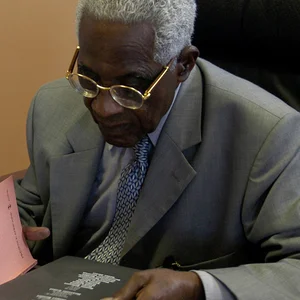
Ivorian political figure and prominent voice in Côte d'Ivoire's public life. Embodying the meeting point between African cultural traditions and modern political engagement, she represents women's participation in the institutions of postcolonial West Africa.
Akwa Boni(1708 — ?)
Akwa Boni
Côte d'Ivoire
8 min read
Frequently asked questions
Key Facts
- Ivorian political figure active after Côte d'Ivoire's independence (1960)
- A female voice in a predominantly male political landscape in West Africa
- Deeply rooted in the cultural and symbolic traditions of the peoples of Côte d'Ivoire
Works & Achievements
A corpus of prophecies attributed to Akwa Boni, passed down orally from generation to generation, concerning the destiny of the Akan peoples, the arrival of strangers, and the rebirth of Africa in a new form.
The female Sandogo initiatory society preserves ritual songs in which the figure of Akwa Boni is invoked as protector of women and families, opening communication with supernatural powers.
Foundation narratives from several Baoulé villages in which Akwa Boni appears as a tutelary figure who advised the first chiefs on the location of settlements and the rules of communal life.
Akan ritual masks and choreographies incorporate mythic narratives in which Akwa Boni embodies feminine wisdom and spiritual authority recognized by the community as a whole.
Anecdotes
According to Baoulé oral traditions, Akwa Boni was born during a lunar eclipse in 1708, an omen of an exceptional destiny. Her birth is said to have been accompanied by the songs of rare birds, and the village elders reportedly recognized in her a messenger of the ancestral spirits, gifted with the power to speak to both the dead and the living.
Legend has it that Akwa Boni could cross the boundary between the world of the living and the spirit world — the *blolo* in the Baoulé language. She is said to have guided her people through major communal decisions, serving as an intermediary between human leaders and the founding ancestors of the nation.
In Ivorian mythological tales, Akwa Boni is often depicted planting the first kapok tree in a village destined to become a place of political gathering. This founding act symbolizes the union between spiritual authority and civil power, and is still commemorated in certain Baoulé ceremonies.
The griots of Côte d'Ivoire recount that Akwa Boni predicted the arrival of European colonizers decades before they came, warning the kings and chiefs of West Africa. Her prophetic vision, passed down from generation to generation, earned her a place as an invoked figure during the independence struggles of the 20th century.
An oral tradition holds that Akwa Boni possessed a kente cloth in the colors of the earth and sky, woven by the spirits themselves. This mythical garment granted her an authority recognized by all the peoples of the region, and the women leaders who invoked her name during traditional councils would symbolically wear her sacred colors.
Primary Sources
Akwa Boni is the one who holds the thread between the living and the ancestors. She speaks with the voice of the earth and the hands of the sky. No chief would make a decision without first hearing her words carried on the wind.
Akan societies give a special place to female figures who mediate between the visible world and the invisible. These women, called mothers of the spirits, are consulted during major political decisions and collective crises.
In the ceremonies of the Poro and the Sandogo, initiated women invoke the founding ancestors. Among them stands a first mediator, the one who opens the passage between worlds and whose word binds the entire community.
The mythical female figures of West Africa often embody the continuity between the ancestral past and the political future of their peoples. They are at once guardians of memory and prophetesses of the change to come.
Key Places
Sakassou is considered the spiritual capital of the Baoulé people of Côte d'Ivoire. In the mythology surrounding Akwa Boni, this territory represents the meeting point between the living and the ancestors, where her voice is said to have been heard for the very first time.
The Bandama River and its forested banks are, in mythological tradition, the domain of water spirits and ancestors. It is here that Akwa Boni is said to have undergone her initiations and received her powers of mediation with the invisible world.
The mythical place of origin of the Baoulé chiefs, Yamoussoukro is associated with the founding narratives of the Ivorian nation. The myth of Akwa Boni is linked here to the idea of wise female governance and ancestral legitimacy passed down to modern leaders.
Abidjan, now the Ivorian metropolis, is in contemporary mythology the place where ancestral traditions meet political modernity. Women's cultural associations there keep the memory of Akwa Boni alive as a tutelary symbol.
In Baoulé cosmology, the *blolo* is the afterlife, the spirit world from which souls come and to which they return. Akwa Boni is described as an inhabitant of this world, able to travel there and back to transmit divine wisdom.
Typical Objects

In Akan mythological tradition, Akwa Boni is associated with gilded masks symbolizing the collective soul of the people. These masks were used during ceremonies of power transmission and communication with the ancestors.

Kente, a sacred cloth woven from gold threads and silk, is Akwa Boni's mythological attribute. Its motifs symbolize Akan cosmogony — sun, moon, cycles of life and death — and wearing it is reserved for figures of authority.

The decorated gourd is the divination instrument attributed to Akwa Boni in oral traditions. It contained sacred herbs and symbols used to read omens and consult ancestral spirits.

The carved stool is the supreme symbol of political and spiritual power in Akan tradition. Akwa Boni is described as the guardian of the founding ancestral stool, representing the continuity of legitimate power.

Bead jewelry is the attribute of female figures of authority in Akan mythology. According to legend, Akwa Boni wore beads inherited from the first ancestors, each bead symbolizing a pact made with a protective deity.

The palaver staff is the tool of speech and mediation in West African societies. Attributed to Akwa Boni, it symbolizes her role as mediator between worlds and between human and divine powers.
School Curriculum
Vocabulary & Tags
Key Vocabulary
Tags
Daily Life
Morning
In Baoulé mythology, Akwa Boni begins each day with a ritual ablution at the edge of the sacred river, invoking the water spirits to seek their guidance. She then consults omens — the positions of birds, the shapes of clouds — before receiving those who come to ask for her counsel or mediation.
Afternoon
In the afternoon, Akwa Boni presides over palavers beneath the central fromager tree of the village, settling disputes and advising chiefs on important decisions. Her words, considered to be carried by the ancestors, are listened to with the greatest respect by both the men and women of the community.
Evening
As evening falls, Akwa Boni performs the rites of communication with the blolo, the world of the ancestors. She weaves or prepares ritual offerings, sings the sacred songs that open the passage between worlds, and passes on to initiated young women the spiritual knowledge of which she is the guardian.
Food
In mythological accounts, Akwa Boni's nourishment comes primarily from the sacred foods offered during ceremonies: yams boiled as the first fruits of the harvest, forest fruits gathered according to ritual rules, and palm wine during libations. Some accounts suggest she could fast during periods of intense initiation, sustaining herself on spiritual energy alone.
Clothing
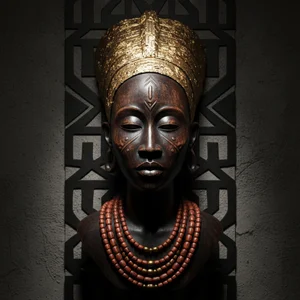
Akwa Boni is described as wearing a kente in the colors of gold, blood red, and black — symbolizing royalty, vital force, and connection to the ancestors, respectively. She wears heavy necklaces of carnelian and gold beads, bronze bracelets inherited from the founders, and an elaborate hairstyle held in place by carved combs.
Housing
Akwa Boni's mythical dwelling is described as a round hut with walls adorned with geometric patterns painted in ochre and white, surrounded by a garden of medicinal and ritual plants. At its center stands the ancestral stool made of fromager wood, flanked by perpetually renewed offerings for the protective spirits.
Historical Timeline
Period Vocabulary
Visual Style
Illustration mythologique aux couleurs chaudes de l'Afrique de l'Ouest : ocres, verts forêt, or et bleu nuit. La figure d'Akwa Boni s'inspire des arts akan et baoulé — bijoux d'or, tissu kente, motifs adinkra — dans un style graphique alliant tradition africaine et illustration contemporaine.
Sound Ambience
Ambiance de la forêt sacrée ivoirienne à l'aube : tambours parleurs fontomfrom, chants rituels féminins en langue baoulé, sons du fleuve Bandama et des oiseaux de la forêt dense — un univers sonore où le monde des vivants et celui des ancêtres se rejoignent.
Liens externes & ressources
Références
Œuvres
Prophéties d'Akwa Boni — traditions orales baoulé
XVIIIe siècle (tradition orale)
Chants d'invocation du Sandogo
XVIIIe–XIXe siècle
Mythes de fondation des villages baoulé
XVIIIe siècle
Répertoire des masques et des danses sacrées akan
XIXe–XXe siècle