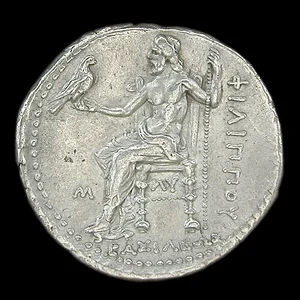

King of Macedon from 370 to 368 BC, son of Amyntas III and elder brother of Philip II. His brief reign was marked by internal unrest before his assassination by Ptolemy of Aloros.
Alexander II of Macedon
Alexander II of Macedon
royaume de Macédoine
7 min read
Frequently asked questions
Key Facts
- Reigned as king of Macedon from 370 to 368 BC
- Son of Amyntas III and elder brother of Philip II of Macedon
- Assassinated around 368 BC by Ptolemy of Aloros, who seized power as regent
- His brother Philip II succeeded him after a period of instability and established Macedonian dominance
Works & Achievements
Alexander II attempted to extend Macedonian influence by supporting the Aleuadae of Larissa in their internal Thessalian disputes. This ambitious expansionist policy was his main act of reign before being thwarted by the Theban intervention of Pelopidas.
Compelled by Pelopidas, Alexander II negotiated a peace agreement with Thebes and handed over high-ranking Macedonian hostages, including his brother Philip. This imposed diplomatic act had considerable historical consequences, shaping the future conqueror Philip II through his exposure to Theban military strategy.
Despite a brief and turbulent reign, Alexander II strove to maintain the cohesion of the Macedonian kingdom against simultaneous pressures from internal nobles, the Illyrians to the northwest, and Thessalian ambitions to the south.
Anecdotes
Alexander II ascended to the throne of Macedonia in 370 BC following the death of his father Amyntas III, inheriting a kingdom weakened by rivalries among Macedonian nobles and external pressure from the Illyrians and Thessalians. In his early twenties, he took the reins of a disputed throne with unstable borders and little time to consolidate his authority.
Shortly after coming to power, Alexander II launched a military expedition into Thessaly to support the Aleuadae of Larissa against their internal rivals. This venture prompted the intervention of the Theban general Pelopidas, dispatched by the Boeotian League to restore the balance of power in the region. Alexander II was ultimately forced to abandon his Thessalian ambitions and hand over hostages to Thebes — among them his own younger brother, the boy Philip.
Philip II, the future conqueror and father of Alexander the Great, spent several years as a hostage in Thebes — a direct consequence of his elder brother's diplomatic failures. It was there that he closely observed the methods of the Theban army, including Epaminondas's oblique tactics and the discipline of the Sacred Band. This enforced stay, born of the weaknesses of Alexander II's reign, would go on to transform the course of Greek history.
In 368 BC, after barely two years on the throne, Alexander II was assassinated during a ritual dance by Ptolemy of Aloros, his ambitious brother-in-law, who immediately seized power in Macedonia. This premeditated murder — likely carried out amid court festivities — illustrates the brutal dynastic struggles that defined the Hellenistic kingdoms of the fourth century BC.
Primary Sources
Amyntas died after a long reign over the Macedonians, leaving three sons of whom Alexander was the eldest. Alexander, having succeeded to the throne, was killed by Ptolemy of Aloros after a reign of only two years.
Pelopidas, sent to Macedonia, restored the agreement with Alexander, took as hostages the young Philip and thirty other children of Macedonian nobles, whom he brought to Thebes to guarantee the execution of the treaty.
Macedonia, after the death of Amyntas, fell into succession disputes. Alexander, his eldest son, was assassinated by Ptolemy of Aloros, who then ruled as guardian of Amyntas's minor sons.
Key Places
Administrative capital of the Kingdom of Macedonia in the 4th century BC and the primary residence of Alexander II. The royal palace of Pella, with its pebble mosaic floors, served as the political and diplomatic center of the Argead kingdom.
Ancient ceremonial capital and royal necropolis of the Argeads, where Macedonian kings were crowned and buried. Alexander II was most likely interred here according to traditional Macedonian royal funeral rites.
Chief city of the Aleuadae of Thessaly and the site of Alexander II's military intervention, through which he sought to assert Macedonian hegemony over this fertile agricultural plain to the south of his kingdom.
The dominant power in Greece following the victory at Leuctra (371 BC), Thebes imposed its authority over Macedonia through Pelopidas. It was here that the young Philip, brother of Alexander II, was held as a hostage.
Typical Objects

A white cloth band tied around the head, the supreme emblem of Hellenic kingship. Alexander II wore it on all public occasions to assert his Argead dynastic legitimacy on the throne of Pella.

A double-edged sword of about 60 cm, the prestige weapon of the Macedonian warrior-king. The kings of Macedon were expected to prove their valor in combat in order to maintain the loyalty of the nobility.

A circular bronze shield decorated with the sixteen-pointed star, symbol of the Argead dynasty. The king carried it during military ceremonies and battles to display his dynastic identity.

A shallow precious-metal bowl used during sacrifices to the gods and royal banquets. It may well have been during just such a festive ceremony that Alexander II was caught off guard and assassinated by Ptolemy of Aloros.

A wool cloak dyed with Phoenician purple and fastened over the right shoulder with a gold fibula, marking the dignity of Macedonian kingship. Its rare and costly color signaled the supreme rank of the wearer.

A wooden and bronze spear roughly 2 meters long, the standard weapon of Macedonian warriors before Philip II introduced the sarissa. The king led his troops carrying this weapon, a symbol of the royal warrior role.
School Curriculum
Vocabulary & Tags
Key Vocabulary
Tags
Daily Life
Morning
Alexander II rose at dawn in the palace of Pella to oversee the military training of his personal guard, the royal hetairoi. Equestrian exercises and close-combat drills occupied the first part of the morning, as a Macedonian king had to remain a respected warrior in order to maintain the loyalty of his nobility.
Afternoon
The afternoon was devoted to royal audiences in the great hall of the palace: Macedonian nobles, ambassadors from Greek city-states, and Thessalian delegates took turns negotiating alliances, tribute payments, and land disputes. The king also administered justice as the supreme arbiter of the Argead kingdom.
Evening
Evenings unfolded at the royal symposion — a banquet at which the king and his companions drank Macedonian wine, discussed military strategy, and distributed rewards to loyal nobles. These nocturnal gatherings, accompanied by the music of the aulos, also served as opportunities to reinforce political alliances within the court.
Food
The Macedonian royal table favored hunted game — boar, deer, and hare — served alongside barley and wheat bread, olives, goat cheeses, and wine diluted with water. Royal banquets featured abundant roasted meats, reflecting the aristocratic Macedonian identity and setting it apart from the more austere diet of the southern Greek city-states.
Clothing
Alexander II wore a purple wool chlamys fastened on the right shoulder with a gold fibula — a symbol of Macedonian royal dignity — over a white linen tunic. In military settings, he donned an engraved bronze breastplate and a crested Macedonian helmet, while a white diadem marked his royal prerogative on all public occasions.
Housing
Alexander II resided in the palace of Pella, a vast architectural complex of mud brick and local marble organized around a peristyle courtyard, with monumental banquet halls, private apartments, and interior gardens. The floors of black-and-white pebble mosaics depicting hunting scenes attest to the growing refinement of the Macedonian court in the 4th century BCE.
Historical Timeline
Period Vocabulary
Visual Style
Style classique grec tardif inspiré des fresques funéraires de Vergina et des orfèvreries argéades du IVe siècle av. J.-C., sobre et guerrier, aux tonalités or et pourpre macédonien.
Sound Ambience
Ambiance de la cour royale de Pella au IVe siècle av. J.-C., mêlant le quotidien militaire macédonien aux rituels des banquets aristocratiques grecs sous un ciel de Macédoine.
Liens externes & ressources
Références
Œuvres
Intervention militaire en Thessalie
370 av. J.-C.
Traité avec Thèbes et remise d'otages
369 av. J.-C.
Maintien de l'unité du royaume argéade
370-368 av. J.-C.