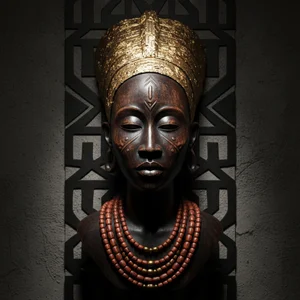

Legendary queen of the Baoulé people in the 18th century, she led her people from the Ashanti kingdom to present-day Ivory Coast. Oral tradition holds that she sacrificed her only son to allow her people to cross the Comoé River, a founding act of Baoulé identity.
Abla Pokou II
Abla Pokou (also known as Abraha Pokou or Aura Poku)
9 min read
Frequently asked questions
Key Facts
- 18th century: she leads a breakaway Akan faction from the Ashanti kingdom westward
- Legend: she sacrifices her son so that the Comoé River parts before her fleeing people
- The name 'Baoulé' means 'the child is dead' in Akan, preserving the memory of her sacrifice
- She founds and governs the Baoulé people in what is today central Ivory Coast
- Her legacy is transmitted exclusively through oral tradition and remains central to Ivorian identity
Works & Achievements
A major political and spiritual act: Abla Pokou organizes the settlement of the central Ivorian region by the Baoulé clans, creating a political entity distinct from the Ashanti Empire from which she came.
The sacrifice of her only son is the founding event of Baoulé identity, recounted in all versions of the oral tradition and perpetuated in Ivorian art, literature, and education.
A body of narratives transmitted orally from generation to generation, forming the collective memory of the Baoulé people. Collected and transcribed by French and Ivorian ethnographers from the 19th century onward.
A dramatic work by Ivorian writer Bernard Dadié that stages the epic of Abla Pokou, helping to bring the figure of the queen to African and international audiences.
A novel by Ivorian writer Véronique Tadjo that revisits the myth by offering multiple versions of the legend, exploring maternal sacrifice, collective memory, and contemporary African identity.
Anecdotes
During the flight from the Ashanti kingdom, Abla Pokou led thousands of refugees through the dense forests of West Africa. Upon reaching the banks of the flooding Comoé River, her people found themselves trapped, pursued by enemy warriors. According to Baoulé oral tradition, a diviner consulted the ancestors and revealed that only the sacrifice of what Abla Pokou held most precious could appease the river and open a passage.
The word “Baoulé” itself carries the memory of the queen's sacrifice. After throwing her only son into the waters of the Comoé to allow her people to cross, Abla Pokou is said to have spoken these words in the Akan language: “Ba ouli,” meaning “the child is dead.” This name became that of the people she had just founded, forever preserving the memory of her act.
Legend has it that after the sacrifice, the waters of the Comoé parted miraculously — in other versions, hippopotamuses formed a living bridge — allowing thousands of refugees to cross safely. This miraculous crossing is regarded by the Baoulé as the birth of their people as a community distinct from the Ashanti.
Once settled in Côte d'Ivoire, Abla Pokou organized the new Baoulé kingdom, distributing the clans across different regions of the forest and savanna. She is venerated not only as a founding queen but also as a spiritual ancestor whose soul watches over her people. Some traditions attribute to her powers of divination and direct communication with nature spirits.
The figure of Abla Pokou has endured through the centuries to become a national symbol of Côte d'Ivoire. Her story has inspired writers, playwrights, and artists since Côte d'Ivoire's independence in 1960. An Ivorian university today bears her name, testament to the central place she holds in the country's collective memory.
Primary Sources
The Baoulé elders recount that when Queen Pokou reached the Comoé River with her people, the waters were so high that no crossing seemed possible. On the advice of the diviner, she threw her only son into the river, and the waters parted before her people.
Pokou was beautiful as the breaking dawn. She had the soul of great queens — those who know how to sacrifice their personal happiness for the happiness of their people. She cast her child into the raging river, and the song of the calmed waters was then heard.
Tradition holds that the Baoulé descended from an Akan group that fled the Ashanti kingdom in the eighteenth century under the leadership of a princess named Aura Poku, to whom her people owe their name and identity.
The queen had left Kumasi after the death of her brother the king. She refused to see a stranger reign over her people. She made the decision to leave, taking with her the members of her royal family and the warriors who had remained loyal to her.
Key Places
The city from which Abla Pokou departed with her clan during the succession conflicts. Kumasi was the political, spiritual, and commercial heart of the Ashanti Empire in the eighteenth century.
The mythic river where the founding sacrifice took place. By throwing her only son into its floodwaters, Abla Pokou enabled her people to cross and be born as the Baoulé people.
A village considered the traditional and spiritual capital of the Baoulé people, home to the customary chiefs who descend from Abla Pokou. It is here that her memory is most actively preserved and celebrated.
The vast forest massif crossed by the Baoulé refugees during their migration from Ghana to central Côte d'Ivoire. This landscape embodies the founding ordeal and the rebirth of a people.
The main city of the Baoulé region, home today to a university bearing the name of Abla Pokou. It has become the economic and cultural center of the Baoulé people in modern Côte d'Ivoire.
Typical Objects

A carved wooden throne inlaid with gold, symbolizing royal power and the bond with the ancestors. Abla Pokou is said to have carried the royal stool with her during her flight, thereby preserving the spiritual legitimacy of her clan in exile.

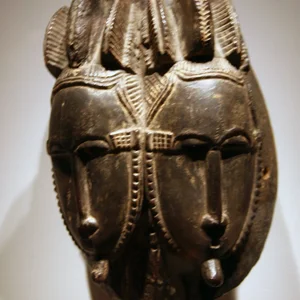
In Baoulé artistic traditions, a carved figurine representing a child serves as a reminder of the founding sacrifice. These ritual objects are kept by noble Baoulé families as a living testament to the queen's act.

Wide bracelets, necklaces, and pendants in solid gold, marks of Akan royalty and wealth. Gold craftsmanship lies at the heart of the Ashanti civilization from which Abla Pokou descended, and the Baoulé continued this tradition.

A hand-woven multicolored strip fabric worn by Akan royal families during ceremonies. Queen Pokou and her retinue are said to have traveled dressed in these precious textiles, symbols of their rank even in exile.

A large court drum used to summon the people, announce royal decisions, and communicate with the ancestors. Its rhythms marked the court rituals and the great decisions made by Abla Pokou during the migration.

A carved and decorated gourd vessel used in rituals of offering to the ancestors and the water spirits. At the sacrifice on the banks of the Comoé, ritual libations are said to have been poured into the river from this sacred vessel.
School Curriculum
Vocabulary & Tags
Key Vocabulary
Tags
Daily Life
Morning
As a queen leading her people into exile, Abla Pokou began each day with libations to the ancestors and spirits of nature, pouring water and palm wine onto the ground. She then consulted diviners and clan elders to decide on the route ahead and settle tensions within the migrating group.
Afternoon
The afternoons during the migration were devoted to advancing through the dense forest, with Abla Pokou watching over the most vulnerable and arbitrating conflicts. Once the people were settled in Côte d'Ivoire, her afternoons were dedicated to royal audiences, negotiating alliances with neighboring peoples, and distributing lands among the clans.
Evening
In the evenings, griots recited royal genealogies and the deeds of the ancestors to maintain the group's cohesion. Abla Pokou presided over assemblies of elders deliberating on the affairs of the nascent kingdom. Nocturnal protection rites — prayers, offerings, and the activation of amulets — were performed before the camp fell asleep.
Food
The diet was built around yam, a sacred food among Akan peoples, prepared as fufu or spicy soup. This was supplemented with forest game, smoked fish caught from the Comoé, leafy greens, and tropical fruits. Palm wine was reserved for ceremonies; river water was used in purification rituals.
Clothing
Abla Pokou wore a kente cloth in royal colors — gold, red, and green — woven by the craftsmen of her retinue. She adorned herself with heavy solid-gold jewelry: wide bracelets, pendant necklaces, and headdress ornaments. A white cotton shawl sometimes covered her shoulders during funeral ceremonies and mourning rites.
Housing
During the migration, the queen lived in temporary shelters made from forest materials — bamboo and raffia leaves — but always set apart from common dwellings by royal symbols. Once the people were established, the Baoulé built rectangular banco houses, with royal residences enclosed by a surrounding wall and decorated with geometric patterns painted in ochre and white.
Historical Timeline
Period Vocabulary
Visual Style
Un style visuel inspiré de l'art akan et de l'illustration africaine contemporaine, dominé par l'or, les ocres profonds et le vert forêt, avec une atmosphère à la fois solennelle, mythique et fondatrice.
Sound Ambience
Une ambiance sonore mêlant la forêt ivoirienne, le grondement sourd de la Comoé en crue, les tambours cérémoniels akan et les chants rituels féminins, évoquant à la fois le deuil, le sacrifice et la marche d'un peuple vers sa renaissance.
Liens externes & ressources
Références
Œuvres
Fondation du royaume baoulé
c. 1750
Traversée de la Comoé — acte fondateur légendaire
c. 1750
Tradition orale baoulé — geste d'Abraha Pokou
XVIIIe–XXe siècle
Abraha Pokou — pièce de théâtre de Bernard Binlin Dadié
1954
Reine Pokou — roman de Véronique Tadjo
2004