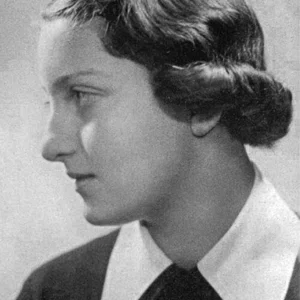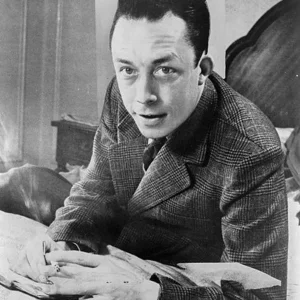

French writer, philosopher, and journalist (1913–1960), Albert Camus is one of the major figures of 20th-century literature. Author of The Stranger and The Plague, he developed a philosophy of the absurd and received the Nobel Prize in Literature in 1957.
Albert Camus(1913 — 1960)
Albert Camus
France
8 min read
Frequently asked questions
Famous Quotes
« There is but one truly serious philosophical problem, and that is suicide.»
« Real generosity toward the future lies in giving all to the present.»
« Even in the depths of despair, one must go on living.»
Key Facts
- 1942: Publication of The Stranger, a landmark novel exploring absurdity and indifference
- 1947: Publication of The Plague, an allegory of World War II and the human condition
- 1942: Publication of The Myth of Sisyphus, a foundational philosophical essay on the absurd
- 1957: Awarded the Nobel Prize in Literature at the age of 43
- 1960: Accidental death in Villeblevin (car accident)
Works & Achievements
An iconic novel presenting Meursault, a man indifferent to social norms, embodying the philosophy of the absurd. This major work of the 20th century explores the alienation of the individual in the face of an absurd society.
An allegory of the human condition narrated through a plague epidemic in Oran. This philosophical novel depicts human solidarity in the face of the absurd and inevitable evil.
A foundational philosophical essay defining the absurd as the conflict between the human need for meaning and the meaninglessness of the universe. Camus proposes revolt and acceptance as responses.
A major essay exploring the metaphysical, political, and artistic revolt of man against the absurd. This work examines the ethical limits of revolutionary rebellion.
A short philosophical novel in the form of a monologue by a former lawyer turned judge-penitent. An introspective work questioning guilt, hypocrisy, and the human condition.
A play staging the Roman emperor confronted with the absurd. It illustrates the destructive consequences of absolute freedom detached from any moral meaning.
A play exploring the moral dilemma of Russian revolutionaries resorting to terrorism. The work questions the ethical limits of violence in service of a cause.
Anecdotes
Albert Camus was born in French Algeria in Mondovi in 1913, into a modest family. His father, an agricultural worker, was killed at the Battle of the Marne in 1914, before young Albert had ever known him. This paternal absence deeply marked the writer throughout his life.
In 1957, at only 43 years old, Camus received the Nobel Prize in Literature, making him one of the youngest laureates of this prestigious distinction. The jury thus recognized his talent as a writer and his profound reflection on the existential questions of his time.
Camus participated in the French Resistance during the Second World War as a journalist and member of the Combat movement. He committed himself to defending freedom and justice, values that remain central throughout his entire literary work.
The writer maintained a friendship and then a dramatic falling-out with Jean-Paul Sartre, another great French thinker of the 20th century. Their political and philosophical disagreement in 1952 divided Parisian intellectuals and remains one of the most famous conflicts in French literary history.
Camus died prematurely in a car accident in 1960 in Villeblevin, at the age of 46. An unfinished manuscript entitled The First Man was discovered in the wreckage, revealing an autobiographical project the author had not been able to complete.
Primary Sources
Mother died today. Or maybe yesterday; I don't know. I received a telegram from the home: 'Mother deceased. Funeral tomorrow. Yours sincerely.' That doesn't mean anything. Perhaps it was yesterday.
One must imagine Sisyphus happy. That last sentence of my work sums up all my heart. For I do not write that final word in vain. What I see in it is the lesson of an entire life.
Above this city hitherto protected by its walls of gemstone and chalk, the plague already spreads its wings. The most terrible thing is not so much the evil it brings as the void it hollows out in souls.
Rebellion, if it cannot save man, can at least save in him his dignity. It saves him from the nothingness imposed on him by the realities of the day.
Art delivers us all to the same demand and sets us on the same road. It only obliges us to understand before we judge.
Key Places
Birthplace of Albert Camus on November 7, 1913. This small town in Kabylia marks the beginning of his life and his deep attachment to Algeria, which would greatly inspire his literary work.
The Algerian capital where Camus grew up, studied, and began his career as a journalist. The Mediterranean city and its landscapes provide the setting for several of his major works, such as The Stranger and The Plague.
The center of his intellectual and literary life from the 1940s onward. Camus settled there after World War II, collaborated with Sartre, and published his major works in the French capital.
A Roman archaeological site in Algeria that profoundly inspired Camus. Its ruins and Mediterranean atmosphere fueled his philosophical reflection and appear in several of his essays.
Site of the fatal car accident on January 4, 1960, where Albert Camus died at the age of 46, bringing an exceptional literary career to an end.
The school where Camus studied and later worked as a philosophy teacher. This place reflects his commitment to education and the transmission of philosophical ideas.
Typical Objects
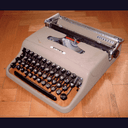
An essential tool of Camus's work, the typewriter was the instrument of choice for 20th-century writers. It symbolizes his creative process in drafting his major novels and essays.
📷 Domaine public · Wikimedia Commons ↗
An iconic accessory of the modern writer of the 1950s, visible in many photographs of Camus. It embodies the image of the engaged Parisian intellectual of that era.
📷 Domaine public · Wikimedia Commons ↗
An honor received by Camus in 1957 at the age of 43, recognizing his major contribution to world literature. It marks the peak of his international recognition.
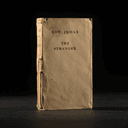
A novel published in 1942, Camus's masterpiece expounding his philosophy of the absurd. It is one of his most iconic works and widely studied in French schools.
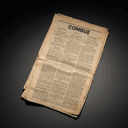
A French Resistance publication of which Camus was editor-in-chief after the Liberation. It symbolizes his journalistic and political commitment to the intellectual debates of the post-war period.

A daily working tool for the writer-philosopher to record his reflections. Camus's notebooks bear witness to his creative method and continuous thought.
📷 Domaine public · Wikimedia Commons ↗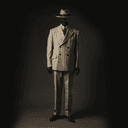
The classic attire of the French intellectual of the mid-20th century, visible in portraits of Camus. It reflects the understated elegance and serious commitment of the engaged writer.
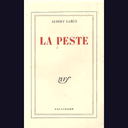
A novel published in 1947 using an epidemic as an allegory for occupation and the human condition. It is a major work exploring the themes of solidarity and the absurd.
📷 Domaine public · Wikimedia Commons ↗School Curriculum
Vocabulary & Tags
Key Vocabulary
Daily Life
Morning
Camus rose early, often around 7-8 AM, and began his day with black coffee, an indispensable drink for the Parisian intellectual of the 20th century. He would then dedicate himself to writing, working on his manuscripts with discipline during the morning hours, which he considered the most productive for literary creation.
Afternoon
The afternoon was devoted to meetings with his editors, his collaborators at the journal Écrits rebelles or the newspaper Combat, as well as intellectual encounters in Parisian cafés such as the Café de Flore. Camus was an active participant in the cultural and political life of his time, contributing articles and engaging in the debates of the era.
Evening
Camus's evenings often unfolded in Parisian literary salons or dinners among intellectuals, where he discussed philosophy, politics, and literature. He might also work on his plays or revise his texts, as Camus was a man of creative discipline who maintained a steady work rhythm well into the night.
Food
Camus followed the Mediterranean diet of his North African childhood, enjoying olive oil, fresh fruits and vegetables, while also adopting Parisian eating habits with bread, cheese, and wine. He was known for his taste for coffee, tobacco, and alcohol — typical indulgences of the intellectual writers in his circle and era.
Clothing
Camus adopted the sober, elegant appearance of the Parisian intellectual: dark suit, white shirt, understated tie, and his characteristic beige raincoat. A regular smoker, he was often photographed with a cigarette in hand, a reflection of the smoky atmosphere of Parisian cafés and salons of the 1940s–1950s.
Housing
After World War II, Camus settled in Paris in an apartment in the 6th arrondissement, a quintessentially intellectual neighborhood frequented by existentialist youth. His home was modest but functional, arranged for a writer's life with a substantial personal library and a dedicated workspace.
Historical Timeline
Period Vocabulary
Visual Style
Un style épuré et contrasté, mêlant le film noir des années 1950 à une esthétique méditerranéenne austère, où la lumière dramatique souligne l'absurdité existentielle et l'isolement humain propres à l'univers camusien.
Sound Ambience
Une ambiance intellectuelle méditerranéenne mêlant les sons d'une plume créatrice (machine à écrire, papier) aux bruits d'une ville française du XXe siècle, enveloppée d'une mélancolie philosophique et d'une tension existentielle subtile.
Liens externes & ressources
Références
Œuvres
L'Étranger
1942
La Peste
1947
Le Mythe de Sisyphe
1942
L'Homme révolté
1951
La Chute
1956
Caligula
1944
Les Justes
1949