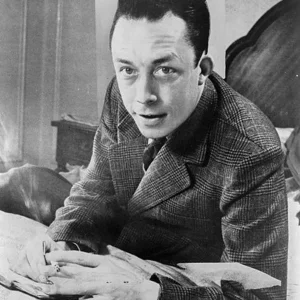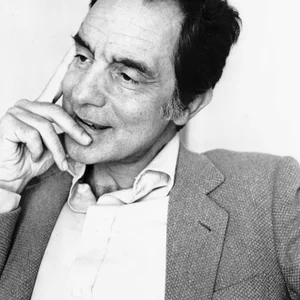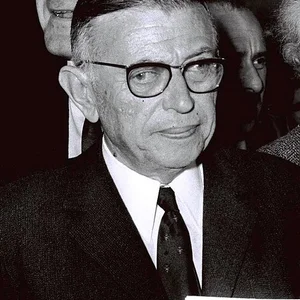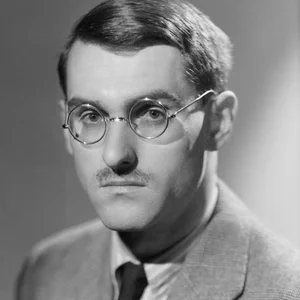

French playwright (1910–1987), Jean Anouilh wrote modern plays that reinterpret ancient myths. His 1944 adaptation of Antigone became a landmark work of 20th-century French theatre.
Jean Anouilh(1910 — 1987)
Jean Anouilh
France
7 min read
Frequently asked questions
Key Facts
- 1910: Born in Bordeaux
- 1944: Premiere of Antigone, a play transposing the Sophoclean myth into a modern context
- 1950: Creates La Ronde, another major dramatic adaptation
- 1987: Dies in Lausanne
- 1996: Posthumous film adaptation of Antigone based on his work
Works & Achievements
A modern rewriting of Sophocles' tragedy, staged under the Occupation, the play explores the conflict between individual moral law and political order. It is today part of the curriculum in French high schools.
A dark play about an amnesiac who refuses to reclaim his troubled past, addressing themes of identity and guilt. It marks the maturity of Anouilh's style.
A bourgeois drama about the impossibility of happiness between individuals of different social backgrounds. The play illustrates the Anouilhian tension between purity and compromise.
A brilliant comedy featuring twin brothers and a poor young girl invited to an aristocratic ball. It combines fantasy, play on appearances, and social critique.
A masterful historical play about the relationship between Henry II Plantagenet and his chancellor Thomas Becket, who became archbishop. It examines loyalty, honor, and betrayal.
A rewriting of the trial of Joan of Arc, presented as a play about freedom of conscience in the face of power. It extends the reflection begun in Antigone on heroic refusal.
A lighthearted and whimsical play blending a gang of disguised thieves and a bourgeois family. It is one of Anouilh's most performed works, combining lightness and poetry.
Anecdotes
At the premiere of Antigone at the Théâtre de l'Atelier in February 1944, during the German Occupation, the play was simultaneously applauded by collaborators who saw in Creon a responsible head of state, and by resistance fighters who admired Antigone's heroic refusal. This ambiguity, deliberately crafted by Anouilh, allowed him to outwit Nazi censorship while deeply moving the French audience.
As a teenager, Anouilh discovered theatre by chance while reading a play by Jean Giraudoux, and it was an absolute revelation. He decided on the spot to dedicate his life to playwriting, convinced that theatre was the only art capable of making life both more beautiful and more true at the same time.
Anouilh had a habit of classifying his own plays into poetic categories: 'Pièces roses' (Pink Plays), 'Pièces noires' (Black Plays), 'Pièces brillantes' (Brilliant Plays), and 'Pièces grinçantes' (Jarring Plays). This classification, which he published in his collected works, reflects his worldview oscillating between lightness and despair, between comedy and tragedy.
To write Becket, or the Honour of God (1959), Anouilh had immersed himself in English medieval chronicles. He discovered too late that the historian he had followed had confused certain facts, but pressed on nonetheless, believing that the poetic and human truth of the relationship between Henry II and Thomas Becket mattered far more than strict historical accuracy.
Anouilh was for a long time the secretary of Louis Jouvet, one of the greatest French theatre directors of the interwar period. This modest position allowed him to observe the inner workings of professional theatre firsthand and to forge his own demanding conception of the craft of dramatic writing.
Primary Sources
Antigone: '...I am here to say no and to die.' — Creon: 'It is easy to say no.' — Antigone: 'Not always.'
Becket: 'The honour of God is a heavy burden, Your Highness. It is the burden of those who have no other honour.'
Gaston: 'I have no past. It is an extraordinary chance that everyone should have once in their life.'
Anouilh declares: 'Theatre is life with what life has that is unbearable: clarity.' He explains his distrust of ideologies and his faith in the sole truth of the stage.
Anouilh explains the genesis of his classification and asserts that the 'pièces noires' seek to show 'impossible purity in a compromised world'.
Key Places
Jean Anouilh was born in Bordeaux on June 23, 1910, into a modest family. The city formed the backdrop of his childhood before his move to Paris.
Paris was the heart of Anouilh's professional life. He frequented the Boulevard and Left Bank theatres, worked with Jouvet, and saw his plays premiered in the major Parisian venues.
The Théâtre de l'Atelier, directed by André Barsacq, was the venue for the premiere of many of Anouilh's plays, including the celebrated Antigone in 1944. It was his favourite theatre.
Anouilh settled in Switzerland in the final decades of his life, seeking a certain distance from the Parisian theatre world. He died there on October 3, 1987.
The play Becket, or the Honour of God premiered in London before Paris and triumphed in the West End theatres, securing Anouilh international recognition.
Typical Objects

Anouilh wrote his plays on a typewriter, often in cafés or hotel rooms. The portable typewriter was the indispensable tool of the Parisian playwright of the 20th century.

Anouilh drew deeply from Greek tragedies, particularly for Antigone and Medea. His copies of Sophocles and Euripides were covered in personal notes and reinterpretations.

The Théâtre de l'Atelier, directed by André Barsacq, was the emblematic venue for Anouilh's premieres, most notably Antigone. The spare, stylized sets of this theatre were a perfect match for Anouilh's aesthetic.

The programmes of Parisian shows from the interwar period are precious records of the theatrical world in which Anouilh moved, caught between modernism and classical tradition.

Anouilh often worked on several plays simultaneously, accumulating drafts and variants. His manuscripts bear witness to a highly rigorous formal approach to language and dramatic structure.

The posters of shows from the 1940–1944 period illustrate the paradox of an intense cultural life under censorship. The poster for Antigone, understated and elegant, has become a historical document.
School Curriculum
Vocabulary & Tags
Key Vocabulary
Daily Life
Morning
Anouilh woke up late, like many theatre people whose professional lives revolved around evening performances. He devoted his mornings to reading newspapers and correspondence, far from the bustle of Paris.
Afternoon
The afternoon was the heart of his writing work: settled in a café or at his desk, he worked on his plays in progress, often several projects at once, typing at the typewriter or correcting proofs.
Evening
Evenings were dedicated to rehearsals and performances. Anouilh regularly attended rehearsals of his plays, overseeing the actors' performances and the director's decisions with a demanding attention well known to all.
Food
Anouilh frequented the brasseries and neighbourhood restaurants of theatrical Paris, rubbing shoulders with actors and directors. His diet was typical of the cultivated Parisian bourgeoisie: classic French cuisine, red wine, strong coffee.
Clothing
Anouilh cultivated a discreet, bourgeois elegance typical of the Parisian intellectual of the 1940s–1960s: dark suit, overcoat, felt hat. He avoided any sartorial eccentricity, preferring a sober style that stood in contrast to the bohemian image sometimes associated with artists.
Housing
Anouilh lived for many years in comfortable Parisian apartments, first in working-class districts and then in more bourgeois arrondissements as his success grew. In his later years, he settled in Switzerland, in a house offering peace and withdrawal from the Parisian scene.
Historical Timeline
Period Vocabulary
Visual Style
Esthétique théâtrale épurée des années 1940, entre rigueur classique et modernité sobre, dominée par les contrastes noir et blanc et les décors minimalistes.
Sound Ambience
L'univers sonore d'Anouilh est celui du théâtre parisien des années 1940-1960 : coulisses fébriles, salle bruissante, Paris en arrière-plan.
Liens externes & ressources
Références
Œuvres
Le Voyageur sans bagage
1937
La Sauvage
1938
L'Invitation au château
1947
Becket ou l'Honneur de Dieu
1959
Le Bal des voleurs
1938