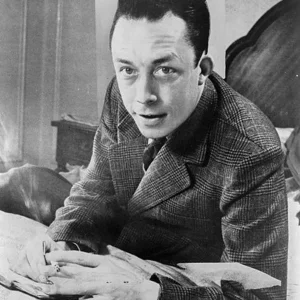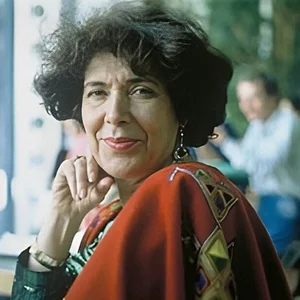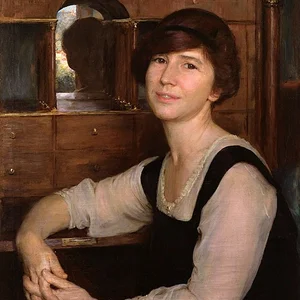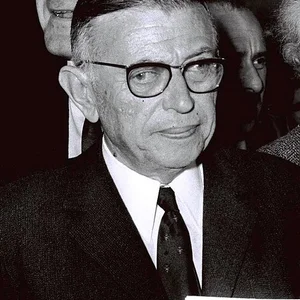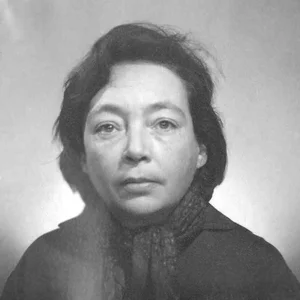

French writer, playwright, screenwriter, and filmmaker (1914–1996), Marguerite Duras is a major figure in contemporary literature. Author of The Lover, she revolutionized the novel form by exploring psychological introspection and the formal ruptures of the Nouveau Roman.
Marguerite Duras(1914 — 1996)
Marguerite Duras
France
7 min read
Frequently asked questions
Famous Quotes
« I believe that always, or almost always, in all childhoods and in all the lives that follow them, the mother represents madness.»
« Writing is forgetting.»
« You must never explain anything, never.»
« We know nothing about anyone.»
Key Facts
- 1943: Publication of her first novel Les Impudents (The Insolent Ones)
- 1960: Screenplay for the film Hiroshima mon amour directed by Alain Resnais
- 1984: Publication of The Lover, an autobiographical narrative that won the Prix Goncourt
- 1985: Direction of the film The Lover as a filmmaker
- 1996: Death in Paris, leaving behind a body of work considered fundamental to the Nouveau Roman
Works & Achievements
Duras's first major autobiographical novel, it recounts a poor childhood in Indochina and her mother's struggle against the colonial administration. A finalist for the Prix Goncourt, it revealed her talent to the general public.
A novel associated with the Nouveau Roman, it depicts a bourgeois woman fascinated by a crime of passion. Through its ellipses and pared-down language, it marks a major stylistic turning point in Duras's work.
The screenplay for Alain Resnais's film, exploring memory, forgetting, and love between a French woman and a Japanese man in Hiroshima. A founding work of the French New Wave, it received a special Palme d'Or at Cannes.
A novel set in colonial India, it portrays madness, marginality, and existential pain. Considered one of her most ambitious and complex texts.
A film directed by Duras, adapted from her own stage play. An experimental work dissociating voices from images, it is now considered a masterpiece of auteur cinema.
An autobiographical novel recounting her teenage affair with a Chinese man in Indochina. Awarded the Prix Goncourt and translated into forty languages, it remains her most widely read and best-known work in the world.
A collection of autobiographical texts about waiting for the return of deported Robert Antelme, rediscovered in forgotten notebooks. A shattering document on the war, the Resistance, and the pain of love.
Anecdotes
Marguerite Duras was born in French Indochina (present-day Vietnam) in 1914, under the name Marguerite Donnadieu. It was in this tropical country, marked by her family's poverty and by her encounter with a wealthy Chinese man when she was fifteen, that she would draw the material for her most celebrated novel, The Lover, published seventy years later.
In 1984, her novel The Lover won the Prix Goncourt, France's most prestigious literary prize. Duras was 70 at the time: a belated but resounding consecration for an already recognized author, and the book became a worldwide bestseller translated into forty languages, with several million copies sold.
During the Second World War, Marguerite Duras joined the French Resistance. Her husband, Robert Antelme, was arrested by the Gestapo and deported to the Dachau concentration camp. Duras, devastated, waited months before finding him alive, emaciated to the extreme. This traumatic experience left a profound mark on her entire body of work.
Duras was a fixture of the Café de Flore and the Saint-Germain-des-Prés neighborhood in Paris, where she rubbed shoulders with Simone de Beauvoir, Jean-Paul Sartre, and the great intellectuals of the post-war era. Her apartment on the Rue Saint-Benoît was a meeting place for writers, filmmakers, and philosophers for several decades.
Toward the end of her life, Marguerite Duras maintained a singular relationship with Yann Andréa, a young man thirty-eight years her junior who had written her admiring letters. He became her companion, her secretary, and her witness until her death in 1996, inspiring several of her late works including Yann Andréa Steiner.
Primary Sources
I am fifteen and a half. It is the crossing of a ferry on the Mekong. The image lasts throughout the entire crossing of the river.
I found this diary in two notebooks in the blue wardrobes at Neauphle-le-Château. I have no memory of having written it.
You saw nothing in Hiroshima. Nothing. — I saw everything. Everything.
— Do you want to read? asked the lady. — No, said the child. The lady was not surprised by this refusal.
Writing is also not speaking. It is keeping silent. It is screaming without making a sound.
Key Places
Marguerite Duras's birthplace in 1914, this city near Saigon and the Mekong landscapes nourished her entire literary imagination, particularly in The Lover and The Sea Wall.
Duras's Parisian apartment where she lived for decades and received the French intelligentsia. This location at the heart of Saint-Germain-des-Prés was the center of her intellectual and social life.
Duras's country house where she liked to retreat to write. It was there that she rediscovered the notebooks that became The War: A Memoir, and where several film shoots took place.
A city symbolic of the worldwide trauma of the atomic bomb, made famous in Duras's work through the screenplay of Hiroshima mon amour, a meditation on memory and forgetting.
Nazi concentration camp where Robert Antelme, Duras's husband, was deported. His miraculous but physically devastated return inspired the autobiographical work The War: A Memoir.
Typical Objects

Duras wrote her texts on a typewriter, often at night. This object symbolizes her obsessive relationship with writing as a physical and repetitive act.

She kept personal diaries and notebooks, notably those found in the blue wardrobes of Neauphle-le-Château, which gave birth to La Douleur.

Duras struggled with alcoholism throughout her life, which she herself addressed in L'Amant and in interviews. Alcohol is inseparable from her image and her relationship with nocturnal writing.

A director of more than twenty films, Duras used lightweight cameras for her experimental shoots, based on the dissociation between voice and image.

Photographs of Duras often show her wearing straw hats or simple dresses, recalling the colonial outfits of her Indochinese childhood described in L'Amant.

Duras had a passion for music, particularly for the melodies that run through India Song and her other works. Records by Carlos d'Alessio, the composer of her films, adorned her living room.
School Curriculum
Vocabulary & Tags
Key Vocabulary
Daily Life
Morning
Duras rarely woke up early. Her mornings were often spent rereading what she had written the night before, black coffee in hand. She could stay in her dressing gown for hours, absorbed in her manuscripts or notebooks.
Afternoon
In the afternoon, she received friends, publishers, or filmmakers in her apartment on rue Saint-Benoît. Conversations could last for hours, blending politics, literature, and personal life, often over a drink.
Evening
It was at night that Duras truly wrote, in a silence punctuated by music or cigarettes. She often worked until the early hours of the morning, sometimes accompanied by alcohol, in a state of near-mystical concentration.
Food
Duras had a difficult relationship with food, shaped by the deprivations of her poor colonial childhood. She appreciated simple French cuisine, but alcohol — white wine, whisky — occupied an excessive place in her daily life, something she acknowledged in her writings.
Clothing
Duras favored a sober and personal elegance: simple dresses, often black, sometimes complemented by a hat. As she aged, she adopted looser, more informal outfits. In her photographs, she always exudes a strong presence despite her modest dress.
Housing
She lived for many years in an apartment at 5 rue Saint-Benoît in Paris, a bourgeois dwelling filled with books, papers, and creative disorder. She also owned a country house in Neauphle-le-Château, a retreat and writing space surrounded by a garden she loved.
Historical Timeline
Period Vocabulary
Visual Style
Un esthétisme en clair-obscur, entre le noir et blanc de Paris existentialiste et les teintes sépia et tropicales de l'Indochine coloniale, reflétant la dualité mémorielle de l'œuvre de Duras.
Sound Ambience
L'univers sonore de Duras mêle le silence de l'écriture nocturne parisienne au souvenir obsédant des pluies et des fleuves de l'Indochine de son enfance.
Liens externes & ressources
Références
Œuvres
Un barrage contre le Pacifique
1950
Moderato Cantabile
1958
Le Vice-consul
1966
La Douleur
1985