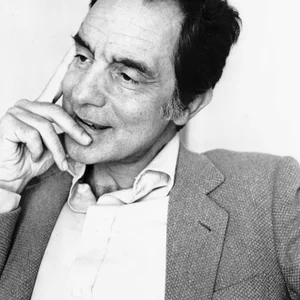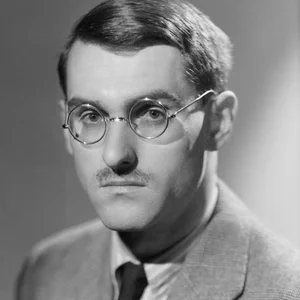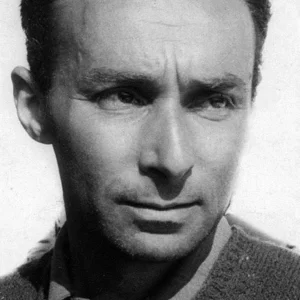

Italian writer and chemist (1919-1987), Primo Levi is the author of landmark testimonies about the Holocaust. Arrested in 1943 as an antifascist partisan, he was deported to Auschwitz where he survived thanks to his skills as a chemist. After the war, he became an essential voice in witness literature.
Primo Levi(1919 — 1987)
Primo Levi
Italie, royaume d'Italie
9 min read
Frequently asked questions
Famous Quotes
« I survived by telling myself stories.»
« It happened, therefore it can happen again.»
« The persecutors win when the victims forget.»
Key Facts
- 1943: Arrested as an antifascist partisan in northern Italy
- 1944-1945: Deported to Auschwitz-Monowitz, a Nazi concentration camp
- 1947: Publication of 'If This Is a Man', a foundational Holocaust testimony
- 1963: Publication of 'The Truce', an account of his journey home after liberation
- 1987: Death in Turin, likely suicide following depression
Works & Achievements
Primo Levi's first and most celebrated account of his deportation to Auschwitz. Written between 1945 and 1947, this sober and clear-eyed memoir is considered one of the founding texts of Holocaust literature and is studied in many school curricula around the world.
A sequel to 'If This Is a Man', this book recounts Primo Levi's nine-month journey across Europe to return to Italy after the liberation of Auschwitz. Winner of the 1963 Campiello Prize, it offers a perspective that is by turns tragic and picaresque on post-war Europe.
A collection of twenty-one autobiographical stories, each named after a chemical element from Mendeleev's periodic table. Hailed as a masterpiece by international critics, the book weaves together science, memory, and autobiography in an original and poetic way.
A novel centered on Faussone, a rigger of metal structures, through whom Primo Levi celebrates the value of work done well and the dignity of the craftsman. Winner of the 1979 Strega Prize, the book reveals a brighter, more optimistic side of his literary world.
A historical novel following a band of Soviet Jewish partisans as they make their way across war-torn Europe toward Palestine. Primo Levi's first work of fiction, it tackles the question of Jewish resistance — a subject often overlooked in collective memory.
Primo Levi's last published book, an intellectual and moral testament on the memory of the Holocaust. In it, he develops his seminal concept of the 'grey zone' — the ambiguous space where victims and perpetrators sometimes found themselves bound by complex relationships that ordinary moral judgment cannot fully assess.
Anecdotes
At Auschwitz, Primo Levi had to pass an oral chemistry exam in front of an SS officer in order to join the camp's Chemistry Kommando. He passed the exam in 1944, and this assignment likely saved his life, as laboratory workers were better protected from the cold and exhaustion.
After Auschwitz was liberated by the Red Army in January 1945, Primo Levi embarked on a chaotic journey home that lasted nine months across a devastated Europe. This extraordinary odyssey — taking him through Russia, Romania, and Hungary — would be recounted in his book 'The Truce', published in 1963.
In 1947, Primo Levi submitted the manuscript of 'If This Is a Man' to the publisher Einaudi, who rejected it. The book was first published by a small press in a run of just 2,500 copies and went almost unnoticed. It was not until 1958, when Einaudi reissued it, that it achieved the worldwide recognition that would make it a masterpiece of testimonial literature.
Throughout his life, Primo Levi worked as a chemist at a paint factory in Turin, alongside his writing career. This dual identity as both writer and scientist runs through his work, most notably in 'The Periodic Table' (1975), where each chapter is named after a chemical element and tells a chapter of his own life.
During a talk at an Italian school, a student asked Primo Levi how ordinary people could have committed such atrocities. He replied that it was precisely because they were ordinary — and that every generation must remain vigilant. This conviction that the worst can always resurface shaped his entire life's work as a witness.
Primary Sources
You who live safe in your warm houses, you who find on returning in the evening warm food and friendly faces: consider if this is a man who toils in the mud, who does not know peace, who fights for a crust of bread, who dies at a yes or a no.
Now, for the first time, we realized that our language lacks words to express this offense, the demolition of a man.
Human memory is a marvelous but fallacious instrument. This is a known truth: the memories that lie within us are not carved in stone; not only do they tend to fade over the years, but they often change, or even grow by incorporating foreign elements.
Chemistry is the art of separating, weighing, and distinguishing: these are three exercises useful also to one who undertakes to describe events or give body to their imagination.
I wrote this book to bear witness, not to complain. I believed that my particular way of telling, the restraint of the narrative, could itself constitute a form of denunciation.
Key Places
Primo Levi's birthplace and the city where he spent his entire life, Turin is the heart of his world. It was here that he was born, studied chemistry, was arrested, returned after the war, and wrote most of his work in the family apartment on Corso Re Umberto.
A forced labor camp attached to Auschwitz where Primo Levi was deported from February 1944 to January 1945. This is the place that shaped the core of his work, where he survived thanks to his skills as a chemist in the Chemical Kommando at the Buna-Werke factory.
A Fascist transit camp near Modena where Primo Levi was held after his arrest before being deported to Auschwitz. He describes the agonizing wait before deportation in the opening pages of 'If This Is a Man'.
The mountainous region where Primo Levi joined a group of partisan resistance fighters in the autumn of 1943, following the Nazi occupation of northern Italy. It was in these mountains that he was arrested by the Fascist Militia in December 1943.
The institution where Primo Levi earned his chemistry degree in 1941, despite Fascist racial laws that forced him to list his 'Jewish race' on his diploma. This scientific training proved decisive for his survival at Auschwitz.
Typical Objects

At Auschwitz, every deportee received a number tattooed on their left forearm that replaced their identity. For Primo Levi, this number was both a mark of humiliation and, after the war, a symbol he wore proudly during his testimonies to ensure it would never be forgotten.

Primo Levi's everyday work tool at the SIVA varnish factory in Turin, where he worked until 1975, the white lab coat symbolizes his dual identity as a man of science and a writer — two roles intimately intertwined throughout his work.

A central object of survival in the camp, the tin bowl in which deportees received their meager ration of turnip soup was so precious it could mean the difference between life and death. Primo Levi makes it a symbol of the struggle for dignity in 'If This Is a Man'.

After the war, Primo Levi wrote his works on a typewriter in his Turin apartment, often at night or on weekends, balancing his professional life with his literary calling for more than thirty years.

The iconic poster of every chemistry laboratory, Mendeleev's table is for Primo Levi a metaphor for human existence: each element, with its properties and reactions, illustrates a stage of his life in his autobiographical masterpiece.

Like every chemist of his era, Primo Levi kept meticulous laboratory notebooks recording formulas and observations. This scientific habit of precise note-taking shaped his literary style, characterized by remarkable clarity and restraint.
School Curriculum
Vocabulary & Tags
Key Vocabulary
Tags
Concept
Daily Life
Morning
After the war and until 1975, Primo Levi rose early and made his way to the SIVA factory in Settimo Torinese, a varnish and paint manufacturer where he would eventually become technical director. His day began with laboratory checks and meetings with his team of chemists.
Afternoon
Afternoons were devoted to scientific work: laboratory analyses and solving technical manufacturing problems. Levi balanced his responsibilities as director with the hands-on fieldwork he loved, always maintaining a concrete, practical relationship with chemistry.
Evening
In the evenings, back in his apartment on Corso Re Umberto in Turin, Primo Levi wrote. It was during his evenings and weekends that he composed his books, articles, and short stories. He also took part in school visits, reader meetings, and public discussions about the Holocaust.
Food
Piedmontese cuisine was at the heart of Primo Levi's eating habits: risotto, bagna cauda, tajarin (fine local pasta). His time in Auschwitz left a lasting mark on his relationship with food, which he described as a vital need — a reclaimed dignity after the years of starvation in the camp.
Clothing
In his postwar professional life, Primo Levi adopted the understated dress of the Italian technical manager of the 1950s–1970s: a grey or brown suit, a tie, and a white lab coat at work. He had no particular vanity about his appearance, preferring a discreet and functional look.
Housing
Primo Levi spent almost his entire life in the same bourgeois apartment at Corso Re Umberto 75 in Turin, where he had been born in 1919. He shared the home with his mother and mother-in-law until the end of his life — something many interpret as a sign of his deep attachment to his Piedmontese roots.
Historical Timeline
Period Vocabulary
Visual Style
Un réalisme documentaire austère en noir et blanc, oscillant entre l'élégance sobre de Turin des années 1950 et les images glaciales des camps, dans l'esprit du néoréalisme italien.
Sound Ambience
Un contraste entre le silence studieux du laboratoire turinois et les sons oppressants du camp d'Auschwitz-Monowitz, évoquant les deux univers qui structurent la vie et l'œuvre de Primo Levi.
Liens externes & ressources
Références
Œuvres
Si c'est un homme (Se questo è un uomo)
1947 (réédition 1958)
La Trêve (La tregua)
1963
Le Système périodique (Il sistema periodico)
1975
La Clé à molette (La chiave a stella)
1978
Si pas maintenant, quand ? (Se non ora, quando ?)
1982
Les Naufragés et les Rescapés (I sommersi e i salvati)
1986