 flip
flipMission Damper
Mission Damper
Why this dish? Damper was the daily bread at the Hermannsburg mission where Namatjira grew up. Baked in the campfire ashes, it accompanied every meal and every painting expedition into the MacDonnell Ranges. It was the mission's dietary staple, made from ration flour.
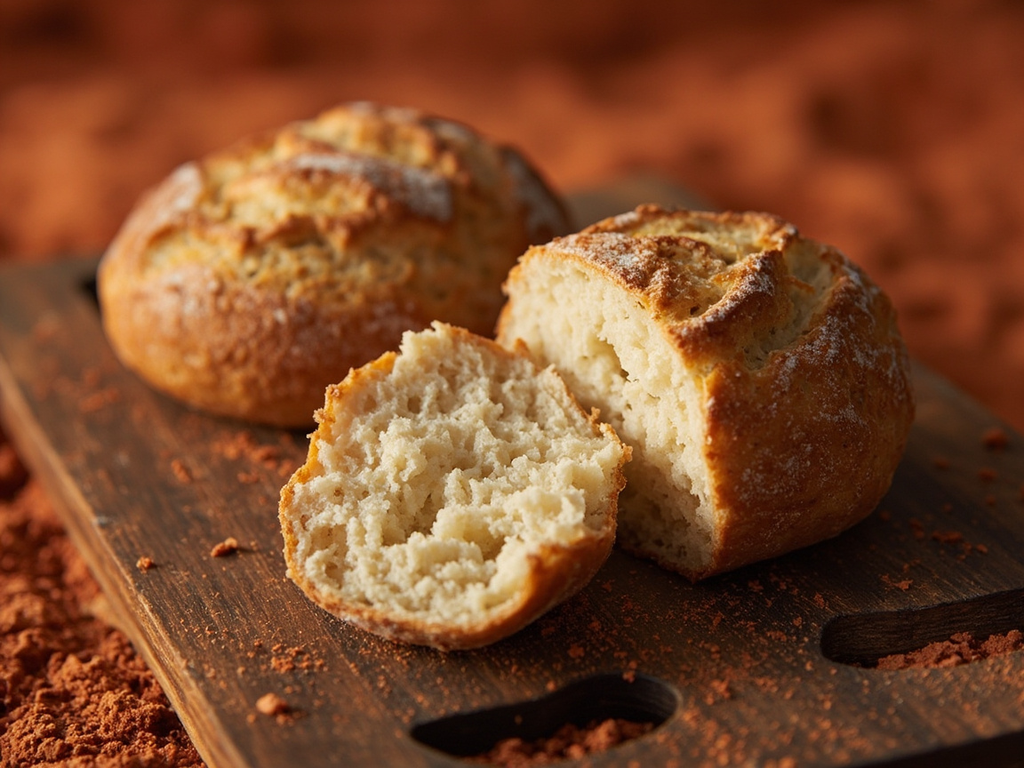
A rustic unleavened bread, hand-kneaded with flour, water and a pinch of salt, then baked directly in the hot ashes of a wood fire. The thick, ashy crust protects a dense, nourishing crumb. It is the quintessential Australian bush bread, inherited from settlers but adopted by Aboriginal mission communities.
This damper is the first thing you learn to make at the mission. You take the ration flour, you add water from the tank, a bit of salt if you have it, and you work the dough with your hands in the red dust. You push the coals aside, place the ball on the hot ground, cover it with ashes and wait. When I go painting in the MacDonnells, I always make my damper in the morning before the light is good. You break the ashy crust, the crumb is warm inside, and with sweet tea it keeps you going all day at the easel.
- •Wheat flour (mission rations) — two good handfuls (bread base)
- •Water — enough to bind (hydration)
- •Salt — a pinch (seasoning)
Mission Damper
A rustic unleavened bread, hand-kneaded with flour, water and a pinch of salt, then baked directly in the hot ashes of a wood fire. The thick, ashy crust protects a dense, nourishing crumb. It is the quintessential Australian bush bread, inherited from settlers but adopted by Aboriginal mission communities.
Why this dish? Damper was the daily bread at the Hermannsburg mission where Namatjira grew up. Baked in the campfire ashes, it accompanied every meal and every painting expedition into the MacDonnell Ranges. It was the mission's dietary staple, made from ration flour.
This damper is the first thing you learn to make at the mission. You take the ration flour, you add water from the tank, a bit of salt if you have it, and you work the dough with your hands in the red dust. You push the coals aside, place the ball on the hot ground, cover it with ashes and wait. When I go painting in the MacDonnells, I always make my damper in the morning before the light is good. You break the ashy crust, the crumb is warm inside, and with sweet tea it keeps you going all day at the easel.
Ingredients (period version)
- Wheat flour (mission rations) — two good handfuls (bread base)
- Water — enough to bind (hydration)
- Salt — a pinch (seasoning)
Ingredients
- Whole wheat flour — 300 g (bread base)
- Warm water — 180 ml (hydration)
- Salt — 1 tsp (seasoning)
- Vegetable oil — 1 tbsp (dough pliability)
Method
- Mix flour and salt in a bowl, make a well in the center.
- Gradually add warm water and oil, mixing by hand until a soft, non-sticky dough forms.
- Knead for 3–4 minutes on a floured surface, shape into a flattened ball about 4 cm thick.
- Preheat oven to 200°C. Place damper on a baking sheet lined with parchment paper.
- Bake 25–30 minutes until the crust is golden and the bread sounds hollow when tapped underneath.
- Let cool 5 minutes, then break apart by hand to serve.
How it was made : The original damper was cooked without an oven, directly in the hot ashes of a mulga or eucalyptus wood fire. The ash was brushed off before breaking the bread. At Hermannsburg, Lutheran missionaries distributed white flour in weekly rations, and damper became a staple food for Aboriginal communities in Central Australia from the late 19th century onward.
The contemporary twist : Add a tablespoon of roasted wattle seed to the dough for a nutty note and a nod to traditional bush tucker.
Sources : Batty, Philip. 'Colliding Worlds: First Contact in the Western Desert, 1932-1984'. Museum Victoria, 2006. · Isaacs, Jennifer. 'Bush Food: Aboriginal Food and Herbal Medicine'. Weldons, 1987.
Albert Namatjira · Charactorium