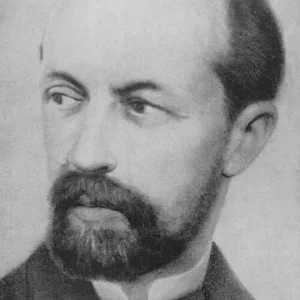

Albert Roussel was a French composer, one of the major figures of French music in the early 20th century. A former naval officer who became a musician, he developed a personal style blending impressionism and neoclassicism.
Albert Roussel(1869 — 1937)
Albert Roussel
France
4 min read
Frequently asked questions
Key Facts
- Born in 1869 in Tourcoing, died in 1937 in Royan
- A naval officer before devoting himself to music from 1894 onward
- Studied and later taught at the Schola Cantorum under Vincent d'Indy
- Composed the ballet The Spider's Feast (1913) and the opera-ballet Padmâvatî (1918)
- Author of four symphonies, including Symphony No. 3 (1930), which marked the height of his maturity
Works & Achievements
Ballet-pantomime inspired by the world of insects, the composer's first major success, with delicate and colourful orchestration.
Opera-ballet inspired by an Indian legend, the fruit of his travels in Asia, blending song, dance and Eastern modes.
Commissioned by the Boston Symphony Orchestra, an energetic and concise work, the pinnacle of his neoclassical period.
Ballet on a mythological subject, whose orchestral suite features in the repertoire of the great orchestras.
His last completed symphony, luminous and balanced, showcasing the mastery of his full maturity.
Triptych for choir, soloists and orchestra evoking India, marking his post-impressionist language.
Anecdotes
Before becoming a composer, Albert Roussel was an officer in the French Navy. He sailed as far as Indochina and the Far East, and these voyages left a lasting mark on his musical imagination, steeped in exoticism.
It was only at the age of 25, in 1894, that he resigned from the Navy to devote himself entirely to music. He then began serious studies, a bold choice for a man who could have pursued a career as an officer.
Roussel studied at the Schola Cantorum, the school founded by Vincent d'Indy, where he himself became a teacher. Among his students were future great names such as Erik Satie, Bohuslav Martinů, and Edgard Varèse.
During the First World War, despite fragile health, Roussel volunteered and served as an ambulance driver and then as a transport officer, at an age when many could have been exempted.
His ballet *The Spider's Feast* (1913), inspired by the observations of the entomologist Jean-Henri Fabre, depicts the world of insects in a garden and remains one of his most frequently performed works.
Primary Sources
For a long time I hesitated between the sea and music; in the end music won out, but the sea taught me a taste for distant horizons.
This symphony was composed for the fiftieth anniversary of the Boston Symphony Orchestra, which commissioned it from the composer.
Roussel demanded rigor in writing without ever stifling each person's individuality; he taught the craft, not his own manner.
Key Places
Town in the north of France where Albert Roussel was born in 1869.
Music school where Roussel studied under Vincent d'Indy and later taught counterpoint.
Premiere venue for several of his major stage works, including “Padmâvatî”.
Town on the Atlantic coast where Roussel settled and where he died in 1937.
Regions he travelled through, sources of the Eastern inspiration behind “Padmâvatî” and “Évocations”.
Typical Objects

Roussel wrote out his works by hand, with meticulous care for the contrapuntal writing he had learned at the Schola Cantorum.

The composer's working instrument, on which he tried out harmonies and themes before orchestration.

Garment from his first career in the French Navy, before he became a musician.

Roussel recorded his impressions of India and Asia, sources of inspiration for his orientalist works.

Tool used to direct the orchestra during the premieres of his symphonies and ballets.
School Curriculum
Vocabulary & Tags
Key Vocabulary
Daily Life
Morning
Like many composers, Roussel devoted his mornings to creative work, in quiet surroundings. He composed methodically and slowly, endlessly reworking his scores at the piano in his study.
Afternoon
Afternoons might be devoted to orchestration or to professional correspondence with publishers and conductors. During his years at the Schola Cantorum, he taught counterpoint to his students.
Evening
Evenings were sometimes taken up by concerts or by mingling in Parisian musical circles. A rather reserved man, Roussel nonetheless preferred the peace of his home to social engagements.
Food
He shared in the French bourgeois diet of his time, made up of structured meals. His fragile health, inherited from his years as a sailor in the tropics, forced him to exercise a certain caution.
Clothing
Roussel wore the bourgeois dress of the early 20th century: a dark suit, a stiff-collared shirt, and a tie. In his youth, he had worn the uniform of a naval officer.
Housing
After his years at sea, he settled in France, dividing his time between Paris for musical life and the Atlantic coast. He eventually settled near Royan, facing the sea he had loved so much.