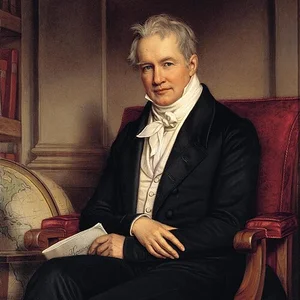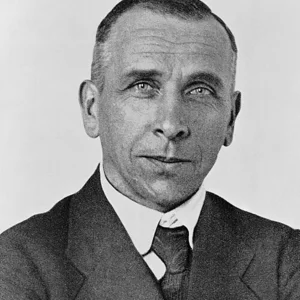

German scientist (1880–1930) who proposed the theory of continental drift in the early 20th century. This revolutionary theory suggests that continents are not fixed but slowly move across the Earth's surface. Though widely rejected at the time, his theory laid the foundations for modern plate tectonics.
Frequently asked questions
Key Facts
- 1912: presentation of the continental drift theory to the German Geological Society
- 1915: publication of the landmark work 'The Origin of Continents and Oceans'
- Observation of geological and paleontological similarities between continents separated by oceans
- Proposal of the supercontinent Pangaea, a single landmass encompassing all present-day continents
- 1930: death in Greenland during a scientific expedition
Works & Achievements
Founding work presenting the theory of continental drift, proposing that the current continents once formed a single supercontinent called Pangaea. This revolutionary theory challenged the static geology of the time.
Major scientific hypothesis suggesting that continents slowly move across Earth's surface. Although rejected by the scientific community during his lifetime, it laid the foundations for the modern theory of plate tectonics.
Several scientific expeditions to Greenland to collect geological and meteorological data. This work provided empirical evidence supporting his theories on climate variations and geology.
Pioneering studies on past climate variations and their relationships with continental movements. This work established connections between climate history and dynamic geology.
Significant scientific work in the study of the atmosphere and meteorological phenomena, complementing his broad understanding of Earth's dynamics.
Anecdotes
In 1912, Wegener presented his theory of continental drift to the German Academy of Sciences. His evidence was impressive: the coastlines of South America and Africa fit together like puzzle pieces, and the same plant and animal fossils were found on both sides of the Atlantic Ocean. Unfortunately, no one could explain the mechanism that would allow continents to move, which made his theory unbelievable to his contemporaries.
Wegener was an adventurous scientist who took part in several expeditions to Greenland to collect meteorological and geological data. These extremely difficult journeys across the frozen landscape allowed him to accumulate observations on rock structure and climatic conditions, which he used to support his bold hypothesis.
The scientific community long rejected Wegener's theory, notably in 1926 at an international congress where his colleagues vigorously challenged his ideas. The rejection was so strong that some scientists declared his theory was as impossible as a hippopotamus flying through the sky!
Wegener disappeared during an expedition to Greenland in November 1930, most likely dead from cold and starvation at only 50 years old. It is a tragic irony that the man who revolutionized our understanding of the Earth lost his life exploring one of its most hostile regions, never having seen his theory finally accepted by the worldwide scientific community.
In 1960, more than 30 years after his death, geologists discovered the mechanisms explaining continental drift and confirmed that Wegener had been right. His theory then became the foundation of plate tectonics, the great scientific revolution of the 20th century in geology, proving that great scientific ideas can wait a long time for recognition.
Primary Sources
The coasts of South Africa and South America fit together like puzzle pieces. This geographical correspondence cannot be a mere coincidence. The continents must once have been joined together and have progressively drifted apart from one another.
I have gathered numerous geological, palaeontological, and climatological pieces of evidence supporting the hypothesis that all continents were once united into a single supercontinent.
Identical fossils found on distant continents suggest that these continents must have been in direct contact. The distribution of fossil animal and plant species can only be explained by continental displacement.
Key Places
Birthplace of Alfred Wegener on November 1, 1880. Berlin was the intellectual center where Wegener received his initial education before pursuing his scientific studies.
Institution where Wegener studied astronomy, meteorology, and geophysics. It was here that he developed his multidisciplinary scientific training before conceiving his revolutionary theory.
Site of his major polar expeditions (1906–1908 and 1912–1913), where Wegener conducted climatological and geological research. He died there during an expedition in 1930.
University where Wegener taught meteorology and geophysics. It was from this academic position that he published and popularized his theory of continental drift in 1912.
Major German institution where Wegener held a professorship. It represents an important center of his research and teaching activities in geophysics.
Research institute created in honor of Wegener after his death. It perpetuates his scientific legacy and continues the studies on climate and polar sciences that he initiated.
Typical Objects

Spherical representation of the Earth showing continents and oceans. An essential tool for Wegener to visualize and demonstrate his continental drift theory by comparing coastline outlines.
📷 CC BY-SA 3.0 · Wikimedia Commons ↗
Detailed cartographic documents from the early 20th century showing the continents. Wegener studied them to observe the remarkable correspondences between coastline shapes, particularly between Africa and South America.

Instrument for measuring atmospheric pressure used in meteorology. Wegener, both a geophysicist and meteorologist, used it for his climatic observations and his expeditions to Greenland.
Device that records ground vibrations and earthquakes. This instrument made it possible to study Earth's movements, which indirectly supported the continental drift theory.
📷 Wikimedia · Wikimedia Commons ↗
Notebook used by geologists and explorers to document observations and measurements. Wegener used it during his expeditions, particularly in Greenland, to record his geological findings.
Petrified remains of ancient organisms found across different continents. Identical fossils discovered in Africa and South America constituted major evidence for Wegener's theory.

Scientific work written by Wegener in 1915 presenting his continental drift theory. This groundbreaking book laid out the geological, paleontological, and climatic evidence for his hypothesis.
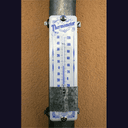
Temperature-measuring instrument used in meteorology and geophysics. Essential for Wegener's climatic observations and the documentation of temperature variations across the studied continents.
📷 CC BY 2.5 · Wikimedia Commons ↗School Curriculum
Vocabulary & Tags
Key Vocabulary
Daily Life
Morning
Alfred Wegener rises early, following the habits of the German bourgeoisie of the early 20th century. He eats a hearty breakfast of bread, cheese, cold cuts, and coffee before heading to his office or the university laboratory where he works as a professor of meteorology and geophysics.
Afternoon
The afternoon is devoted to scientific research, writing publications, or teaching. He also spends time analyzing geographical maps and fossils, building the arguments that support his revolutionary theory of continental drift.
Evening
In the evening, Wegener dines with his family in a typical German bourgeois setting. He then spends time reading scientific literature, corresponding with other European researchers, or preparing his lectures and presentations on his novel theories.
Food
His diet reflects that of the German intellectual middle class: dark or white bread, meats (pork, beef), local cheeses, seasonal vegetables, and fruit in limited quantities. He regularly drinks coffee, tea, and occasionally beer, a traditional German beverage.
Clothing
Wegener wears clothing typical of German scholars of the era: three-piece suits with waistcoats, formal shirts, ties, and bowler hats or top hats in public. During his expeditions to Greenland, he dons specialized gear adapted to extreme conditions.
Housing
He lives in a comfortable German bourgeois house, typical of university professor families. His home includes a personal study where he keeps his maps, scientific documents, and measuring instruments needed for his research.
Historical Timeline
Period Vocabulary
Visual Style
Un style d'illustration scientifique vintage du début du XXe siècle, inspiré par les cartes géologiques et les diagrammes anciens sur parchemin. L'ambiance combine l'esthétique Art Nouveau avec la cartographie antique, évoquant les cabinets de curiosités savantes et les laboratoires d'époque, baignés d'une lumière chaude et contemplative.
Sound Ambience
Une ambiance sonore immersive capturant l'atmosphère d'un laboratoire scientifique du début du XXe siècle, mêlant les bruits de la recherche académique aux sons de la nature et des expéditions, évoquant à la fois le doute scientifique et la révolution théorique.
Liens externes & ressources
Références
Œuvres
La Genèse des continents et des océans (Die Entstehung der Kontinente und Ozeane)
1912
Théorie de la dérive des continents
1912
Expéditions et observations du Groenland
1906-1930
Recherches sur la climatologie historique
1920s
Contributions à la météorologie et à la physique atmosphérique
1905-1930