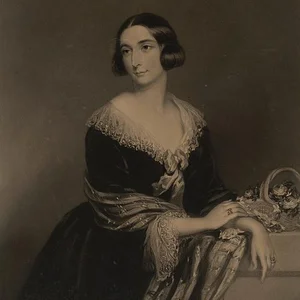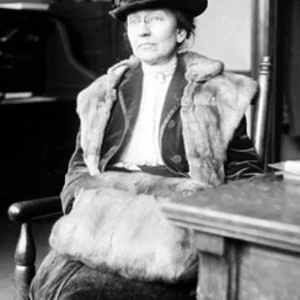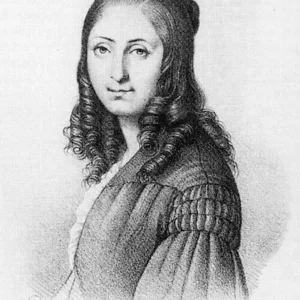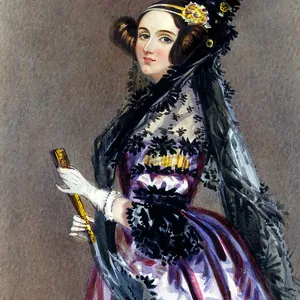

British mathematician (1815-1852), pioneer of computing and programming. She wrote the first algorithm intended to be executed by a machine, working on Charles Babbage's Analytical Engine. Her legacy makes her a founding figure of theoretical computer science.
Ada Lovelace(1815 — 1852)
Ada Lovelace
Royaume-Uni de Grande-Bretagne et d'Irlande
7 min read
Frequently asked questions
Key Facts
- 1833: meets Charles Babbage and discovers his Analytical Engine
- 1843: publication of her notes on Babbage's Analytical Engine, including the first computer algorithm intended for a machine
- 1843: writes the first program designed to calculate Bernoulli numbers
- 1852: death at the age of 36, shortly after her revolutionary contributions
- 20th–21st centuries: recognized as a pioneer of computing and programming
Works & Achievements
Translation and annotation of Luigi Menabrea's memoir on Babbage's Analytical Engine. These notes, three times longer than the original, constitute the first computer program in history and present the first algorithm intended to be executed by a machine.
The first algorithm ever written for a programmable machine, designed to compute Bernoulli numbers. This algorithm, inserted within the Notes, is considered the first computer program in history.
Intensive intellectual exchange between Ada and Babbage on the mathematical and mechanical principles of the Analytical Engine. This collaboration allowed Ada to develop her visionary understanding of the symbolic computation capabilities of machines.
Work on the application of mathematics to biological and neurological phenomena, demonstrating a pioneering approach to the mathematical modelling of complex natural systems.
Theoretical reflection integrated into the Notes on the abstract and universal nature of symbolic operations, anticipating modern concepts of programming and computational logic.
Comparative analysis between the punched card mechanism of the Jacquard loom and the programming principles of the Analytical Engine, establishing a conceptual lineage between textile automation and programmable computation.
Anecdotes
Ada Lovelace was born on Christmas Day 1815. Her father was the famous poet Lord Byron, but Ada never knew him as her parents separated shortly after her birth. Her mother, fearing her daughter might pursue an artistic career like her father, steered her towards mathematics and sciences from a very young age.
In 1833, at the age of 17, Ada met Charles Babbage at a party in London. Fascinated by his Analytical Engine, she became one of the few people to understand its complex workings. This encounter marked the beginning of a scientific collaboration that would last until the end of her life.
Ada wrote notes on the Analytical Engine that are three times longer than the original article she was translating. In these notes, she describes an algorithm for computing Bernoulli numbers, which is considered the first computer program in history, long before modern computers existed.
Ada was passionate about what she called 'scientific poetry', seeking to combine creative imagination with mathematical rigour. She compared mathematics to music and saw machines as capable of manipulating symbols according to rules — a revolutionary vision for her time.
Ada Lovelace had to fight throughout her life against health problems and the social limitations imposed on women in the 19th century. Despite this, she corresponded with the greatest mathematicians of her time and published work recognised by the international scientific community before her death at the age of 36.
Primary Sources
The Analytical Engine weaves algebraical patterns just as the Jacquard loom weaves flowers and leaves. Here, we see the same principle applied to the results of arithmetical operations. [...] A new, vast, and powerful language will be developed for the purposes of mankind.
I am much annoyed at your having altered my Note. You know I am always willing to make any required alterations myself, but that I cannot endure another person to meddle with my sentences.
I have a peculiar way of learning. I require much rigid exactness in the demonstration or statement of principles, but I am remarkably quick in understanding difficulties when fully & clearly put before me.
That the Analytical Engine has no pretensions whatever to originate anything. It can follow analysis; but it has no power of anticipating analytical relations or truths.
Key Places
Ada Lovelace's birthplace on 10 December 1815. It was in the British capital that she grew up and received her exceptional mathematical education, laying the foundations for her future scientific career.
Centre of mathematical excellence where Ada studied by correspondence with Augustus De Morgan, one of the greatest mathematicians of his time, who guided her intellectual development.
The place where Ada met Charles Babbage and learned about his Analytical Engine, a defining event that led her to develop her groundbreaking work on programming.
The workplace and site of collaboration between Ada and Babbage, where she translated and annotated documents on the Analytical Engine, producing the first computer algorithm in history.
A region in southern England where Ada spent part of her adult life. She took an interest in the technological and agricultural innovations of her era in this area.
A contemporary memorial institution where Ada Lovelace's legacy is preserved and celebrated, acknowledging her founding role in the history of computing and programming.
Typical Objects

Mechanical prototype of a programmable calculator designed by Charles Babbage in the 19th century. Ada Lovelace worked on its specifications and wrote the first algorithm intended for this machine, thereby founding theoretical computer science.

Essential writing instrument in the 19th century for scholars and mathematicians. Ada Lovelace used quill and ink to draft her notes and her famous annotations on the Analytical Engine.

Medium for her mathematical work and detailed notes. Ada's manuscripts, in particular her notes on the Analytical Engine published in 1843, are foundational documents in the history of computing.

Characteristic garment of the Victorian era (1837–1901) worn by Ada Lovelace. A symbol of her time and of her position as a learned woman in a highly codified British society.

Graphical tools used by Ada to represent the sequential operations of the Analytical Engine. Her diagrams and tables are precursors to modern computing flowcharts.

19th-century educational resources used by Ada for her advanced mathematical training, which was rare for a woman of her era. Her exceptional education allowed her to understand and improve upon Babbage's work.

Prestigious object and symbol of the Victorian industrial age, emblematic of the precision and mechanics of the era. It represents the world of sophisticated machinery to which Ada theoretically contributed.
School Curriculum
Vocabulary & Tags
Key Vocabulary
Tags
Mouvement
Daily Life
Morning
Ada wakes around 7-8am in her London bedroom, attended by her chambermaids. She has a light breakfast of tea, toast, and jam, before devoting herself to correspondence with her scientific collaborators, particularly Charles Babbage.
Afternoon
The afternoon is generally dedicated to her mathematical work and study of the Analytical Engine, often in her private study surrounded by notes and technical documents. She receives visits from scholars and intellectuals, or attends scientific meetings at the Royal Society according to her schedule.
Evening
Evenings are spent in London's aristocratic salons where she is received as a cultured woman of high society. She may attend concerts, receptions, or dinners among scientific peers, with conversations alternating between mathematics and social affairs.
Food
Ada follows the diet of the Victorian aristocratic classes: roasted meats, fish, seasonal vegetables, fruits, pastries, and fine wines. She takes her meals according to the strict timetable of the era (breakfast, lunch, dinner) served by her domestic staff.
Clothing
She wears long, richly adorned gowns typical of Victorian fashion, with corsets, crinolines, and numerous accessories. Her outfits reflect her status as a countess and woman of high society — carefully chosen and costly.
Housing
Ada lives in aristocratic London residences, particularly in affluent neighbourhoods such as Mayfair. Her living environment includes several spacious rooms, a well-stocked library, and access to the domestic services typical of grand Victorian households.
Historical Timeline
Period Vocabulary
Visual Style
Un style mêlant l'esthétique victorienne raffinée à l'imagerie scientifique steampunk, où l'élégance mathématique rencontre les mécanismes complexes. L'ambiance combine l'illustration scientifique du XIXe siècle avec une luminosité dramatique soulignant algorithmes et machines analytiques.
Sound Ambience
Une atmosphère immersive du Londres victorien du XIXe siècle, mêlant les bruits mécaniques des engrenages et des machines analytiques aux sons délicats de l'écriture scientifique, créant un environnement propice à la contemplation mathématique et à l'innovation technologique pionnière.
Liens externes & ressources
Références
Œuvres
Notes on the Analytical Engine
1843
Algoritmo pour la machine analytique
1843
Correspondance avec Charles Babbage
1833-1852
Recherches sur le système nerveux
1840s
Étude de la machine à tisser de Jacquard
1833-1843