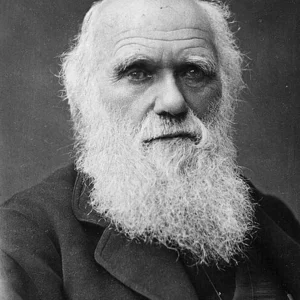

A 19th-century English naturalist, Charles Darwin revolutionized biology by proposing the theory of evolution by natural selection. His observations during the voyage of the Beagle and his subsequent work laid the foundations of modern biology.
Charles Darwin(1809 — 1882)
Charles Darwin
Royaume-Uni de Grande-Bretagne et d'Irlande
7 min read
Frequently asked questions
Famous Quotes
« There is grandeur in this view of life, in which creation extends only to a few first and primitive forms.»
« No species has ever changed into another without intermediate forms.»
Key Facts
- 1831–1836: voyage around the world aboard HMS Beagle, including crucial observations in the Galápagos Islands
- 1859: publication of 'On the Origin of Species by Means of Natural Selection'
- Development of the theory of natural selection: the best-adapted individuals survive and reproduce
- 1871: publication of 'The Descent of Man', applying evolution to human beings
- Explanation of biodiversity and the adaptation of organisms to their environment
Works & Achievements
Founding work of evolutionary biology, setting out the theory of natural selection. The first print run of 1,250 copies sold out on the very day of publication.
Scientific and literary account of Darwin's voyage around the world aboard HMS Beagle, combining geological, zoological, and botanical observations.
Work in which Darwin applies his theory of evolution to the human species, asserting the common ancestry of humans and great apes.
Pioneering study demonstrating emotional continuity between humans and animals, laying the foundations of ethology and evolutionary psychology.
Darwin's first work after On the Origin of Species, demonstrating through the example of orchids the mechanisms of coevolution between plants and insects.
Darwin's last published work, the fruit of forty years of patient observation on the fundamental role of earthworms in soil formation.
Anecdotes
As a child, Charles Darwin was a passionate beetle collector. One day, already holding a specimen in each hand, he spotted a third one and put one of the insects in his mouth to free a hand. The beetle sprayed an acidic liquid onto his tongue, forcing him to spit everything out.
Darwin's father considered him lazy and once told him: 'You care for nothing but shooting, dogs, and rat-catching, and you will be a disgrace to yourself and all your family.' Charles had by then abandoned his medical studies in Edinburgh, unable to bear the sight of blood during surgical operations.
During the Beagle voyage, Darwin suffered terribly from seasickness. For nearly five years, he was regularly ill on board, to the point of spending long days lying in his hammock. Paradoxically, this sea voyage was the foundation of his entire scientific career.
Darwin hesitated for more than twenty years before publishing his theory of evolution. He only made up his mind in 1858, when he received a letter from Alfred Russel Wallace outlining a theory very similar to his own. The two works were presented jointly to the Linnean Society of London.
To test his ideas on selection, Darwin bred domestic pigeons for years in the garden of Down House. He became so skilled a breeder that he earned the respect of professional pigeon fanciers in London, who sometimes had no idea he was first and foremost a naturalist.
Primary Sources
I have called this principle, by which each slight variation, if useful, is preserved, by the term Natural Selection, in order to mark its relation to man's power of selection. Variations neither useful nor injurious would not be affected by natural selection.
The natural history of these volcanic islands is eminently curious, and well deserves the attention of the naturalist. Considering the small size of these islands, we feel the more astonished at the number of their aboriginal beings.
The voyage of the Beagle has been by far the most important event in my life, and has determined my whole career. I have always felt that I owe to the voyage the first real training or education of my mind.
The main conclusion arrived at in this work, namely that man is descended from some lowly-organised form, will, I regret to think, be highly distasteful to many persons.
Key Places
Darwin's residence for forty years, where he wrote most of his works. His greenhouse, experimental garden, and the Sandwalk were his main places of work.
Volcanic archipelago in the Pacific where Darwin observed in 1835 the variations in finches and tortoises between the islands — observations crucial to his theory of natural selection.
Darwin's birthplace, where he grew up in the family home known as The Mount. It was here that he developed his passion for nature from childhood.
Darwin studied here from 1828 to 1831 and met the botanist John Stevens Henslow, who opened the doors to the Beagle voyage for him.
Darwin's burial place, interred alongside Isaac Newton in 1882, the highest recognition of his contribution to science.
Liens externes & ressources
Références
Œuvres
L'Origine des espèces par le moyen de la sélection naturelle
1859
Le Voyage du Beagle (Journal of Researches)
1839
La Filiation de l'homme et la sélection liée au sexe
1871
L'Expression des émotions chez l'homme et les animaux
1872
De la fécondation des orchidées par les insectes
1862
La Formation de la terre végétale par l'action des vers de terre
1881