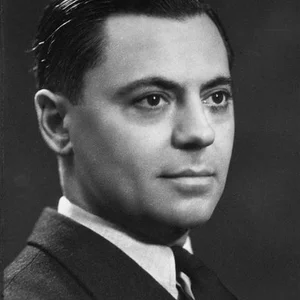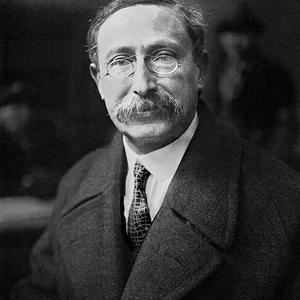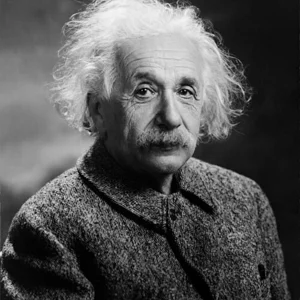

German-born physicist who became Swiss and later American (1879–1955), Albert Einstein revolutionized physics by developing the theories of special and general relativity. He is the author of the famous equation E=mc² and received the Nobel Prize in Physics in 1921 for his work on the photoelectric effect.
Albert Einstein(1879 — 1955)
Albert Einstein
États-Unis, Suisse, Allemagne, république de Weimar, Royaume du Wurtemberg, apatride, Cisleithanie
8 min read
Frequently asked questions
Famous Quotes
« Imagination is more important than knowledge. Knowledge is limited, imagination encircles the world.»
« Life is like riding a bicycle. To keep your balance, you must keep moving.»
Key Facts
- 1905: publication of four groundbreaking papers, including the one on special relativity and the equation E=mc²
- 1915: completion of the general theory of relativity, which redefined gravitation
- 1921: awarded the Nobel Prize in Physics for his explanation of the photoelectric effect
- 1933: fled to America in the face of the rising Nazi regime in Germany
- 1939: played a role in alerting the United States to the risk of a German atomic bomb
Works & Achievements
Einstein publishes his revolutionary theory showing that space and time are relative and interdependent. This theory introduces the fundamental concept that the speed of light is constant in all inertial frames of reference.
Einstein derives this famous equation establishing the equivalence between mass and energy. It revolutionizes our understanding of physics and becomes a universal symbol of modern science.
Einstein develops his major theory of gravitation, describing gravity as a curvature of spacetime caused by mass. This theory transforms the understanding of the universe and replaces Newtonian mechanics.
Einstein provides a quantum explanation of the photoelectric effect, demonstrating that light behaves as particles called photons. This discovery earns him the Nobel Prize in Physics in 1921.
Einstein contributes to the development of quantum mechanics, notably by developing the concept of photons and working on the wave-particle duality of light.
Einstein writes a crucial letter to the American president warning of the risks of a German atomic bomb and recommending American research in nuclear physics, indirectly influencing the Manhattan Project.
Einstein co-signs this manifesto calling for nuclear disarmament and world peace, rallying the international scientific community against the atomic threat shortly before his death.
Anecdotes
In 1905, at just 26 years old, Albert Einstein was working as a clerk at the Patent Office in Bern, Switzerland. It was in this small office, far from prestigious universities, that he wrote four revolutionary papers that upended physics, including the one on special relativity. That year became famous under the name 'annus mirabilis' (miraculous year) and marked the beginning of his worldwide recognition.
Albert Einstein was known for his love of music and played the violin regularly from childhood. He claimed that music and physics were intimately linked in his mind, and he often played the violin while reflecting on complex scientific problems. The instrument became one of his most faithful companions throughout his life.
When the Nazi regime came to power in 1933, Einstein, who was Jewish, left Germany for good. He settled in the United States and worked at the Institute for Advanced Study in Princeton, New Jersey. Shortly before, the Nazi government had burned his books and announced a reward for his arrest.
In 1939, Einstein wrote a letter to U.S. President Franklin D. Roosevelt warning him that Nazi Germany might be developing an atomic bomb. This letter was one of the reasons that pushed the United States to launch the Manhattan Project, the secret nuclear research program. Later in his life, Einstein expressed regret over the indirect role he had played in the creation of nuclear weapons.
Albert Einstein was a committed political thinker who championed pacifism and civil rights. After World War II, he actively campaigned against the nuclear arms race and became one of the leading voices of the global disarmament movement. His moral engagement extended well beyond his scientific field and made him an iconic figure of the 20th century.
Primary Sources
The laws by which the states of physical systems change do not depend on whether these changes of state are referred to one or the other of two coordinate systems in uniform translatory motion relative to each other.
Matter tells space how to curve; space tells matter how to move.
It has become conceivable that heavy elements may be broken down by neutron bombardment and that this process could be made into a chain reaction... This could also lead to the construction of extremely powerful bombs.
If a body gives off energy L in the form of radiation, its mass diminishes by L/c². The fact that the energy radiated comes from matter shows us that matter possesses an extraordinary capacity for energy transformation.
The school should seek to develop in each young person a love of truth and independence of thought, rather than the mere accumulation of knowledge.
Key Places
German city where Albert Einstein was born on March 14, 1879. His birth house has been turned into a museum dedicated to his life and scientific discoveries.
Bavarian capital where Einstein grew up and completed his secondary education before leaving Germany in 1895. The city hosted his early years of intellectual formation.
Swiss city where Einstein studied at the Federal Polytechnic School and obtained Swiss citizenship. It is here that he pursued his research in theoretical physics and met his future colleagues.
Swiss capital where Einstein worked at the Federal Office of Intellectual Property (1902–1909). During this period, he developed the special theory of relativity in 1905.
German city where Einstein served as director of the Kaiser Wilhelm Institute of Physics from 1914 to 1933. It is there that he completed his work on general relativity in 1915.
City in New Jersey, United States, where Einstein settled in 1933 and worked at the Institute for Advanced Study until his death in 1955. He continued his research there and obtained American citizenship.
Typical Objects

Symbol of Einstein's teaching and theoretical research. The physicist regularly used blackboards to develop his complex relativity equations and explain them to his students.

Einstein's distinctive and emblematic hairstyle, which became iconic in the 20th century. This unconventional appearance reflects the image of the eccentric and brilliant scientist of the early 20th century.
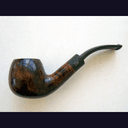
A personal accessory closely associated with Einstein, who smoked it regularly. The pipe was a common attribute among intellectuals and scholars of his era.
📷 CC BY-SA 3.0 · Wikimedia Commons ↗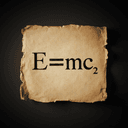
The most famous equation in modern physics and the ultimate symbol of Einstein's genius. It establishes the equivalence between mass and energy and revolutionized our understanding of the universe.

An astronomical observation instrument representative of the theoretical and observational physics of the early 20th century. Einstein's work on general relativity was validated through astronomical observations.

The distinction awarded to Einstein in 1921 for his exceptional contribution to physics, particularly his work on the photoelectric effect. It symbolizes the international recognition of his discoveries.

A specimen of the notebooks and manuscripts in which Einstein developed his revolutionary theories. These documents reveal the intellectual creative process of the scientist.

Representative of the technological advances of the early 20th century and of scientific documentation. Photographs of Einstein and his experiments illustrate the contemporary era of his discoveries.
School Curriculum
Vocabulary & Tags
Key Vocabulary
Tags
Concept
Daily Life
Morning
Einstein generally wakes up around 7-8 AM and has a light breakfast of coffee and bread. He devotes the first hours of the day to theoretical thinking, often smoking his characteristic pipe during this period when his mind is freshest for tackling complex physics problems.
Afternoon
In the afternoon, he goes to his office or laboratory at the university (at Princeton after 1933), where he discusses ideas with colleagues and collaborators. He attends seminars, reviews student work, and continues his personal research, interspersed with breaks for stimulating conversations.
Evening
At the end of the day, Einstein unwinds by playing the violin — an instrument he has been deeply attached to since childhood — or by going for walks. He usually dines with family or intellectual friends, enjoying conversations on physics, philosophy, and contemporary social issues.
Food
Einstein follows a diet typical of the upper-middle class of the 1900s–1950s: bread, cheese, fruits, vegetables, occasional meat, and plenty of coffee. After his arrival in the United States, his eating habits become more Americanized while retaining his preference for simple, moderate food.
Clothing
Einstein is famous for his disheveled appearance: a dark suit often ill-fitting, wild uncombed hair, and a thick mustache. He shows little interest in fashion or formal appearance, which stood in contrast to the conventions of the academic circles of his time.
Housing
After modest beginnings, Einstein lives in comfortable apartments as a university professor, then in a respectable house in Princeton, New Jersey, after 1933. His interior is filled with books, scientific documents, and a few works of art, reflecting his intellectual priorities rather than ostentatious comfort.
Historical Timeline
Period Vocabulary
Visual Style
Un style mêlant l'illustration scientifique du début du XXe siècle avec des éléments Art Déco géométriques. L'ambiance combine rigueur technique et poésie cosmique, utilisant des sépia rétro illuminés par des bleus électriques et ors évoquant l'énergie et la lumière.
Sound Ambience
Une atmosphère sonore immersive de laboratoire de physique du début du XXe siècle, mêlant les sons discrets d'instruments de précision, les murmures de discussions académiques en allemand, et l'ambiance contemplative d'un lieu de recherche scientifique révolutionnaire.
Liens externes & ressources
Références
Œuvres
Théorie de la relativité restreinte
1905
Équation E=mc²
1905
Théorie de la relativité générale
1915
Explication de l'effet photoélectrique
1905
Contribution à la théorie quantique
1906-1920s
Lettre à Franklin D. Roosevelt
1939
Appel de Russell-Einstein
1955