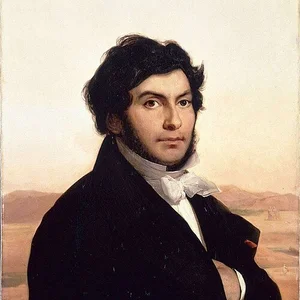

French Egyptologist (1790-1832) who revolutionized the study of ancient Egypt by deciphering Egyptian hieroglyphs using the Rosetta Stone. His work opened the door to understanding Egyptian civilization and established Egyptology as a scientific discipline.
Champollion(1790 — 1832)
Jean-François Champollion
France
7 min read
Frequently asked questions
Key Facts
- 1799: Discovery of the Rosetta Stone during Napoleon's Egyptian campaign
- 1822: Champollion deciphers Egyptian hieroglyphs using the Rosetta Stone and his knowledge of Coptic
- 1824: Publication of his foundational discoveries on the Egyptian writing system
- 1828-1829: Expedition to Egypt to study monuments and validate his theories
- 1831: Foundation and direction of the French school of Egyptology at the Louvre
Works & Achievements
Champollion's first major work, a geographical description of ancient Egypt based on the study of Coptic and Greek sources. He published it at the age of 24.
The founding document of Egyptology, in which Champollion announces that he has cracked the secret of hieroglyphs. This letter, read before the Académie des Inscriptions, marks a landmark date in the history of science.
A work in which Champollion develops and systematizes his discovery, demonstrating that hieroglyphic writing is both phonetic and ideographic.
A monumental publication of the surveys and drawings made by Champollion during his expedition to Egypt. The work was completed and published by his brother Jacques-Joseph.
The first grammar of the ancient Egyptian language, published after his death by his brother. It long remained the standard reference work for the study of hieroglyphic Egyptian.
A dictionary of hieroglyphs compiled by Champollion throughout his career and published after his death. It constitutes the first lexicographic tool for the ancient Egyptian language.
Anecdotes
At just 16 years old, Champollion presented a paper before the Academy of Sciences of Grenoble in which he argued that Coptic was the last form of the language of the ancient Egyptians. This brilliant intuition would be the key that allowed him, years later, to decipher the hieroglyphs.
On September 14, 1822, after years of relentless work, Champollion finally understood the hieroglyphic system by comparing the royal cartouches on the Rosetta Stone and the Philae obelisk. He ran to his brother Jacques-Joseph's office at the Institut de France and cried out 'I've got it!' before fainting from exhaustion. He remained unconscious for five days.
Champollion was a language prodigy. By the age of 13, he was already studying Arabic, Syriac, Chaldean, and Coptic in addition to Latin and Greek. It is reported that he had mastered a dozen Oriental languages before the age of 20, which earned him an appointment as professor of history at the University of Grenoble at just 19 years old.
During his expedition to Egypt in 1828–1829, Champollion was finally able to read inscriptions on monuments directly. Standing before the temple of Abu Simbel, he was so moved by his ability to decipher the texts carved in stone that he wept. He wrote to his brother: 'I am proud now that, having followed the course of the Nile, I can say that nothing has been exaggerated.'
Champollion had a celebrated rivalry with the English scholar Thomas Young, who had also worked on deciphering the hieroglyphs. Young had identified certain phonetic signs in the royal cartouches, but it was Champollion who understood that the hieroglyphic system combined ideographic and phonetic signs, thereby resolving the writing system as a whole.
Primary Sources
I am certain that phonetic hieroglyphs were used in Egypt to write the titles, names, and surnames of Greek and Roman sovereigns, and that analogous signs were also used in ideographic texts carved long before the arrival of the Greeks in Egypt.
Hieroglyphic writing is a complex system, a script that is at once figurative, symbolic, and phonetic, within the same text, the same sentence — I would almost say within the same word.
I am now quite proud that, having followed the course of the Nile from its mouth to the second cataract, I have the right to tell you that nothing was exaggerated by the writers of Antiquity regarding Thebes: it was in reality even greater.
The Egyptian language, considered as a whole, is a language unto itself, not directly linked to any of the known language families, although it does present analogies with the Semitic languages.
Key Places
Champollion's birthplace, where he was born on December 23, 1790. His childhood home is now a museum dedicated to the world's writing systems.
The city where Champollion grew up and completed his early studies. He became a professor of history at the university there at the age of 19 and conducted his first research on hieroglyphics.
Champollion created and organized the Egyptian antiquities department there from 1826 onwards. He installed the collections that still form the core of the Egyptian department today.
The institution where the first chair of Egyptology was created in 1831, specifically for Champollion. He would only deliver a few lectures there before illness claimed his life.
During his 1828–1829 expedition, Champollion explored the temples of Karnak, Luxor, and the Valley of the Kings, deciphering inscriptions directly on the monuments for the first time.
Typical Objects

Champollion spent years working on copies and rubbings of this trilingual stele. It was the comparison between the Greek text, the Demotic, and the hieroglyphs that allowed him to unlock the secret of Egyptian writing.

Champollion had compiled an in-depth Coptic grammar from his adolescence. His mastery of Coptic, the last form of the ancient Egyptian language, was the decisive tool for understanding the phonetic value of hieroglyphs.

During his 1828–1829 expedition, Champollion filled numerous notebooks with drawings and records of inscriptions copied directly from monuments in the Nile Valley.

To study the fine details of hieroglyphic inscriptions on papyri and monument copies, Champollion used magnifying glasses and precise drawing instruments.

The table presented alongside the Lettre à M. Dacier in 1822 catalogued the phonetic hieroglyphic alphabet. This founding document is held at the Institut de France.

Champollion built and studied collections of Egyptian papyri, notably for the Louvre Museum, whose Egyptian section he organised from 1826 onwards.
School Curriculum
Vocabulary & Tags
Key Vocabulary
Daily Life
Morning
Champollion rose early to devote himself to study. From dawn, he would settle at his desk, cluttered with papyri, copies of inscriptions, and dictionaries of Oriental languages. He ate a frugal breakfast, eager to return to his research on hieroglyphics.
Afternoon
The afternoon was dedicated to the courses he taught (in Grenoble and later at the Collège de France), to visits to the Louvre to organize the Egyptian collections, or to correspondence with other European scholars. He also received visitors and students who came to consult his work.
Evening
In the evening, Champollion often worked very late by candlelight, comparing inscriptions and refining his translations. His fragile health suffered from these prolonged late nights. He corresponded extensively with his elder brother Jacques-Joseph, his closest collaborator and intellectual confidant.
Food
Champollion had a simple diet, typical of the French provincial bourgeoisie of the early 19th century: bread, soups, vegetables, boiled meats, and cheeses. His fragile health and absorption in his work often made him neglectful of his meals.
Clothing
Champollion wore the characteristic clothing of a university academic during the Restoration period: a dark frock coat, waistcoat, high-collared shirt, and knotted cravat. During his expedition to Egypt, he adopted lighter and more practical clothing, sometimes in the local style.
Housing
Champollion first lived in Grenoble at his brother's home, then in modest lodgings in Paris. His living space was overrun with books, papyri, and copies of inscriptions. At the Louvre, he had an office in the midst of the Egyptian antiquities he was cataloguing and studying.
Historical Timeline
Period Vocabulary
Visual Style
Un style visuel mêlant l'élégance académique de la France du début XIXe siècle aux motifs monumentaux de l'Égypte ancienne, dans des tons dorés, ocre et bleu profond évoquant le sable, le papyrus et le lapis-lazuli.
Sound Ambience
L'atmosphère sonore mêle le calme studieux d'un cabinet de savant du début du XIXe siècle aux sons de l'Égypte découverte lors de l'expédition de 1828 — le vent du désert, l'écho des temples et les eaux du Nil.
Liens externes & ressources
Références
Œuvres
L'Égypte sous les Pharaons
1814
Lettre à M. Dacier relative à l'alphabet des hiéroglyphes phonétiques
1822
Précis du système hiéroglyphique des anciens Égyptiens
1824
Monuments de l'Égypte et de la Nubie
1835-1845 (posthume)
Grammaire égyptienne
1836 (posthume)
Dictionnaire égyptien en écriture hiéroglyphique
1841-1844 (posthume)