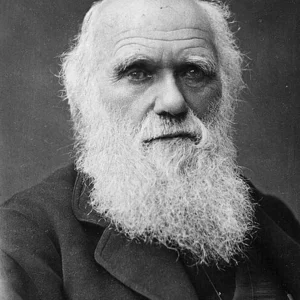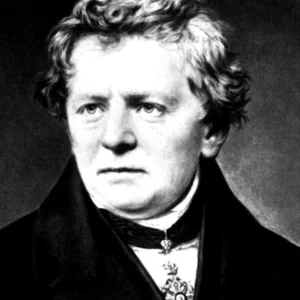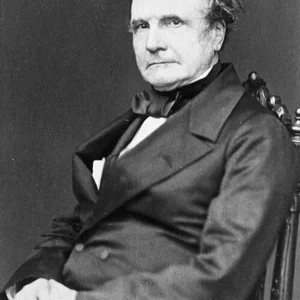

British mathematician (1791–1871), Charles Babbage is the pioneer of modern computing. He designed the Analytical Engine, the first programmable machine in history, and the Difference Engine, both conceptual ancestors of the computer.
Charles Babbage(1791 — 1871)
Charles Babbage
Royaume-Uni de Grande-Bretagne et d'Irlande
7 min read
Frequently asked questions
Famous Quotes
« On two occasions I have been asked, 'Pray, Mr. Babbage, if you put into the machine wrong figures, will the right answers come out?' I am not able rightly to apprehend the kind of confusion of ideas that could provoke such a question.»
Key Facts
- 1822: Design of the Difference Engine, intended to automatically compute mathematical tables
- 1837: Invention of the Analytical Engine, the first programmable machine capable of executing complex algorithms
- Collaboration with Ada Lovelace (1840s): writing of the first algorithm intended for a machine
- 1847–1849: Publication of his works on the mechanisation of calculation and the logic of machines
- 1791–1871: Teaching career at Cambridge and foundational contributions to algebra and mathematics
Works & Achievements
Babbage's first attempt to mechanize the computation of mathematical tables using the method of finite differences. Though unfinished, the built fragment proved the validity of the concept.
Revolutionary design of a universal machine programmable by punched cards, equipped with a memory and a calculation unit. It foreshadowed the architecture of modern computers.
A simplified and more elegant version of the first machine, using one third fewer parts. Successfully built in 1991 by the Science Museum in London, it operates perfectly.
A founding work on the analysis of industrial processes and the division of labour. It profoundly influenced Karl Marx and John Stuart Mill.
Babbage's intellectual autobiography, blending personal memories, reflections on the sciences, and technical descriptions of his machines.
Logarithmic tables of remarkable precision, verified with extreme care, which remained a reference for over a century.
Anecdotes
Charles Babbage despised street musicians who played beneath his windows in London. He waged a veritable crusade against barrel organs, going so far as to have a law passed in Parliament in 1864 to ban them from certain streets. This obsession earned him mockery in the press and even death threats.
Babbage once wrote a letter to the poet Alfred Tennyson to correct two lines of his poem "The Vision of Sin". Tennyson had written "Every moment dies a man, every moment one is born". Babbage pointed out that if this were true, the population would remain constant, and suggested replacing it with "Every moment dies a man, every moment one and a sixteenth is born", adding that the exact figure was too long to fit into a verse.
At the Great Exhibition of 1862 in London, Babbage requested permission to display a section of his Analytical Engine. The committee refused, deeming the machine unfinished and too difficult for the public to understand. Babbage was deeply wounded by this, having devoted decades to the project.
Ada Lovelace, daughter of the poet Lord Byron, became Babbage's most important intellectual collaborator. In 1843, she wrote notes on the Analytical Engine that contained what is now considered the first computer program in history. Babbage called her "the Enchantress of Numbers".
Babbage spent approximately £17,000 of public funds and a considerable personal fortune attempting to build his Difference Engine, without ever completing it. The British government eventually cut funding in 1842, after more than ten years of financing. A complete version was not built until 1991 by the Science Museum in London — and it worked perfectly.
Primary Sources
The whole of arithmetic now appeared within the grasp of mechanism. I felt sure that the machine I had designed could be made to execute not merely arithmetic, but every operation of analysis.
The division of labour can be applied with equal success to mental as to mechanical operations, and it ensures in both the same economy of time.
The Analytical Engine weaves algebraical patterns just as the Jacquard loom weaves flowers and leaves. The engine might compose elaborate and scientific pieces of music of any degree of complexity.
I have now arrived at a point where the whole of arithmetic is within the power of mechanism. The engine I have contrived will calculate any formula that does not contain an infinite number of terms.
Key Places
Babbage's main residence for most of his life. It was in his drawing room that he held famous scientific and social gatherings, and in his workshop that he worked on his machines.
Babbage studied mathematics there from 1810 and co-founded the Analytical Society to promote continental mathematics in England.
Now houses the original fragments of Babbage's machines as well as a complete, functional replica of Difference Engine No. 2, completed in 1991.
Prestigious scientific institution of which Babbage was elected a Fellow in 1816. He presented his early work on mechanical computation there and forged decisive connections.
The burial place of Charles Babbage, interred there in 1871. His brain, preserved separately, is on display at the Science Museum and the Hunterian Museum.
Typical Objects

Essential components of Babbage's machines, machined with extreme precision. Each wheel represented a digit, and their meshing allowed mechanical calculations to be performed.
Printed collections of mathematical calculations, often riddled with human errors. It was while correcting these tables that Babbage had the idea of mechanizing calculation.
Babbage produced thousands of detailed technical drawings for his machines. These remarkably precise plans were used to build the Difference Engine in the 20th century.
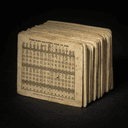
Inspired by the Jacquard loom, these cards were intended to program the Analytical Engine. They constitute the first programmable data input system.

Indispensable writing instruments for Babbage's prolific correspondence with the scientists, politicians, and industrialists of his era.
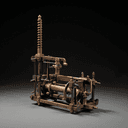
The only completed portion of the first machine, an assembly of 2,000 parts that served as a demonstration piece at Babbage's society gatherings.
School Curriculum
Vocabulary & Tags
Key Vocabulary
Tags
Époque
Daily Life
Morning
Babbage rose early at his Dorset Street home and began his day by reading through his voluminous correspondence. He would have a classic English breakfast — tea, toast, eggs — while browsing the newspapers. He would then head to his adjoining workshop to check on the progress of work on his machine.
Afternoon
The afternoon was devoted to visits and meetings. Babbage frequented the Royal Society, scientific clubs, and called on engineers and craftsmen. He also spent long hours drawing technical plans and solving mechanical problems related to his machines.
Evening
On Saturday evenings, Babbage hosted celebrated gatherings in his drawing room, where scientists, writers, politicians, and aristocrats mingled. The fragment of the Difference Engine, a true curiosity, was on display for all to admire. On other evenings, he worked late on his calculations and correspondence.
Food
Babbage ate according to the habits of the Victorian middle class: roast meat, boiled vegetables, puddings, and pastries. He enjoyed tea and wine. During his travels on the Continent, he discovered French and Italian cuisine, which he commented on with enthusiasm in his writings.
Clothing
As a Victorian gentleman, Babbage wore a dark frock coat, waistcoat, knotted cravat, and top hat. In his workshop, he would sometimes don a work apron when handling parts of his machines. His dress was always neat and in keeping with his social standing.
Housing
Babbage lived mainly at 1 Dorset Street, in Marylebone, a spacious middle-class townhouse. Part of the ground floor served as a mechanical workshop where craftsmen assembled the components of his machines. The drawing room, elegantly furnished, hosted his celebrated Saturday evening gatherings.
Historical Timeline
Period Vocabulary
Visual Style
Style d'illustration technique victorienne aux tons sépia et ambrés, mêlant la précision des planches d'ingénierie et la chaleur des intérieurs éclairés au gaz, avec des engrenages en laiton et des plans mécaniques.
Sound Ambience
L'atelier victorien de Babbage, entre le cliquetis méthodique des engrenages en laiton, le grattement de la plume sur les plans techniques et les bruits de la rue londonienne.
Liens externes & ressources
Références
Œuvres
Machine à différences n°1
1821-1832
Machine analytique
1833-1871
Machine à différences n°2
1847-1849
On the Economy of Machinery and Manufactures
1832
Passages from the Life of a Philosopher
1864
Table of Logarithms of the Natural Numbers from 1 to 108000
1827