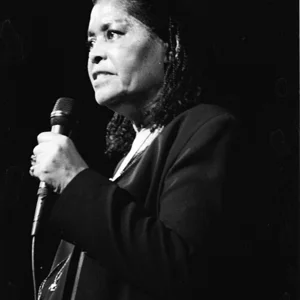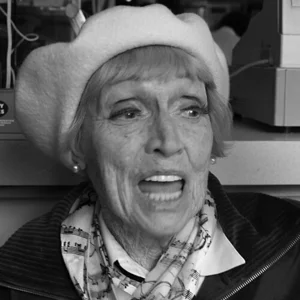

American jazz singer (1919-2006), a major figure of swing and later bebop vocals. She rose to fame as the vocalist of the big bands of Gene Krupa and Stan Kenton, distinguishing herself through her rhythmic, percussive phrasing and her mastery of scat singing.
Anita O'Day(1919 — 2006)
Anita O'Day
États-Unis
6 min read
Frequently asked questions
Key Facts
- 1919: born in Chicago as Anita Belle Colton
- 1941: success of the duet “Let Me Off Uptown” with Roy Eldridge in Gene Krupa's orchestra
- 1944-1945: sings with Stan Kenton's big band (“And Her Tears Flowed Like Wine”)
- 1958: a memorable performance at the Newport Jazz Festival, immortalized in the film “Jazz on a Summer's Day” (1960)
- 1981: publication of her autobiography “High Times Hard Times,” recounting her career and her years of drug addiction
- 2006: dies in Los Angeles
Works & Achievements
A swing duet hit that brought her to the wider public; the sung black-and-white exchange is remarkable for its time.
A hit with Stan Kenton's orchestra that cemented her reputation as a big-band vocalist.
A solo album on Verve, often regarded as one of the high points of 1950s vocal jazz.
A Verve album showcasing her swing and her sense of rhythm on standards.
Recorded with Oscar Peterson's quartet, a virtuosic record that reveals her rapport with first-rate soloists.
A filmed stage performance that became an absolute classic of jazz singing, blending scat and improvisation.
A candid autobiography in which she looks back on her career, her art, and her struggle with addiction.
Anecdotes
As a child, Anita O'Day underwent a tonsil operation during which the surgeon mistakenly removed her uvula. Without that organ, she could never hold a note for long or develop a vibrato. Rather than a handicap, she turned this quirk into her signature: a short, rhythmic, percussive singing style that imitated the phrasing of a wind instrument.
Born Anita Belle Colton, she chose the stage name “O'Day” at a very young age. In coded slang (pig latin), “O'Day” is a distortion of the English word “dough,” meaning “money.” It was a mischievous way of flaunting her ambition: to make a living from her voice.
In 1941, with Gene Krupa's orchestra, she recorded “Let Me Off Uptown” as a duet with the Black trumpeter Roy Eldridge. The record, on which she shouts the famous “Blow, Roy, blow!” just before the trumpet solo, became a huge hit. At a time of intense segregation, seeing a white singer and a Black musician share the spotlight like this was bold.
Anita O'Day hated the word “canary,” which at the time referred to the pretty, decorative singers fronting the big bands. To prove she was a full-fledged musician, she demanded to wear the same uniform jacket on stage as the instrumentalists, instead of an evening gown.
At the 1958 Newport Jazz Festival, filmed for the documentary “Jazz on a Summer's Day,” she appears wearing a large feathered hat and white gloves. Her high-octane renditions of “Sweet Georgia Brown” and “Tea for Two” have remained among the most famous moments of the film and of the history of jazz singing.
Primary Sources
Spoken exchange launching the trumpet solo: “Hey Roy! — What? — Are you gonna give?” then “Blow, Roy, blow!”
In it, Anita O'Day—in a black dress, white gloves, and a wide-brimmed hat—performs “Sweet Georgia Brown” and “Tea for Two” before the Newport crowd, transforming the melody into rhythmic improvisation.
In it she recounts how the accidental removal of her uvula prevented her from holding notes and using vibrato, steering her toward an “instrumental” style, along with her years of drug addiction.
A swing hit by Stan Kenton's orchestra carried by Anita O'Day's syncopated phrasing, which cemented her reputation with the general public.
Key Places
Birthplace where, as a teenager during the Great Depression, she took part in dance marathons and got her start in the clubs.
Jazz capital where she recorded with the great orchestras and lived the excitement of swing and then bebop.
Site of the 1958 jazz festival where her performance, filmed for “Jazz on a Summer's Day,” became legendary.
Hub of recording studios and West Coast musical life where part of her solo career unfolded.
City where she spent her final years and where she died in 2006.
Typical Objects

Her true instrument: she used it like a soloist, controlling her breath and attack to compensate for her lack of vibrato.

She insisted on wearing the same uniform jacket as the musicians in Gene Krupa's band, so she would be treated as an instrumentalist rather than a decorative singer.

Part of her iconic outfit at the 1958 Newport Jazz Festival, seen in “Jazz on a Summer's Day”.

The large hat she wears at Newport has become inseparable from her most famous image.

The format of her early 1940s hits like “Let Me Off Uptown”, played on jukeboxes and the radio.

The medium for her 1950s masterpieces as a solo vocalist, such as “Anita” and “Anita Sings the Most”.

For years, she crisscrossed the United States by bus with the big bands, from ballroom to ballroom.
School Curriculum
Vocabulary & Tags
Key Vocabulary
Tags
Daily Life
Morning
Tour mornings started late, since the concerts ended in the dead of night. Waking up in the hotel of a new city, coffee, and packing the bags before heading back on the road with the band.
Afternoon
The afternoon was spent traveling by bus between two cities, rehearsing, and doing sound checks in the ballroom or the theater where they would play that evening. New arrangements written for the voice also had to be rehearsed.
Evening
The evening belonged to the stage: several sets in a row in front of dancers or a club audience, with the band. There Anita unleashed her scat singing and her percussive phrasing, sometimes until very late.
Food
Life on tour meant irregular meals, eaten in cafeterias and roadside restaurants, plenty of coffee and cigarettes. This exhausting pace unfortunately encouraged, for a time, the drug use that was widespread in the scene.
Clothing
At first, she insisted on wearing the band's uniform jacket so she would be seen as a musician. Later, as a soloist, she adopted elegant outfits and her famous ensemble of a dress, white gloves, and the large Newport hat.
Housing
Her life unfolded mostly between hotel rooms as the tours dictated and apartments in Chicago, New York, and later California, without any real permanent home during her big band years.