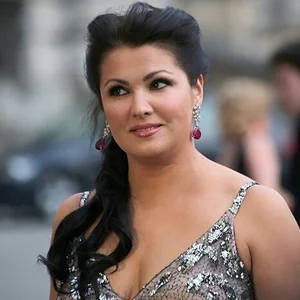

Anna Netrebko is a Russian-Austrian soprano born in 1971, considered one of the greatest opera singers of her generation. Trained at the Saint Petersburg Conservatory, she has conquered the world's most prestigious stages — the Metropolitan Opera, La Scala in Milan, and the Vienna State Opera.
Anna Netrebko(1971 — ?)
Anna Netrebko
Autriche, Russie
7 min read
Frequently asked questions
Key Facts
- Born on September 18, 1971, in Krasnodar, Russia
- Trained at the Rimsky-Korsakov Conservatory in Saint Petersburg in the 1990s
- International debut at the Metropolitan Opera in New York in 1995
- Won a Grammy Award in 2009 for her album Souvenirs
- Naturalized as an Austrian citizen in 2006, she became one of the most high-profile opera artists in the world
Works & Achievements
Her portrayal of the title role in this Romantic opera is considered one of the greatest in recent history. The mad scene, with its exceptional dramatic and vocal intensity, was broadcast in HD to thousands of cinemas worldwide.
This album of great Italian soprano arias introduced Netrebko to a worldwide mainstream audience. It ranked among the bestselling classical music releases in Europe and the United States.
Her portrayal of Violetta in this Verdi masterpiece, directed by Willy Decker, became the stuff of legend. The production was filmed and broadcast around the world.
In this role from the French repertoire, Netrebko demonstrated her versatility by embodying a heroine who is at once sensual and tragic, further expanding her range beyond bel canto roles.
Taking on Norma, the iconic lirico-spinto soprano role, signaled Netrebko's transition toward more dramatic and vocally demanding parts, marking a new chapter in her career.
With Tosca, Netrebko confirmed her transformation into a dramatic soprano. This role demands the power and vocal weight that her now-matured voice was fully capable of delivering.
Anecdotes
Anna Netrebko began her career sweeping the corridors of the Mariinsky Theatre in Saint Petersburg to pay for her studies at the Conservatory. It was the legendary conductor Valery Gergiev who noticed her and offered her first major roles, permanently changing the course of her life.
In 2002, she made her debut at the Metropolitan Opera in New York in the role of Natasha in Prokofiev's 'War and Peace.' The audience rose to its feet and gave her a standing ovation lasting several minutes — a rare consecration for a 31-year-old singer making her first appearances at this temple of world opera.
In 2006, Time magazine ranked her among the 100 most influential people in the world, an exceptional distinction for an opera singer at a time when opera was often perceived as a declining elite art form. Netrebko helped rejuvenate and popularize the genre for a global audience.
Anna Netrebko took Austrian citizenship in 2006 while retaining her Russian nationality. This dual cultural identity symbolizes her position at the crossroads of the Slavic and Western worlds, which deeply informs her interpretation of roles from both the Russian and Italian repertoire.
Primary Sources
Anna Netrebko states: 'I don't consider myself a diva in the traditional sense. I come from a simple family in Krasnodar, and I never forget where I come from. Music is my universal language.'
The Met's artistic direction notes: 'Anna Netrebko brings to Lucia a psychological fragility and vocal power rarely combined. Her mad scene will go down in the annals of this house.'
Netrebko receives the honorary title of Kammersängerin, the highest distinction awarded by the Vienna State Opera to its singers: 'This house is my second home. Every evening on this stage is a conversation with the history of music.'
She recounts: 'At the Mariinsky, I cleaned the floors in the morning and sang in the evening. That discipline taught me that nothing is guaranteed, that the voice is an instrument demanding daily work and complete humility.'
Key Places
It was at this prestigious institution that Anna Netrebko received her formal vocal training, heir to a long Russian musical tradition. There she developed the technical foundations of her career.
The historic Russian stage where Netrebko took her first professional steps, first as a stagehand and then as a soloist. It was here that Valery Gergiev launched her onto the world stage.
The 'Met' is the largest opera house in the world. Netrebko's debut there in 2002 and her many subsequent productions cemented her international reputation as a top-tier soprano.
One of the world's great centers of operatic culture, where Netrebko was awarded the title of Kammersängerin. Vienna also became her city of residence, reflecting her deep roots in Austrian culture.
The temple of Italian opera, where Netrebko has shone in the great repertoire of Verdi and Donizetti. To be acclaimed at La Scala is the ultimate distinction for any opera singer.
Typical Objects

Opera scores covered in pencil annotations are Netrebko's essential working tool. She marks her breathing cues, dramatic intentions, and the guidance of her conductors throughout.

Stage costumes for lyric sopranos often feature rigid corsets for baroque or romantic repertoire, shaping the silhouette and influencing vocal and breathing technique.

An indispensable fixture in the dressing room of a world-renowned singer, the humidifier protects the vocal cords from the drying effects of the air conditioning systems found in major opera houses.

Every role is prepared at the piano with a répétiteur before orchestral rehearsals begin. This instrument lies at the heart of how the European lyric tradition is passed down from one generation to the next.

Netrebko has recorded numerous albums for Deutsche Grammophon. Since the 1990s, the recording studio has become an essential space for bringing opera to a global audience.

The outfits worn at opening nights in Vienna, Milan, or New York are haute couture creations that contribute to the image of the modern diva and to the spectacular dimension of contemporary opera.
School Curriculum
Vocabulary & Tags
Key Vocabulary
Tags
Daily Life
Morning
Anna Netrebko's mornings start late, around 9 or 10 a.m., to protect her vocal rest. She does breathing exercises and light vocalizations before breakfast. On performance days, the morning is devoted to silence and relaxation to conserve her energy.
Afternoon
Afternoons are reserved for stage or musical rehearsals with the conductor and fellow cast members. Between productions, she works on future roles with her vocal coach, reviewing Italian, Russian, or French texts depending on the repertoire.
Evening
On performance nights, she arrives at the theater three hours before curtain for costume fittings, makeup, and final vocal warm-ups. After the show, standing ovations and a dressing room filled with flowers are often followed by a late dinner with the artistic team at a local restaurant.
Food
Caring for her voice requires a careful diet: she avoids dairy products and cold foods before singing, and stays well hydrated. On performance days, her meals are nourishing but light, and she takes care to avoid alcohol, which dries out the vocal cords.
Clothing
On stage, Netrebko wears sumptuous costumes created by the finest opera costume workshops — 19th-century gowns, corsets, crinolines, or romantic attire depending on the role. In everyday life, she favors elegant outfits and European designers, reflecting her status as an international public figure.
Housing
Netrebko splits her time between her Viennese apartment — her main home base since obtaining Austrian citizenship — and hotel suites in major cultural capitals such as New York, Milan, or Moscow during her tours. The décor of her Vienna residence reflects a taste for luxurious comfort and Slavic culture.
Historical Timeline
Period Vocabulary
Visual Style
L'esthétique visuelle associée à Netrebko mêle le faste des grandes salles d'opéra européennes du XIXe siècle — dorures, velours rouge, éclairages dramatiques — à la modernité glamour d'une artiste internationale du XXIe siècle.
Sound Ambience
L'univers sonore d'Anna Netrebko est celui des grandes maisons d'opéra — orchestres en fosse, silence électrique d'un public retenant son souffle, acoustiques majestueuses des salles viennoises, new-yorkaises et milanaises.
Liens externes & ressources
Références
Œuvres
Album 'Sempre libera'
2004
Manon (Massenet) — Metropolitan Opera
2012
Norma (Bellini) — Opéra de Vienne
2014
Tosca (Puccini) — Opéra de Vienne et Metropolitan Opera
2018