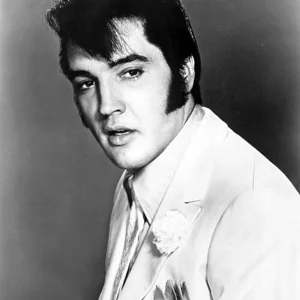

American singer and actor born in 1935, Elvis Presley is considered the “King of Rock and Roll.” He revolutionized popular music by blending country, gospel, and rhythm and blues, becoming a global icon of pop culture.
Elvis Presley(1935 — 1977)
Elvis Presley
États-Unis
10 min read
Frequently asked questions
Famous Quotes
« Before Elvis, there was nothing. — John Lennon»
« I don't know anything about music. In my line you don't have to. — Elvis Presley»
Key Facts
- 1935: Born in Tupelo, Mississippi
- 1954: First recording at Sun Records in Memphis
- 1956: Release of Heartbreak Hotel, first national #1 — national stardom
- 1958–1960: Military service in Germany
- 1977: Death in Memphis at the age of 42
Works & Achievements
The first single recorded at Sun Studio, this cover of a blues track by Arthur 'Big Boy' Crudup marks the starting point of rock and roll. Its radio broadcast sparked an immediate phenomenon among the youth of Memphis.
Elvis's first national number 1, selling over a million copies within a few weeks. The song, with its dark, reverb-drenched sound, established Elvis as a national figure and revolutionized public expectations of popular music.
One of Elvis's most iconic films, in which he plays a young delinquent turned rock star. The choreographed sequence of the title song is considered one of the first music videos in history.
Recorded just after his return from military service, this album showcases Elvis's artistic maturity, blending rock, ballads, and gospel. It marks a stylistic turning point toward a more adult and more varied sound.
The last number 1 of Elvis's career in the United States, this song with its building dramatic structure coincided with his triumphant return to the stage. It remains one of the best-known pop songs of the 20th century.
The first concert by a solo entertainment artist broadcast live by satellite worldwide, watched by an estimated audience of around one billion people. This unprecedented event illustrated the globalization of American pop culture.
Anecdotes
In July 1954, Sam Phillips, founder of Sun Studio in Memphis, asked Elvis to record 'That's All Right'. The song was aired that same evening on radio station WHBQ and triggered such a flood of phone calls that disc jockey Dewey Phillips had to play it fourteen times in a row. Elvis, who was at the movies, was urgently summoned back to the studio for a live interview.
In October 1954, after a performance at the Grand Ole Opry in Nashville, talent director Jim Denny advised Elvis to give up music and go back to his former job as a truck driver. The snub did nothing to shake the young singer's resolve, and he went on to make numerous appearances at clubs and fairs across the American South.
During his third appearance on The Ed Sullivan Show, on January 6, 1957, producers ordered cameramen to film Elvis only from the waist up, deeming his hip movements too provocative for a family audience. Yet 82% of American television viewers tuned in that evening — roughly 60 million people.
In 1958, Elvis was drafted into the U.S. Army despite offers to serve in special entertainment units. He insisted on being treated like any other soldier, which earned him widespread public respect. It was while stationed in Bad Nauheim, Germany, that he met Priscilla Beaulieu, whom he would marry in 1967.
In January 1973, the 'Aloha from Hawaii' concert was broadcast live by satellite to more than 40 countries and watched by an estimated audience of one billion people — more than had tuned in for the first moon landing in 1969. It was the first time a popular entertainer had staged a worldwide television event of such scale.
Primary Sources
Elvis Aron Presley agrees to provide Sun Record Company with exclusive rights to his recordings for a set period. Sam Phillips signs alongside the young artist and his mother, Gladys Presley, Elvis being still a minor at the time.
I can't explain why young people react the way they do to what I do. All I know is that when I get on stage and start singing, something happens inside me and I just get carried away by the music.
Private Elvis A. Presley, serial number 53310761, joins the 3rd Armored Battalion of the 1st Armored Division at Fort Hood, Texas, before being deployed to West Germany with the 3rd Armored Division in Friedberg. He is promoted to the rank of sergeant in January 1960.
I served like any other American. The Army taught me discipline and respect. I am proud to have fulfilled my duty to my country, and I can't wait to get back to the music.
I am writing to you as an American patriot to offer my services in the fight against drugs and against the groups that seek to destroy our country. I am prepared to help in whatever way I can.
Key Places
Elvis was born on January 8, 1935, in a modest two-room house built by his father. This city in the Deep South, shaped by racial segregation, was the melting pot where he grew up surrounded by Black gospel music and white country music.
Founded by Sam Phillips in 1950, this studio at 706 Union Avenue is where Elvis recorded his first tracks in 1954. Often called "the Birthplace of Rock and Roll," it also launched the careers of Johnny Cash, Jerry Lee Lewis, and Carl Perkins.
Purchased in 1957 for $102,500, Graceland was Elvis's home until his death in 1977. Now a national museum, it welcomes more than 600,000 visitors a year and stands as a vivid example of the lavish success culture that defined America in the 1960s and 1970s.
It was in this spa town in Hesse that Elvis was stationed from 1958 to 1960 with the 3rd Armored Division. His presence in West Germany, at the height of the Cold War, served as a powerful symbol of America's military commitment to Western Europe.
Starting in July 1969, Elvis performed 57 consecutive sold-out concerts there, drawing more than 100,000 spectators in total. Las Vegas, a city of gambling and spectacle, epitomizes the mass-entertainment capitalism that defined America in the 1960s and 1970s.