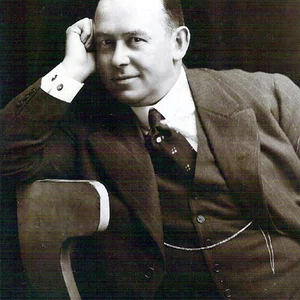

British impresario and theatre director (1866–1941), Fred Karno founded a music-hall troupe that revolutionized burlesque comedy. He trained Charlie Chaplin and Stan Laurel among others, helping to shape the rise of comic cinema worldwide.
Fred Karno(1866 — 1941)
Fred Karno
Royaume-Uni
8 min read
Frequently asked questions
Key Facts
- Founded the “Fred Karno’s Army” troupe in the 1890s, which became famous throughout the United Kingdom
- Charlie Chaplin joined his company around 1908 and honed his comic craft there before leaving for the United States
- Stan Laurel, future partner of Oliver Hardy, was also trained within the Karno troupe
- Fred Karno developed silent, acrobatic sketches that prefigured the visual gags of burlesque cinema
- He ended his life in poverty, his fortune squandered, and died in 1941
Works & Achievements
Karno's burlesque masterpiece, parodying a disastrous music-hall show with an increasingly rowdy fictional audience. This sketch was performed thousands of times across Britain and the United States, introducing the world to Charlie Chaplin's comic genius.
A comic sketch featuring bumbling prisoners and their incompetent guards. One of the most popular pieces in the Karno repertoire, it brilliantly played on the audience's delight in seeing authority figures made a fool of.
A burlesque comedy about the daily life of working-class people at the crack of dawn, filled with misunderstandings and physical gags. This sketch showcases Karno's ability to wring comedy out of ordinary, universally relatable situations.
A farce lampooning a secret society with absurd rituals and catastrophic initiations. This is the sketch in which Stan Laurel and Charlie Chaplin performed together during the 1912–1913 American tours.
Two triumphant tours of the United States that introduced Chaplin and Laurel to the American entertainment world. These tours represent Karno's most significant — if indirect — contribution to the history of world cinema.
Anecdotes
Fred Karno, whose real name was Frederick John Westcott, began his career as an apprentice plumber and circus acrobat before becoming one of Britain's greatest music-hall producers. His innate gift for physical comedy allowed him to transform a modest gymnastic act into an empire of laughter that would influence comedy throughout the twentieth century.
It was in Fred Karno's troupe that a young Charlie Chaplin, in his early twenties, learned the fundamentals of burlesque. During an American tour in 1910, Hollywood producers noticed Chaplin in the sketch 'Mumming Birds' and offered him a contract with Keystone Films, launching the career of the greatest clown of the silent screen.
Stan Laurel (then Arthur Stanley Jefferson) was also part of the Karno troupe and, during the American tours, served as Chaplin's official understudy. Without Fred Karno, the Laurel and Hardy duo might never have existed: it was in the United States, on these very tours, that Laurel decided to try his luck in Hollywood.
During the First World War, the expression 'Fred Karno's Army' entered common parlance as an ironic term for the British army, seen as disorganised. Sung by soldiers to the tune of a hymn, the phrase illustrates the enormous popular fame Karno had achieved across all social classes.
At the height of his fame, Fred Karno had a luxurious houseboat built on the Thames at Tagg's Island, christened The Astoria — a true floating palace complete with a ballroom. Ironically, after his bankruptcy in 1926, Karno was forced to sell this jewel and ended his days in relative poverty, forgotten by almost everyone.
Primary Sources
Karno didn't explain his comedy; he had an instinct for it. He was a genius at creating atmosphere. He was also a great teacher, though he never seemed to be teaching. From him I learned economy of expression.
Mr. Fred Karno's latest production has proved an enormous success. The piece, entitled Mumming Birds, is a burlesque of the ordinary music-hall entertainment, and as such is quite irresistibly funny.
Fred Karno's English Comedians have arrived in New York to begin their American tour. The company brings with them several of their celebrated sketches, including the famous Mumming Birds.
Fred Karno, whose real name was Frederick John Westcott, died on September 18, 1941. He was one of the greatest music-hall impresarios Britain ever produced, and the names of Charlie Chaplin and Stan Laurel stand as monuments to his genius for discovering and training comedy talent.
Key Places
Birthplace of Frederick John Westcott, known as Fred Karno, born on **26 March 1866**. It was in this town in south-west England that the life began of the man who would go on to revolutionize British comic entertainment.
Karno established his artistic headquarters in London, where his troupes performed in the great halls before thousands of spectators. It was in Camberwell that he kept his offices and rehearsal workshops.
A lavish houseboat built by Karno in **1922**, a symbol of his success. This floating palace, complete with a ballroom, welcomed show business celebrities until Karno's bankruptcy in **1926**.
The Karno troupe undertook two major tours of the United States (**1910** and **1912–1913**), performing in New York, Chicago, and San Francisco. These tours proved decisive in launching the Hollywood careers of Chaplin and Stan Laurel.
The place where Fred Karno spent his final years in poverty following his bankruptcy. He died there on **18 September 1941**, far from the spotlight, at the age of 75.
Liens externes & ressources
Références
Œuvres
Mumming Birds (A Night in an English Music Hall)
1904
The Jail Birds
1906
Early Birds
1907
The Wow-Wows
1909