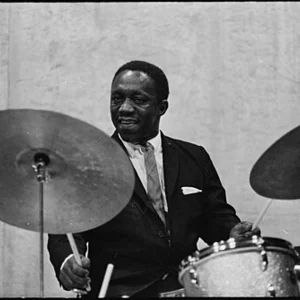

American jazz drummer and a major figure of hard bop. For over thirty years he founded and led the Jazz Messengers, a band that launched many young musicians who went on to become some of the biggest names in jazz.
Art Blakey(1919 — 1990)
Art Blakey
États-Unis
6 min read
Frequently asked questions
Key Facts
- Born in 1919 in Pittsburgh (Pennsylvania) and died in 1990 in New York
- Co-founded the Jazz Messengers in 1954-1955 and led them until his death
- A pioneer of hard bop, a style blending bebop, blues, and gospel
- Trained generations of musicians: Wayne Shorter, Freddie Hubbard, Wynton Marsalis, and more
- Converted to Islam in the 1940s and took the name Abdullah Ibn Buhaina
Works & Achievements
More than a band, a jazz school led for thirty-five years that revealed dozens of future big names.
Live concerts captured at Birdland, regarded as a recorded birth certificate of hard bop.
An album exploring percussion, in which Blakey brought together several drummers and drew on African and Afro-Cuban rhythms.
An emblematic album built around a gospel call-and-response theme written by Bobby Timmons; a huge success, especially in France.
An album featuring trumpeter Lee Morgan and saxophonist Wayne Shorter, among the finest recruits of the Messengers.
A peak of hard bop intensity and energy, showcasing the fire of Blakey's drumming.
Anecdotes
As a child in Pittsburgh, Art Blakey first learned the piano and played in clubs from his teenage years. He liked to tell how, one evening, a nightclub owner supposedly forced him to hand the piano over to another musician (the future great Erroll Garner) and move behind the drums. True or embellished, the story nicely captures how this pianist became one of the greatest drummers in jazz.
Toward the end of the 1940s, Blakey grew interested in Islam and the cultures of Africa. He took the name Abdullah Ibn Buhaina, and his musicians would affectionately nickname him “Bu” throughout his career.
For more than thirty-five years, Blakey recruited very young musicians into his Jazz Messengers, gave them their first major stage, then let them spread their wings once they had matured. Wayne Shorter, Lee Morgan, Freddie Hubbard, Benny Golson, and Wynton Marsalis all learned their craft there: the group was nicknamed “the university of hard bop.”
Blakey is famous for a spectacular drumming move, a long snare-drum roll that swells like a wave (the “press roll”) to spur the soloists on. His playing was so powerful that people said you could hear it all the way to the back of the clubs, even without a microphone.
In 1959, the French filmmaker Roger Vadim called on Blakey and the Jazz Messengers for part of the music for his film “Les Liaisons dangereuses.” American jazz thus met French cinema, and the Messengers would be welcomed triumphantly during their tours in France.
Primary Sources
Introduced on stage as “the fabulous Art Blakey Quintet,” Blakey leads Clifford Brown, Lou Donaldson, Horace Silver, and Curly Russell: one of the earliest recorded documents of the emerging hard bop sound.
“I'm gonna stay with the youngsters. When these get too old, I'll get some younger ones.”
“Music washes away the dust of everyday life.”
A film that follows Blakey on tour and shows him passing his craft on to the young musicians of the Jazz Messengers, a direct testament to his role as a mentor.
Key Places
Blakey's hometown, where he learned music and started out as a pianist before switching to drums.
The legendary club named after Charlie “Bird” Parker, where Blakey recorded landmark hard bop concerts in 1954.
The legendary Blue Note studio where Blakey and the Messengers cut many of their albums.
The region Blakey explored in the late 1940s, fueling his interest in Islam and African rhythms.
The jazz capital where Blakey spent most of his career and where he died in 1990.
Typical Objects

His instrument and his signature: Blakey drew from it a rare power and swing, the rhythmic foundations of all the Jazz Messengers.

At the heart of his famous “press roll,” that long, tight roll that swelled to spur the soloists on.

The large cymbal that carries the steady pulse of jazz; with Blakey, it lends an irresistible swing.

A pair of cymbals worked by the foot, marking the weak beats (2 and 4) typical of swing.

The drummer's tools; Blakey played loud and long, wearing out his sticks over the course of high-energy sets.

The Blue Note label's LPs, with their instantly recognizable cover artwork, carried his music all around the world.

Dark suit and tie: the Jazz Messengers cultivated an elegant, professional look on stage.
School Curriculum
Vocabulary & Tags
Key Vocabulary
Tags
Daily Life
Morning
A musician of the night, Blakey often slept late after playing into the early hours. His mornings were devoted to rest and organization: phone calls to manage the band, traveling from one city to the next.
Afternoon
Afternoons were dedicated to rehearsals, sound checks, and recording sessions in the studio. It was also when he mentored his young recruits and worked out the repertoire.
Evening
The evening formed the heart of his life: concerts and club sets that sometimes ran one after another until dawn, driven by his explosive drumming and famous rolls.
Food
Constantly on tour, his meals were irregular: fast-food restaurants, soul food, and sandwiches wolfed down between two concerts. Coffee and cigarettes accompanied the long nights of work, as was often the case in the jazz world of the era.
Clothing
On stage, Blakey and the Messengers took care of their appearance: a dark suit, shirt and tie, sometimes a hat, to project an elegant and professional image.
Housing
Based in New York, he spent most of his time on tour: hotel rooms, trains, planes, and buses carried him across the United States, Europe, and Japan, on the heels of countless concerts.