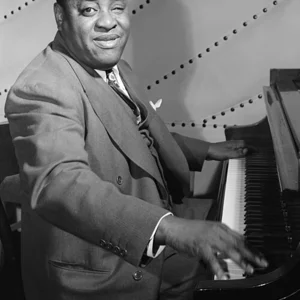

Arthur "Art" Tatum (1909-1956) was an American jazz pianist, regarded as one of the greatest virtuosos in the history of the piano. Nearly blind from birth, he revolutionized piano technique through his velocity, his daring harmonies, and his reharmonizations.
Art Tatum(1909 — 1956)
Art Tatum
États-Unis
6 min read
Frequently asked questions
Key Facts
- Born on October 13, 1909, in Toledo (Ohio), affected by a severe visual impairment from childhood
- First solo recordings in 1933, including a dazzling version of "Tiger Rag"
- Formed an influential trio in 1943 with guitarist Tiny Grimes and double bassist Slam Stewart
- Recorded a monumental series of solo and group sessions for producer Norman Granz in the 1950s
- Died on November 5, 1956, in Los Angeles, leaving behind an unmatched technical legacy
Works & Achievements
An anthology piece from his early solo recordings, a dazzling display of velocity that astounded the pianists of his time.
A virtuosic reharmonization of a popular song, which became the emblem of his art of transforming “standards”.
A ballad by Jerome Kern that he performed on numerous occasions, a peak of his lyricism and refined harmonies.
With Tiny Grimes on guitar and Slam Stewart on double bass, a small-ensemble format that had a lasting influence on chamber jazz.
More than a hundred solo tracks recorded for Norman Granz, a monumental body of work regarded as the crowning achievement of his career.
A series of intimate sessions with giants such as Ben Webster, Benny Carter, and Lionel Hampton, among his last recordings.
Anecdotes
One evening, while the star pianist Fats Waller was playing in a New York club, Art Tatum walked into the room. Waller stopped and announced to the audience: “I only play piano, but tonight, God himself is in the house.” The line became legendary, so much so that a compilation of his live recordings was later titled God Is in the House.
Nearly blind from birth, young Art learned in large part by listening to mechanical player-piano rolls. Some of these rolls had been recorded by two pianists playing together: Tatum, believing it was a single musician, strove to reproduce every note on his own, which forged his sound of astonishing density and velocity.
The greatest virtuosos of classical piano came to listen to him in amazement. Vladimir Horowitz, Sergei Rachmaninoff, and even the composer George Gershwin attended his concerts, and many declared they had never heard such a prodigious piano technique, classical or jazz alike.
Afflicted with cataracts from birth, Tatum could see almost nothing: he could make out shapes only faintly, with a single eye, after several operations. He could read greatly enlarged sheet music by holding it right up to his face, but he relied above all on his perfect pitch and his phenomenal memory.
In the after-hours clubs of Harlem, pianists engaged in “cutting contests,” genuine musical duels to determine the best. Tatum reigned there unchallenged: even masters like James P. Johnson or Fats Waller preferred to bow out. He often gave his very best late at night, once the paying concerts were over.
Primary Sources
I just play the piano, but tonight God is in the house.
Arthur Tatum, Toledo's Blind Pianist — the billing under which the young Tatum hosted his own piano show on Toledo's local radio station.
Foundational session in which Tatum recorded solo versions of “Tea for Two,” “Tiger Rag,” “St. Louis Blues,” and “Sophisticated Lady,” revealing his virtuosity and his reharmonizations to the public.
Recording marathons organized by producer Norman Granz: Tatum laid down more than a hundred solo pieces, a monumental summation of his art and his discographic testament.
Key Places
Tatum's hometown, where he studied music and hosted a piano show on radio station WSPD before leaving for New York.
The heart of jazz, where Tatum made his name in the clubs and after-hours spots, dominating the famous pianists' duels known as “cutting contests.”
A stop on his 1938 British tour, which reflected his international reputation among European jazz fans.
One of the great jazz scenes where Tatum performed regularly in the clubs during the 1930s and 1940s.
The city where he recorded his monumental sessions for Norman Granz and where he died in 1956.
Typical Objects

His instrument of choice, which he pushed to its very limits through his velocity and the richness of his chords. For him, the keyboard was a veritable orchestra.

A perforated paper strip read by player pianos; by imitating it as a child, Tatum developed his famous “four-handed” sound.

The shellac disc onto which his performances were cut, from “Tea for Two” to the Solo Masterpieces, which spread his genius far beyond the clubs.

Nearly blind, Tatum wore thick glasses; he retained a tiny remnant of vision in one eye, which he used by holding sheet music right up against his face.

As early as the late 1920s, he hosted his own show on Toledo's WSPD station, where he was billed as “the blind pianist of Toledo.”

To compensate for his blindness, he read sheet music printed in a very large format, held just a few centimeters from his working eye.

Renowned for his appetite for beer during long nights of playing and recording marathons, a habit that shaped his nocturnal way of life.
School Curriculum
Vocabulary & Tags
Key Vocabulary
Tags
Daily Life
Morning
A nocturnal musician, Tatum slept late and rarely got up before midday. His mornings were quiet, often spent listening to the radio, including the baseball broadcasts he loved.
Afternoon
His afternoons were split between rest, listening to records, and card games (he was fond of pinochle) with his friends. His exceptional ear let him pick up and memorize everything around him.
Evening
In the evening, he played his sets in the clubs; but the real magic came afterward, in the after-hours, where he played for other musicians until dawn in piano duels that became legendary.
Food
His reputation as a heavy beer drinker followed him through the long nights of playing and recording sessions. His diet remained the ordinary fare of a big-city American of the era.
Clothing
On stage, he wore a smart suit and tie, as the jazz clubs required. Thick glasses corrected his severely impaired vision as much as possible.
Housing
He lived in apartments in the cities his engagements took him to — Toledo, New York, then Los Angeles — in modest urban dwellings, following a life shaped by touring.