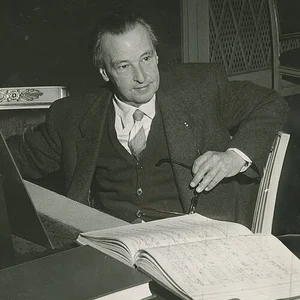

Franco-Swiss composer (1892–1955), member of Les Six, Arthur Honegger is the creator of *Pacific 231* and *King David*. His work blends modernism and spirituality.
Arthur Honegger(1892 — 1955)
Arthur Honegger
Suisse, France
8 min read
Frequently asked questions
Famous Quotes
« I am not a musician who makes music for the sake of making music.»
Key Facts
- Born on 10 March 1892 in Le Havre, to Swiss parents
- Joined Les Six in 1920 alongside Milhaud, Poulenc, and Auric
- Composed *Pacific 231* in 1923, a musical evocation of a locomotive
- Wrote *King David* (1921), an oratorio that earned him international renown
- Died in Paris on 27 November 1955
Works & Achievements
A dramatic psalm for narrator, chorus, and orchestra on a text by René Morax. A masterpiece that revealed Honegger to the world, it perfectly illustrates his ability to blend Christian spirituality with musical modernism.
An orchestral piece inspired by steam locomotives, a symbol of mechanization and the energy of the industrial age. A landmark work of 1920s modernism, it caused both scandal and admiration at its Paris premiere.
A one-act opera with a libretto by Jean Cocteau after Sophocles. A neoclassical work that confirmed Honegger's place in the Parisian artistic avant-garde of the 1920s.
An orchestral piece inspired by team sport, expressing the vitality and energy of human life. It reflects Honegger's fascination with the raw forces of modern life.
A dramatic oratorio on a text by Paul Claudel, for soloists, chorus, and orchestra. A monumental work blending spirituality, theatricality, and lyricism, it has become one of the great landmarks of twentieth-century choral music.
Composed under the Occupation, this symphony for string orchestra conveys a deep dramatic tension, often interpreted as a musical testament to inner resistance in the face of barbarism.
A powerful three-movement work (*Dies Irae*, *De Profundis*, *Dona Nobis Pacem*), a musical expression of the horrors of the Second World War and a call for peace. Regarded as his spiritual testament.
Anecdotes
In 1923, Honegger composed *Pacific 231*, an orchestral piece inspired by the steam locomotives he loved to watch. The title refers to the American classification of a high-powered locomotive (2 leading axles, 3 driving axles, 1 trailing axle). Yet Honegger himself clarified that his goal was not to imitate the sound of a train, but to express a visual and physical sensation of mechanical power.
Despite being born in Le Havre in 1892, Honegger considered himself above all Swiss, the son of German-speaking Swiss parents originally from Zurich. He always retained his Swiss nationality and completed his military service in Switzerland, which briefly took him away from Paris during the First World War. This dual French-Swiss identity shaped his entire career and his artistic relationships.
In 1920, music critic Henri Collet published an article in the journal *Comoedia* entitled “The Five Russians, the Six Frenchmen and Erik Satie”, giving birth to the name 'Groupe des Six'. Honegger was grouped with Darius Milhaud, Francis Poulenc, Georges Auric, Louis Durey and Germaine Tailleferre under this label, though he admitted having little musical common ground with his colleagues.
King David, premiered in 1921 in a small popular Swiss theatre in Mézières, was first written in three weeks for a play by René Morax. Originally conceived for a small ensemble, the work was reworked as an oratorio in 1923 and went on to achieve sweeping international success. It was this score that earned Honegger his worldwide reputation and revealed his gift for blending modernism with Christian spirituality.
During the German Occupation of Paris (1940–1944), Honegger chose to remain in France despite his Swiss nationality, which would have allowed him to leave. He composed his Symphony No. 2 for strings in 1941, a dark and tense work widely seen as a metaphor for spiritual resistance in the face of barbarism. His decision to stay with the French people was celebrated after the Liberation.
Primary Sources
I did not want to depict a train, or even a locomotive. I wanted to express a visual impression and a physical sensation through music. Pacific 231 is a sonic transposition of a feeling, not of a mechanical reality.
I have always had a great passion for locomotives. To me they are living creatures that I love the way others love women or horses. Pacific 231 conveys the visual impression and physical sensation of a locomotive hurtling along at full speed.
Six young French composers — Louis Durey, Arthur Honegger, Darius Milhaud, Germaine Tailleferre, Georges Auric and Francis Poulenc — form a group whose shared aesthetic is a reaction against Impressionism and a return to clarity.
A dramatic psalm in three parts, poem by René Morax, music by Arthur Honegger. First performance at the Théâtre du Jorat, Mézières (Vaud), on 11 June 1921, conducted by Ernest Ansermet.
Your text struck me at once with its poetic power and spiritual depth. For Joan of Arc at the Stake, I am seeking a music that is both accessible to the general public and ambitious in its form — popular and learned at the same time.
Key Places
Arthur Honegger's birthplace, where he was born on 10 March 1892. An industrial and cosmopolitan port city, it shaped his early years and fostered his lifelong fascination with mechanical modernity.
Honegger settled in Paris in 1911 and spent most of his life there, particularly in the Pigalle neighbourhood. The capital was the centre of his creative activity, his artistic encounters, and his greatest successes.
The venue where *Le Roi David* received its world premiere on 11 June 1921. This popular Swiss theatre hosted the work that launched Honegger's international career and revealed his genius to the musical world.
The city where *Jeanne d'Arc au bûcher* received its world premiere on 12 May 1938. Honegger maintained deep ties with Switzerland, where his family and musical roots were firmly anchored.
The institution where Honegger studied from 1911. There he received a rigorous training that shaped his musical language, balancing classical tradition with an openness to new aesthetic currents.
Typical Objects

The central instrument in Honegger's creative life, on which he sketched and worked his compositions daily. He used it to test harmonies and structures before orchestrating his scores.

The direct source of inspiration for his most celebrated work, *Pacific 231*. Honegger observed locomotives with passion, fascinated by their mechanical power, their rhythm, and their breath.

Honegger wrote all his scores by hand on ruled music paper. His manuscripts, preserved in archives, bear witness to careful musical notation and a highly structured way of thinking.

Honegger was an enthusiastic rugby fan, to the point of composing a symphonic movement titled *Rugby* (1928) to celebrate the energy and collective dynamics of the sport.

An indispensable tool for setting the tempos of his works. Honegger attached great importance to questions of rhythm and pulse throughout his symphonic compositions.

The iconic device of the 1920s–1940s that made it possible to listen to the first musical recordings. Honegger followed the recordings of his contemporaries and of his own works with close attention.
School Curriculum
Vocabulary & Tags
Key Vocabulary
Daily Life
Morning
Honegger rose early and began composing in the first hours of the morning, a time when he felt his mind was most receptive. He would settle at his piano or writing desk to set down his musical ideas before the day's obligations drew him away.
Afternoon
Afternoons were devoted to revising scores, rehearsals, and professional meetings. He frequented Parisian cafés — particularly those in Montparnasse and Pigalle — where he met colleagues from the *Groupe des Six*, poets such as Jean Cocteau or Paul Claudel, and performers.
Evening
Evenings were often dedicated to concerts, musical premieres, and Parisian performances. Honegger attended the premieres of his contemporaries' works and actively participated in the musical life of the capital. He came home late, after long artistic discussions in salons or brasseries.
Food
Like many Parisians of the interwar years, Honegger took his meals in brasseries or neighborhood restaurants. His daily fare was simple — bread, cheese, charcuterie, bistro dishes — accompanied by a glass of wine with meals, in keeping with the French customs of the time.
Clothing
Honegger adopted the elegant but understated dress of the bourgeois Parisian composer: dark suit, white shirt, carefully knotted tie. In period photographs, he appears in a jacket and neat collar, reflecting an artistic milieu that prized a serious and respectable image.
Housing
Honegger lived in Paris in apartments in the Pigalle and Montmartre district, an area then favored by artists and musicians. His home included a grand piano — essential to his work — and a well-stocked musical library. He shared his life with the pianist and composer Andrée Vaurabourg, whom he married in 1926.