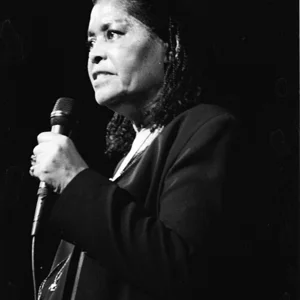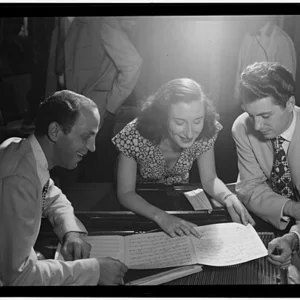

Barbara Carroll (1925-2017) was an American jazz pianist and singer, regarded as one of the first women to play bebop on the piano. She enjoyed a long career in the clubs of New York.
Barbara Carroll(1925 — 2017)
Barbara Carroll
États-Unis
6 min read
Frequently asked questions
Key Facts
- Born in 1925 in Worcester, Massachusetts, and died in 2017 in New York
- A bebop piano pioneer in the 1940s, at a time when few women made their mark in the genre
- Formed her own trio in the late 1940s and performed on Broadway
- Long-running musical residency at the Bemelmans Bar of the Carlyle Hotel in New York
- A career spanning more than six decades, lasting into the 2010s
Works & Achievements
A musical by Rodgers and Hammerstein in which she appears on stage as a pianist, a rare occurrence for a jazz musician.
An iconic album by her trio, showcasing her bebop piano playing.
An album in which she revisits standards, confirming her reputation as a refined pianist.
A long-running musical engagement that became a New York jazz institution, where she played and sang for decades.
A long series of recordings that places her among the most enduring jazz pianists of her generation.
Anecdotes
In the 1940s, bebop was a new kind of jazz — fast and complex, played almost exclusively by men. Yet Barbara Carroll established herself as one of the first women to master it on piano, leading her own trio in the clubs of 52nd Street in New York. The famous critic Leonard Feather noticed her very early on and praised her talent.
In 1953, the great Broadway composers Rodgers and Hammerstein gave her a role in their musical *Me and Juliet*: she appeared on stage as a pianist, before New York audiences. It was rare at the time for a genuine jazz musician to perform that way in a Broadway show.
Early in her career, her trio included the bassist Joe Shulman, whom she married in 1954. Their story was brief: Shulman died prematurely in 1957, and Barbara then put her career on hold for several years.
After a long break devoted to her family life, she returned to the stage in the 1970s and settled in at the Bemelmans Bar of the Carlyle Hotel in Manhattan. She would play there for decades, almost until her death in 2017, becoming a true institution of New York jazz.
First known as a pianist for her playing, Barbara Carroll began singing later in her career, adding her voice to her renditions of standards. She was still performing regularly at over 90 years old, faithful to her piano right to the end.
Primary Sources
The newspaper describes Barbara Carroll as a pioneer of bebop piano who died at age 92, long a fixture of Manhattan's clubs and supper clubs.
The Rodgers and Hammerstein production features Barbara Carroll as a pianist appearing on stage during the show.
A piano-bass-drums recording that documents her bebop playing and her repertoire of standards, a direct testimony to her artistry.
The critic and jazz historian singles out Barbara Carroll as one of the few women instrumentalists able to play bebop with genuine mastery.
Key Places
New England city where Barbara Carroll was born in 1925.
Renowned conservatory where she trained in music before turning to jazz.
Famous “Swing Street” lined with jazz clubs where she performed with her trio during the golden age of bebop.
Elegant Manhattan bar where she held a musical residency for decades, almost until her death.
City where she spent most of her career and where she died in 2017.
Typical Objects

Her lifelong instrument, on which she played bebop and later accompanied her own songs in the New York clubs.

The central instrument of her trio, played notably by her husband Joe Shulman; it gave her piano its rhythmic and harmonic foundation.

An essential tool once she added singing to her repertoire, in the hushed atmosphere of the supper clubs.

The format on which her albums were released, notably for RCA Victor, spreading her jazz piano playing.

Collections of the great themes from the Great American Songbook that she reinterpreted and improvised on at the piano.

An elegant outfit worn for her concerts in Manhattan's chic clubs and bars, such as the Bemelmans Bar.
School Curriculum
Vocabulary & Tags
Key Vocabulary
Daily Life
Morning
Like many club musicians who play late into the night, Barbara Carroll started her day late. The morning was for rest and, often, for a few hours of work at the piano to keep her bebop technique sharp.
Afternoon
The afternoon might be devoted to rehearsals, choosing the pieces, and working on arrangements, sometimes with the musicians of her trio. It was also the time for an artist's practical business: recordings, dealing with the clubs and the record companies of Manhattan.
Evening
The evening was the heart of her professional life: she performed in New York's clubs and supper clubs, playing in a trio or alone, and later singing between numbers. The shows could stretch late into the night.
Food
Her life followed the rhythm of Manhattan's restaurants and bars. Before playing, many club artists favor light meals, with most of the food and drink going along with the hushed atmosphere of the venues where they perform.
Clothing
On stage, in chic spots like the Bemelmans Bar, she wore elegant outfits, polished evening gowns suited to the refined atmosphere of New York's supper clubs.
Housing
She lived in New York, the city of her entire career, in the urban setting of Manhattan, close to the clubs and venues where she performed.