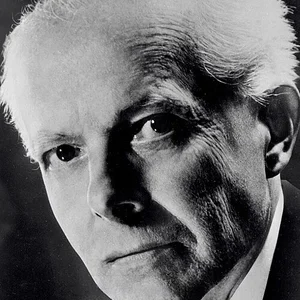

Béla Bartók was a Hungarian composer, pianist, and musicologist, one of the most important of the 20th century. A pioneer of ethnomusicology, he collected and studied the folk music of Central and Eastern Europe to incorporate it into a modern musical language.
Béla Bartók(1881 — 1945)
Béla Bartók
Hongrie, États-Unis
6 min read
Frequently asked questions
Famous Quotes
« Competition is for horses, not artists.»
Key Facts
- Born in 1881 in Nagyszentmiklós (then in Hungary, today in Romania).
- From 1905 onward, together with Zoltán Kodály, he collected thousands of Hungarian, Romanian, and Slovak folk songs.
- Composed his opera Bluebeard's Castle in 1911.
- Emigrated to the United States in 1940 to flee Nazism and the war.
- Died in 1945 in New York, leaving his Viola Concerto unfinished.
Works & Achievements
Bartók's only opera, dark and symbolic, inspired by a folktale; a high point of 20th-century lyric theatre.
A piano piece with a hammered, percussive rhythm, a manifesto of his new style nourished by folk music.
A ballet-pantomime with violent, modern music, long censored for a subject deemed scandalous.
A masterwork of intricate architecture, famous for its mysterious atmospheres known as “night music.”
A collection of 153 piano pieces, a progressive method that has become a classic of music education.
Composed in exile and while ill, it is his most performed orchestral work, brilliant and accessible.
A cycle regarded as one of the most important for quartet since Beethoven, mirroring the evolution of his musical language.
Anecdotes
As early as 1906, Bartók and his friend Zoltán Kodály travelled through the countryside of Hungary, Romania and Slovakia with a wax-cylinder phonograph to record the songs of the peasants. In this way, Bartók collected several thousand folk melodies, transcribed note by note, founding the science of ethnomusicology.
Bartók discovered that genuine Hungarian peasant music had almost nothing to do with the “Gypsy” music played in the cafés, which had been wrongly taken for the national music. This revelation transformed his language as a composer and nourished his entire body of work.
A fierce opponent of Nazism and Fascism, Bartók forbade his music to be broadcast on German and Italian radio. In 1940, refusing to live under Hitler's shadow, he left Hungary to go into exile in the United States.
In the United States, ill and penniless, Bartók obtained a research position at Columbia University to classify a collection of Serbo-Croatian folk songs. There he continued his work as a musicologist until illness made it impossible.
It was on his hospital bed, suffering from leukaemia, that Bartók composed his *Concerto for Orchestra* in 1943, a commission from the conductor Serge Koussevitzky. The work, which became one of his most famous, briefly gave him back the energy to create.
Primary Sources
Peasant music, in the strict sense of the term, refers to the melodies belonging to the repertoire of a nation's peasant class, melodies that are expressed more or less spontaneously.
Ideal peasant melodies are examples of the most accomplished artistic perfection. In my eyes, they are, on a small scale, what Bach's fugues or Mozart's sonatas are on a large scale.
Bartók demanded that no street or square bear his name in Hungary so long as any streets or squares there bore the names of Hitler or Mussolini.
Key Places
Bartók's birthplace, then in Austro-Hungarian Hungary, which became Romanian after 1920. A symbol of the shifting borders of Central Europe that he criss-crossed.
Bartók studied here and then taught piano for nearly thirty years. The heart of his Hungarian musical life.
Rural regions where Bartók collected thousands of Romanian and Hungarian melodies from peasants. The founding ground of ethnomusicology.
In exile, Bartók obtained a research post here to catalogue a collection of Balkan folk songs.
The city of his exile and of his death in 1945, where he composed the *Concerto for Orchestra* despite his illness.