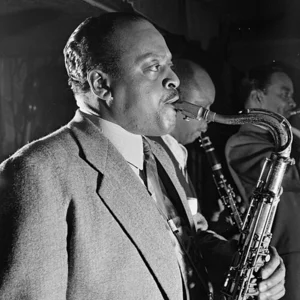

Ben Webster (1909–1973) was an American tenor saxophonist and a towering figure in jazz. He rose to prominence as a member of Duke Ellington's orchestra in the 1940s, developing a warm and expressive style that established him as one of the greatest soloists in jazz history.
Ben Webster(1909 — 1973)
Ben Webster
États-Unis
10 min read
Frequently asked questions
Key Facts
- Born on March 27, 1909, in Kansas City, Missouri, in a rich musical environment
- Joined Duke Ellington's orchestra in 1940, a period considered the peak of his creative output
- Recorded 'Cotton Tail' (1940) with Ellington — a solo that became a benchmark of jazz saxophone
- Moved to Europe in 1964, settling primarily in the Netherlands and Denmark
- Died on September 20, 1973, in Amsterdam, leaving behind an extensive discography
Works & Achievements
Recorded with Duke Ellington's orchestra for RCA Victor, this piece built on the chord changes of 'I Got Rhythm' contains one of the most celebrated tenor saxophone solos in jazz history. Webster displays an energy and technical mastery that make it an absolute benchmark studied by saxophonists everywhere.
A ballad recorded with Duke Ellington that reveals the lyrical, tender side of Ben Webster. The piece perfectly illustrates his ability to produce a warm, intimate sound at slow tempos, cementing his place as one of the greatest ballad interpreters in jazz history.
A jazz standard composed by Juan Tizol and popularized by Ellington's orchestra with Webster on tenor. This piece with its Latin flavor became an indispensable jazz classic, covered by countless musicians for decades.
An album recorded for the Verve label with a quartet, showcasing Ben Webster at the height of his artistic maturity. Regarded as one of his masterworks in a small-group setting, it demonstrates his ability to adapt to more intimate contexts than the big bands of his youth.
A meeting session between two jazz giants recorded for Verve, in which Webster engages in a deeply sensitive dialogue with Canadian pianist Oscar Peterson. Acclaimed by critics worldwide, this album remains a benchmark of collaboration between soloists of classic jazz.
His last major album recorded in the United States before his move to Europe, released on the Impulse! label. Webster demonstrates complete command of his craft and an emotional depth that define his finest years, symbolically marking the close of his American chapter.
Anecdotes
Ben Webster was nicknamed “The Brute” because of the power and intensity of his playing on fast numbers. Yet on ballads, he produced a velvety, almost whispered sound that set him apart from all his contemporaries — as if two very different musicians lived inside him.
In May 1940, Ben Webster recorded “Cotton Tail” with Duke Ellington’s orchestra, building his solo over the chord changes of Gershwin’s “I Got Rhythm.” That electrifying solo sent shockwaves through the jazz world and is still considered one of the greatest saxophone solos in the entire history of music.
Ben Webster had a volcanic temperament and was known to come to blows during arguments in jazz clubs, sometimes fueled by alcohol. Yet his colleagues unanimously spoke of his deep generosity and sensitivity the moment he picked up his saxophone — as if music transformed him completely.
In the 1960s, Ben Webster settled permanently in Europe, feeling that European audiences had a greater appreciation for classic jazz than American ones, who were turning away from the old masters in favor of free jazz and rock. In Amsterdam, the city embraced him as a living legend and even provided him with housing.
In Amsterdam, where he spent his final years, ordinary residents regularly invited Webster to dinner at their homes, valuing the man as much as the musician. At his death in 1973, he was brought back to Denmark — the first European country to have welcomed him — and buried in Copenhagen among the artists he had known.
Primary Sources
Sound recording made on May 4, 1940, featuring Ben Webster's tenor saxophone solo over a harmonic framework derived from 'I Got Rhythm'. This 78 rpm record stands as one of the earliest documented examples of a saxophone style that would go on to influence generations of musicians.
Webster speaks about learning the saxophone and his admiration for Coleman Hawkins, whom he regarded as his ultimate role model: "Coleman showed me what you could really do with this instrument. I'd listen to him and go back at it again and again."
The liner notes written by producer Norman Granz describe Webster as "the last great romantic tenor in jazz," highlighting his singular art of the ballad and the unmatched warmth of his tone in this small-group setting.
Writing about the star soloists of his 1940s band, Ellington portrays Ben Webster as a musician of uncommon expressiveness — capable of absolute tenderness on a ballad and raw power at fast tempos.
Key Places
Ben Webster's hometown, Kansas City was a major crossroads of American jazz in the 1920s and 1930s, renowned for its all-night jam sessions that stretched until dawn and for its particularly swinging style. It was here that Webster discovered music and began his apprenticeship.
The iconic Manhattan neighborhood where Ben Webster honed his craft with the great orchestras of the 1930s. Harlem was home to the most important clubs on the Black American jazz scene, where the biggest names in the genre rubbed shoulders.
The famous Harlem jazz club on 142nd Street where Duke Ellington and his orchestra performed regularly and were broadcast on national radio. Webster played there during his time with Ellington's band — paradoxically performing before an exclusively white audience while all the musicians were Black.
The first European city where Ben Webster settled in the 1960s, drawn by a thriving jazz scene and a warm, knowledgeable Scandinavian audience. He recorded numerous sessions there and found a second home, to the point of being buried in the city upon his death.
The city where Ben Webster spent his final years from the late 1960s onward, and where he died in 1973. He was embraced there as a living legend — the city provided him with housing, and residents regularly invited him to share in their everyday lives.