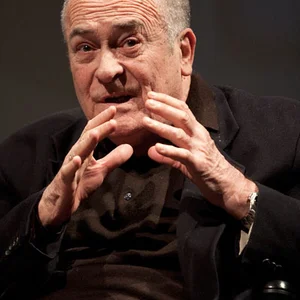

Bernardo Bertolucci (1941-2018) was an Italian director and screenwriter, a major figure of European art-house cinema. He left his mark on the history of the seventh art with ambitious historical frescoes and a sumptuous visual style.
Bernardo Bertolucci(1941 — 2018)
Bernardo Bertolucci
Italie, royaume d'Italie
7 min read
Frequently asked questions
Key Facts
- Born in 1941 in Parma, Italy, son of the poet Attilio Bertolucci
- Directed The Conformist in 1970, adapted from the novel by Alberto Moravia
- Sparked a scandal with Last Tango in Paris (1972)
- The Last Emperor (1987) won 9 Oscars, including Best Picture and Best Director
- Died in 2018 in Rome
Works & Achievements
Portrait of a young Italian bourgeois torn between revolutionary ideals and conformism. The film revealed the talent of the young Bertolucci.
An adaptation of Alberto Moravia about a man who embraces fascism out of cowardice. Its visual beauty makes it a classic studied around the world.
An intimate drama at the heart of an international scandal, which made Bertolucci a worldwide and controversial figure of cinema.
A historical fresco of more than five hours retracing half a century of Italian history through two families, one of peasants and one of landowners.
The story of the life of Puyi, the last emperor of China, filmed in the Forbidden City. Winner of nine Oscars, the peak of his career.
An adaptation of Paul Bowles's novel, filmed in the North African desert, about a couple lost far from home.
A film blending the life of Buddha with a contemporary story, exploring spirituality between Asia and the West.
A dive into the Parisian youth of May 1968, passionate about cinema and politics.
Anecdotes
Bernardo Bertolucci was the son of the famous Italian poet Attilio Bertolucci. At just 21, he published his own collection of poems and won the Viareggio Prize, one of Italy's highest literary honors. But in the end, it was toward cinema, not poetry, that he chose to turn his life.
At barely 20 years old, the young Bertolucci became the assistant to the director and poet Pier Paolo Pasolini on the shoot of his first film, *Accattone* (1961). It was this encounter that convinced him to drop out of university and make filmmaking his career.
To shoot *The Last Emperor* (1987), Bertolucci was granted an exceptional permit: he became the first Western director allowed to film inside the Forbidden City in Beijing, a palace long closed to foreigners. The film mobilized thousands of extras there.
*The Last Emperor* won all nine Oscars for which it was nominated in 1988, including Best Picture and Best Director. A clean sweep that is extremely rare in Oscar history.
In 2011, the Cannes Film Festival awarded him an honorary Palme d'Or for his lifetime achievement. Weakened by back operations, Bertolucci received it seated in a wheelchair, deeply moved to be honored in the very place where he had presented his films for half a century.
Primary Sources
Before cinema, Bertolucci dreamed of being a poet, following in the footsteps of his father **Attilio**; this award-winning first book marked his farewell to writing in verse in favor of the camera.
The director described the emotion of entering, cameras in hand, a place that had been off-limits for centuries, where the Chinese imperial court had to be recreated with thousands of extras.
Awarded Best Director, Bertolucci hailed it as a collective victory for his entire crew, stressing that a film on such a vast scale is above all the fruit of shared work.
Bertolucci shared his emotion at receiving this honor in the very place where he had shown his films throughout his career, making Cannes the home of his memories as a filmmaker.
Key Places
City in Emilia-Romagna where Bertolucci was born in 1941. He grew up there in a literary family, shaped by the poetry of his father Attilio.
Italian capital where Bertolucci built his career, worked with Pasolini, and shot many of his films. He died there in 2018.
Former palace of the emperors of China, where Bertolucci was granted exceptional permission to film “The Last Emperor.” It was the first Western film ever shot in this location.
Setting of “Last Tango in Paris” (1972) and “The Dreamers” (2003), where he depicted the youth of May 1968. The French capital runs throughout his work.
The world's foremost cinema event, where Bertolucci presented his films for decades and received an honorary Palme d'Or in 2011.
Typical Objects

Professional device that exposes the image onto 35-millimetre film, the reference format of the auteur cinema of his time. It is the central tool with which Bertolucci composed his sumptuous shots.

Small hinged-arm slate that is clapped in front of the camera at the start of each take. It serves to identify the scene and to synchronise the image and the sound.

Text detailing the story, the dialogue and the unfolding of a film's scenes. Bertolucci, the son of a poet, placed great importance on writing, which he often signed himself.

Small optical instrument worn around the neck that lets the filmmaker frame a scene by eye before placing the camera. It helps to choose the angle and the focal length of each shot.

Folding canvas seat, often marked with the director's name, from which the filmmaker runs the set. It has become the very symbol of the director's authority.

Golden trophy awarded by the Academy of Motion Picture Arts and Sciences in the United States. Bertolucci won nine of them in a single evening for “The Last Emperor.”

Long strip of film wound on a reel, the physical medium for images before the digital era. Once developed and edited, it made up the film projected in theatres.
School Curriculum
Vocabulary & Tags
Key Vocabulary
Daily Life
Morning
During a shoot, the day of a director like Bertolucci began very early, often before sunrise to take advantage of the light. He would reread the shot breakdown for the day's scenes and discuss the setups with his director of photography.
Afternoon
The afternoon was spent on set, directing the actors, adjusting the lighting and running through takes. A demanding filmmaker, he would redo a scene as many times as necessary to achieve the image he had in mind.
Evening
In the evening, after the shoot, came the time to watch the “rushes,” the footage filmed during the day. Off set, Bertolucci mixed with writers, intellectuals and other filmmakers, in the tradition of Italian auteur cinema.
Food
An Italian deeply attached to his culture, he loved the cuisine of his country, especially pasta and the specialties of his region of Emilia-Romagna, famous for Parmesan and Parma ham. The long shoots abroad also led him to discover very different cuisines, in China or in North Africa.
Clothing
On set, Bertolucci wore casual, practical clothes, like the filmmakers of his time, sometimes with a scarf or director's glasses around his neck. At major ceremonies such as the Oscars or Cannes, he donned a dark suit and evening wear.
Housing
Bertolucci lived mainly in Rome, in an apartment in the Italian capital. His shoots, however, led him to stay for long months far from home, in hotels in Beijing, Paris or in the desert.
Historical Timeline
Period Vocabulary
Liens externes & ressources
Références
Œuvres
Le Conformiste
1970
Novecento (1900)
1976
Le Dernier Empereur
1987
Un thé au Sahara
1990