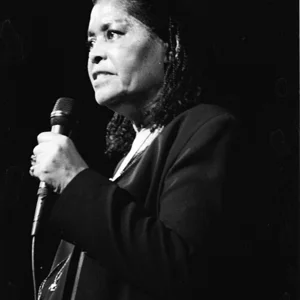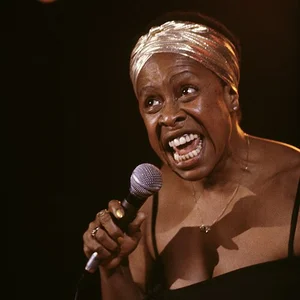

Betty Carter was an American jazz singer, famous for her art of vocal improvisation and scat. A major figure of bebop, she left her mark on vocal jazz in the second half of the 20th century with her rhythmic and melodic freedom.
Betty Carter(1929 — 1998)
Betty Carter
États-Unis
7 min read
Frequently asked questions
Key Facts
- Born on May 16, 1929, in Flint, Michigan, under the name Lillie Mae Jones.
- Got her start in the late 1940s singing with Lionel Hampton's orchestra, who nicknamed her “Betty Bebop.”
- Recorded a celebrated album of duets with Ray Charles in 1961.
- Founded her own independent label, Bet-Car Records, in 1969 — a rarity for an artist of the time.
- Won a Grammy Award in 1988 for the album “Look What I Got!”; died on September 26, 1998, in Brooklyn.
Works & Achievements
Duet album with Ray Charles; her song “Baby It's Cold Outside” became a classic and brought her national recognition.
Record company she created and ran in order to produce her own music freely, a rare move for a jazz artist of the era.
Live double album often regarded as her masterpiece, showcasing her rhythmic freedom and her rapport with the audience.
Album awarded the Grammy Award for Best Jazz Vocal Performance, a recognition from the profession.
Program she founded to identify and train young jazz musicians, extending her role as a discoverer of talent.
Live album recorded in London with young musicians, reflecting her vitality and high standards right up to her final years.
Anecdotes
As a teenager in Detroit, Betty Carter (then still known as Lillie Mae Jones) would step onto the stage in jazz clubs and had the good fortune to sing alongside bebop giants like Charlie Parker and Dizzy Gillespie when they came through town on tour. These early encounters with the inventors of bebop shaped her ear and her love of improvisation.
Hired by vibraphonist Lionel Hampton in the late 1940s, she earned from him the teasing nickname “Betty Bebop,” because she adored this bold new style that Hampton himself barely cared for. Legend has it that he fired her and rehired her several times: it was from this period that her stage name, Betty Carter, came.
In 1961, her duet album with the famous Ray Charles, and especially the song “Baby It's Cold Outside,” brought her national fame. Yet, refusing to become a pop singer, she chose to stay true to demanding jazz, even if it meant going through tougher, more obscure years afterward.
Frustrated by record labels that wanted to control her music, in 1969 she founded her own label, Bet-Car Records: a rare and courageous move for an African American artist of the time, one that allowed her to own and release her own recordings in complete freedom.
Her trio was nicknamed a true “university of jazz”: there Betty Carter trained dozens of young pianists and musicians destined for great careers. In 1993, she formalized this mission with the Jazz Ahead program, dedicated to passing the music on to new generations.
Primary Sources
A studio recording in which the voices of Ray Charles and Betty Carter answer each other in a sung dialogue full of humor and warmth, which became a classic of the Christmas repertoire and the most popular song of her entire career.
A double album recorded in concert, regarded as her masterpiece: in it you can hear her extreme rhythmic freedom, her stretched or accelerated tempos, and her rapport with an audience she called the “half” of her art.
The record that secured her official recognition by the profession and confirmed her place as a major jazz singer, nearly forty years after her debut with Lionel Hampton.
Key Places
Industrial city where Lillie Mae Jones was born in 1929. Her family later moved to Detroit during her childhood.
City of her youth, where she trained in the jazz clubs and sang as a teenager with the bebop pioneers passing through on tour.
Legendary venue of African American culture where the great names of jazz performed and where Betty Carter sang over the course of her career.
Neighborhood where she lived in a brownstone house and set up the offices of her label, Bet-Car. She died there in 1998.
Place where she received the National Medal of Arts from the president in 1997, an official recognition of her work.
Typical Objects

An indispensable tool for the singer, which she used with great finesse to shade her volume and play with silences. Her control of the microphone was a full part of her art of improvisation.

The medium for her self-produced albums on her own label, founded in 1969. Owning her own masters was, for her, an act of artistic independence.

The instrument at the heart of her ensembles: Betty Carter led her music from the piano and brought many young pianists to light there. The piano-bass-drums trio was her favorite setting.

A sheet noting the melody and chord chart of a standard, the starting point for her reinventions. She used it as a springboard to radically transform each tune.

A polished outfit she wore for her concerts in clubs and festivals, asserting the dignity and seriousness of the jazz artist.

A gramophone-shaped statuette received in 1988, a symbol of the late but resounding recognition from the music profession.
School Curriculum
Vocabulary & Tags
Key Vocabulary
Tags
Daily Life
Morning
Like many jazz musicians who played late into the night, Betty Carter often woke up in the late morning. She started the day by listening to records and mentally working out new arrangements, searching for fresh ways to reinvent the standards.
Afternoon
The afternoon was devoted to intense rehearsals with her trio and to mentoring: she drilled her young musicians and corrected them tirelessly. A shrewd businesswoman, she also ran her label Bet-Car, handling contracts and organizing tours.
Evening
In the evening, she took the stage in clubs and at festivals, performing sets that sometimes stretched late into the night. Every concert was unique, because she never sang a piece exactly the same way twice, improvising in dialogue with the audience.
Food
Life on tour meant irregular meals, eaten between two concerts or on the road. Her tastes remained shaped by the African American soul food of the South from her childhood in Michigan.
Clothing
On stage, she took care with her appearance, wearing elegant dresses that asserted the dignity of the jazz artist. In rehearsal and backstage, she opted for simpler, more comfortable outfits.
Housing
For many years she lived in Fort Greene, a neighborhood in Brooklyn, in a brownstone typical of New York. This home also housed the activities of her independent label.