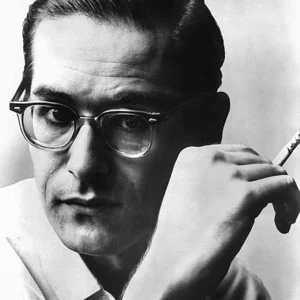

Bill Evans (1929-1980) was an American jazz pianist, one of the most influential of the 20th century. His lyrical playing with its impressionistic harmonies and his approach to the trio make him a major figure in modern jazz, notably through his contribution to Miles Davis's album *Kind of Blue*.
Bill Evans(1929 — 1980)
Bill Evans
États-Unis
5 min read
Frequently asked questions
Famous Quotes
« Jazz is not a what, it is a how.»
Key Facts
- Born on August 16, 1929, in Plainfield, New Jersey.
- In 1959, he played on Miles Davis's album *Kind of Blue*, the best-selling jazz record in history.
- In 1959, he formed a revolutionary trio with bassist Scott LaFaro and drummer Paul Motian, recording *Sunday at the Village Vanguard* and *Waltz for Debby* in 1961.
- Won seven Grammy Awards over the course of his career.
- Died on September 15, 1980, in New York.
Works & Achievements
First album as a leader, featuring the very first version of “Waltz for Debby.”
Album that unveils “Peace Piece,” a solo piano improvisation of great purity.
His contribution shapes modal jazz; it is the best-selling jazz record in history.
First studio album by the trio with Scott LaFaro and Paul Motian, reinventing the three-way dialogue.
Peaks of trio jazz recorded live, shortly before LaFaro's death.
Experimental record of overdubbed pianos; Evans's first Grammy Award.
Introspective solo piano album, also honored with a Grammy.
One of his last records, crowned with a Grammy.
Anecdotes
In 1959, Miles Davis gathered his musicians in the studio with almost nothing written down: a few scales and moods scribbled on paper. Bill Evans contributed greatly to the harmonic colors of the album “Kind of Blue,” which became the best-selling jazz record in history. He is also often credited with composing the piece “Blue in Green.”
On June 25, 1961, the Bill Evans Trio recorded live at the New York club the Village Vanguard, giving rise to the albums “Sunday at the Village Vanguard” and “Waltz for Debby.” Eleven days later, bassist Scott LaFaro died in a car accident at just 25 years old. Devastated, Evans almost stopped playing for several months.
Bill Evans composed one of his most famous melodies, “Waltz for Debby,” for his niece Debby, the daughter of his brother Harry. This tender theme, written as a lullaby-waltz, became a classic covered by countless musicians.
In 1963, Evans made a very daring record, “Conversations with Myself”: through overdubbing, he layered up to three pianos all played by himself, in a way dialoguing with his own hands. The experiment earned him his first Grammy Award.
In a 1966 television documentary, “The Universal Mind of Bill Evans,” the pianist explains to his brother Harry his approach to learning: it is better to perfectly master something simple and true than to get lost in the complicated and the artificial. This patient philosophy sums up his whole art.
Primary Sources
There is a Japanese visual art in which the artist is forced to be spontaneous. He must paint on a thin stretched parchment with a special brush and black water paint in such a way that an unnatural or interrupted stroke will destroy the line or break through the parchment.
I believe that all people are in possession of what might be called a universal musical mind. Any true music speaks with this universal mind to the universal mind in all people.
It's better to do something simple which is real. It's something you can build on because you know what you're doing.
Key Places
Bill Evans's birthplace, where he learned the piano from early childhood.
University where he trained in music and earned his degree in 1950.
Jazz capital where he lived, recorded the bulk of his work, and died in 1980.
Home of the jazz festival where his 1968 concert earned him a Grammy.
Typical Objects

His lifelong instrument: Evans is famous for his delicate touch and the rich voicings of his chords on the acoustic piano.

An electric piano he uses notably on the album “From Left to Right” (1970), blending it with the acoustic piano.

His glasses are part of his recognizable image as a studious, focused musician.

Essential for re-recording several layered piano tracks, as on “Conversations with Myself.”

Sheets giving the melody and chords of the standards that the trio reinvented at every concert.

A machine that enables overdubbing: Evans uses it to play in a trio with himself in 1963.
School Curriculum
Vocabulary & Tags
Key Vocabulary
Tags
Daily Life
Morning
A nocturnal musician, Bill Evans rose late. His quiet mornings served mainly to recover from the previous night's concerts, which often ended in the early hours.
Afternoon
His afternoons were devoted to working at the piano: he tirelessly searched for new voicings (ways of arranging chords) and listened to the classical composers he admired, such as Debussy and Ravel.
Evening
In the evening, he played several sets in a row at jazz clubs like the Village Vanguard, performing in a trio late into the night in an intimate, hushed atmosphere.
Food
His diet was irregular, shaped by tours and late-night gigs: plenty of coffee and cigarettes, and often neglected meals, all the more so as his addiction problems were damaging his health.
Clothing
In the 1950s and 1960s, he cultivated the look of a modern jazzman: an understated suit, a tie, and thick-framed glasses. Over the years, his attire grew more unkempt.
Housing
He lived modestly in New York apartments and spent much of his life on the road, moving between hotels and concert halls as the tours dictated.