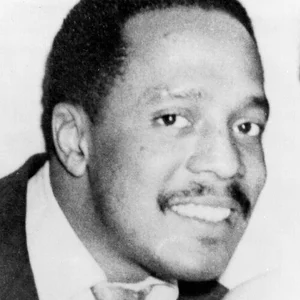

Bud Powell was an American jazz pianist and composer, regarded as one of the greatest pianists of bebop. He transposed to the piano the harmonic and rhythmic language invented by Charlie Parker and Dizzy Gillespie, leaving a lasting influence on the piano playing of modern jazz.
Bud Powell(1924 — 1966)
Bud Powell
États-Unis
6 min read
Frequently asked questions
Key Facts
- Born on September 27, 1924, in New York (Harlem) into a family of musicians
- In the early 1940s, becomes one of the architects of bebop piano alongside Charlie Parker, Dizzy Gillespie, and Thelonious Monk
- Records major albums for Blue Note and Verve in the late 1940s and the 1950s (compositions such as “Un Poco Loco” and “Tempus Fugit”)
- Settles in Paris in 1959, where he plays regularly and inspires the film “Round Midnight”
- Dies on July 31, 1966, in New York, after a life marked by illness and psychiatric confinement
Works & Achievements
Emblematic composition of his trio, which became a classic covered by countless jazz musicians.
A lively, angular theme typical of bebop, recorded for Blue Note; its title would later give its name to the memoirs of Francis Paudras.
A piece with a sinuous melody showcasing Powell's virtuosity and harmonic inventiveness.
A masterpiece recorded with Max Roach, hailed as one of the pinnacles of jazz piano.
A composition evoking the bustle of a Parisian avenue, foreshadowing his future exile in France.
A singular, anxious piece, mirroring the confinement and psychological ordeals he was going through.
A founding album for the Blue Note label that cemented his influence over all of modern jazz piano.
Anecdotes
As a teenager, Bud Powell hung around Minton's Playhouse in Harlem, the club where bebop was being born. The pianist Thelonious Monk, his elder, took him under his wing and gladly let him take over the keyboard. Powell improved so quickly that, it is said, the other pianists dreaded having to play after him.
In 1945, during an arrest in Philadelphia, Bud Powell was violently struck on the head. This injury left him with persistent headaches and marked the onset of serious mental troubles. Hospitalized repeatedly and subjected to electroshock therapy, he nonetheless kept on composing and playing.
On May 15, 1953, at Massey Hall in Toronto, Bud Powell shared the stage with Charlie Parker, Dizzy Gillespie, Charles Mingus and Max Roach. Recorded by Mingus, this concert has remained famous as “the greatest jazz concert of all time,” for it brought the five giants of bebop together one single time.
Settled in Paris from 1959 onward, Powell, ill and frail, was taken in by a French graphic artist with a passion for jazz, Francis Paudras, who watched over him for years. Their friendship inspired Bertrand Tavernier's film “Round Midnight” (1986), whose score by Herbie Hancock won an Oscar.
Bud Powell transposed onto the piano the fast, leaping phrases that Charlie Parker played on the saxophone. His right hand unfurled long, virtuosic melodies while his left hand laid down short, dry chords. Almost every modern jazz pianist, from Bill Evans to Herbie Hancock, owes him something.
Primary Sources
Paudras recounts his meeting with Powell in Paris, the state of neglect in which he found him, and his decision to care for the pianist he admired above all others.
The album presents Powell as the pianist who brought the language of bebop to the keyboard, with sessions bringing together the likes of Fats Navarro, Sonny Rollins, and Max Roach.
The record immortalizes the Toronto concert and was released on the label Mingus had just founded; the musicians are billed as the cream of modern jazz.
Miles Davis recalls Powell's dazzling virtuosity and his decisive role for an entire generation of bebop pianists.
Key Places
African-American neighborhood where Powell was born in 1924 and grew up, at the heart of the musical scene that would give rise to bebop.
Legendary club where, during late-night jam sessions, Powell learned alongside Thelonious Monk and took part in the invention of bebop.
City where Powell was violently struck on the head during an arrest in 1945, an event that triggered his health problems.
Venue where the legendary 1953 concert took place, bringing together the five giants of bebop, including Powell on piano.
Capital where Powell lived from 1959 to 1964, playing at the Blue Note and finding faithful support in Francis Paudras.
City where Powell died in 1966, after returning to the United States, weakened by illness.
Typical Objects

His instrument of choice, on which he forged a style where the right hand sings long melodic lines while the left hand strikes short, sharp chords.

The Blue Note label captured his most famous sessions in the series “The Amazing Bud Powell,” spreading his music far beyond the clubs.

Like the bebop musicians, Powell took the stage in an elegant suit, a mark of the seriousness and dignity claimed by this new generation of jazzmen.

A composer as much as a performer, Powell set down on paper themes with complex harmonies such as “Un Poco Loco” or “Dance of the Infidels.”

Ever-present in the smoky clubs of the era, they accompanied the pianist's long nights of concerts and jam sessions.

A common headpiece among jazz musicians of the 1940s and 1950s, it was part of the polished look associated with the New York bebop scene.
School Curriculum
Vocabulary & Tags
Key Vocabulary
Tags
Daily Life
Morning
Like many club musicians, Powell lived out of step with normal hours: the morning was mostly for recovering from concerts that ended at dawn. He woke late, in a Harlem apartment or, later, a Parisian room.
Afternoon
The afternoon might be spent practicing the piano, searching for new harmonies, and composing. It was also the time for rehearsals and studio recording sessions with his trio or his fellow musicians.
Evening
The real day began in the evening: Powell took the stage in clubs like Birdland or the Blue Note in Paris, stringing together long sets late into the night, sometimes extended by improvised jam sessions among musicians.
Food
The diet of a jazzman of the era was irregular, shaped by nocturnal hours and life on tour: meals grabbed on the run, sandwiches, and club drinks. Illness and alcohol severely undermined his health and his appetite.
Clothing
On stage, Powell took care with his appearance, wearing a suit, shirt, and tie, in keeping with the elegance displayed by bebop musicians, who wanted to be taken seriously as artists.
Housing
He first lived in lodgings in Harlem, interspersed with long stays in psychiatric hospitals. In Paris, he occupied modest apartments and rooms, where Francis Paudras eventually took him in and protected him.