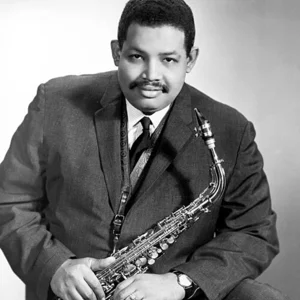

American jazz alto saxophonist, a major figure of hard bop and soul jazz. A member of the Miles Davis sextet on the album *Kind of Blue* (1959), he went on to lead his own quintet with his brother, cornetist Nat Adderley.
Cannonball Adderley(1928 — 1975)
Julian Cannonball Adderley
États-Unis
6 min read
Frequently asked questions
Key Facts
- Born on **September 15, 1928** in **Tampa, Florida**, nicknamed “Cannonball” (a corruption of “cannibal,” a nod to his appetite) as a teenager
- Took part in 1959 in the recording of Miles Davis's *Kind of Blue*, one of the best-selling jazz albums in history
- Formed a hit quintet with his brother **Nat Adderley** at the turn of the 1960s
- Enjoyed major commercial success in 1966 with *Mercy, Mercy, Mercy*, composed by **Joe Zawinul**
- Died on **August 8, 1975** in **Gary, Indiana**, at the age of 46
Works & Achievements
Album released under his own name on Blue Note with, unusually, Miles Davis as a sideman; it features an unforgettable version of “Autumn Leaves.”
Adderley plays alto saxophone alongside John Coltrane on this Miles Davis masterpiece, the best-selling jazz album in history.
Recorded live, this album launched his quintet with the hit “This Here” (Dis Heah), by Bobby Timmons, and established the sound of soul jazz.
Quintet album containing “Work Song,” composed by his brother Nat Adderley and now a jazz standard.
Live album whose title track, written by Joe Zawinul, became a surprise popular hit and brought Adderley fame well beyond the jazz audience.
Recorded at a concert for a civil rights organization; it features “Walk Tall” and embodies the gospel spirit of soul jazz.
Anecdotes
At his high school in Tampa, Florida, young Julian devoured everything he could get his hands on. His classmates nicknamed him “Cannibal” because of his gargantuan appetite. Over time, that nickname morphed into “Cannonball,” which stuck with him for the rest of his life.
In June 1955, Adderley arrived in New York almost unknown, his saxophone under his arm. One evening, at the Café Bohemia club, he was invited on stage with bassist Oscar Pettiford's band: his solo stunned the room. Since the genius Charlie Parker had died just a few months earlier, the press immediately hailed him as “the new Bird.”
Before becoming a star, Adderley was a music teacher: he directed the band at Dillard High School in Fort Lauderdale. Throughout his life he kept this teacher's soul, taking the time to explain to audiences, microphone in hand, the meaning and history of the pieces he played.
In 1959, Adderley took part in the recording of Miles Davis's “Kind of Blue,” alongside saxophonist John Coltrane. The musicians received barely a few cues before playing and improvised almost everything. The record would become the best-selling jazz album in history.
In 1966, his pianist Joe Zawinul composed “Mercy, Mercy, Mercy” on a Wurlitzer electric piano. Recorded in front of an audience clapping and singing along, this gospel-flavored tune became a genuine hit: it climbed the pop charts, an extremely rare feat for a jazz instrumental.
Primary Sources
You know, sometimes we're not prepared for adversity. When it happens, sometimes we're caught short. We don't know exactly how to handle it when it comes up. Sometimes we don't know just what to do when adversity takes over.
Now we're gonna do a new composition by our pianist Bobby Timmons. This one is a jazz waltz; however, it has all sorts of properties — it's simultaneously a shout and a good time. We just call it 'Dis Heah.'
Hipness is not a state of mind; it's a fact of life. And you don't decide you're hip. It just happens that way.
Key Places
City in the southern United States where Julian Adderley was born on September 15, 1928, and where he grew up in a family of musicians.
City where Adderley directed the Dillard High School band in the early 1950s, before trying his luck in New York.
Jazz capital where Adderley was discovered in 1955 at the Café Bohemia, joined Miles Davis, and then built his entire career.
Club where his quintet recorded the live album “In San Francisco” (1959) and his first major hit, “This Here.”
Industrial city where Cannonball Adderley died of a stroke on August 8, 1975.
Typical Objects

His instrument throughout his life, the alto saxophone gave him a round, lively, singing tone. On it, Cannonball unleashed improvisations that were both virtuosic and bursting with joy.

A small strip of cane attached to the mouthpiece, which vibrates when you blow and gives the saxophone its voice. A saxophonist like Adderley went through many of them and chose his reeds with great care.

Adderley wore large, dark-framed glasses that became inseparable from his round, smiling face.

Like the jazz bandleaders of his era, he performed in an elegant suit and tie, a sign of the seriousness and respect owed to the music and the audience.

It was on this warm-sounding electric piano that his pianist Joe Zawinul played “Mercy, Mercy, Mercy,” the quintet's biggest hit.

A long-playing vinyl record on which his albums were released. Several were recorded live, capturing the applause and his spoken introductions.
School Curriculum
Vocabulary & Tags
Key Vocabulary
Tags
Daily Life
Morning
A musician of the night, Adderley got up late. His mornings were quiet: coffee, listening to records, and a bit of saxophone to loosen up his fingers.
Afternoon
Afternoons were for working on music: rehearsals with the quintet, refining tunes with his brother Nat and his pianist Joe Zawinul, or recording sessions in the studio. A former teacher, he also enjoyed thinking about the best way to explain jazz to audiences.
Evening
In the evening, life was in full swing in jazz clubs like the Jazz Workshop in San Francisco or the Village Vanguard in New York. Between numbers, Adderley would take the microphone to introduce the tunes with humor and warmth.
Food
Famous for his enormous appetite — the source of his nickname — he loved the hearty cooking of the American South, the “soul food” of his childhood in Florida.
Clothing
On stage, he wore the elegant suit and tie of jazz bandleaders, topped off with his big dark-rimmed glasses.
Housing
The life of a touring jazzman was spent mostly on trains, in cars, and in hotel rooms, traveling from concert to concert across the United States and Europe; between tours, Adderley lived in the New York area.