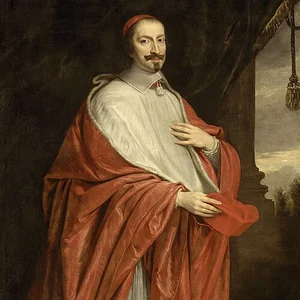

Cardinal and chief minister of state of France, he governed the kingdom during Louis XIV's minority under the regency of Anne of Austria. Richelieu's successor, he signed the Treaties of Westphalia and overcame the Fronde to consolidate the monarchy.
Cardinal Mazarin(1602 — 1661)
Jules Mazarin
France, royaume de Naples
9 min read
Frequently asked questions
Key Facts
- 1602: Born in Pescina in the Papal States (present-day Italy)
- 1642: Succeeds Cardinal Richelieu as chief minister to Louis XIII and then to Anne of Austria
- 1648: Signs the Treaties of Westphalia, ending the Thirty Years' War and establishing French pre-eminence in Europe
- 1648–1653: Overcomes the Fronde, an uprising of parliamentarians and the high nobility against his authority
- 1661: Death of Mazarin; Louis XIV chooses to govern alone, opening the era of personal rule
Works & Achievements
A set of treaties negotiated under Mazarin's leadership, ending the Thirty Years' War and laying the foundations of modern international law. They established France as the foremost power on the continent and enshrined the principle of state sovereignty.
A peace treaty with Spain marking the end of the Franco-Spanish War and the transfer of Artois and Roussillon to France. It paved the way for the marriage of Louis XIV to Marie-Thérèse and confirmed the decline of Spanish power in Europe.
Mazarin opened his personal library to scholars as early as 1643, making it the first public library in France. It held more than 40,000 volumes and remains open to the public today at the Palais de l'Institut, quai de Conti in Paris.
In his will, Mazarin bequeathed 2 million livres to establish a college for young nobles from territories recently annexed by France. The institution, inaugurated after his death, would become the Institut de France.
A passionate music lover, Mazarin brought the first opera companies from Italy to the French court, notably for the performance of La Finta Pazza in 1645. He thereby helped introduce this new musical genre to France, paving the way for Lully's French opera.
By overcoming the Fronde and maintaining royal authority during Louis XIV's minority, Mazarin prepared the conditions for the Sun King's personal reign and French absolutism. His political legacy is inseparable from the building of the modern French state.
Anecdotes
Mazarin was an inveterate gambler, passionate about card games — lansquenet in particular. It is said he organized games even in moments of acute political crisis, seeing in this exercise of cunning a form of training for diplomacy. His opponents were scandalized, while he himself regularly invited the great lords of the kingdom to soften them up.
Born Giulio Raimondo Mazzarino in the Abruzzi, he never quite lost his Italian accent despite thirty years spent in France. This earned him endless mockery in the pamphlets of the time, known as 'mazarinades,' which ridiculed both his foreign origin and his fiscal policies. More than 5,000 of these pamphlets circulated in Paris during the Fronde.
Mazarin assembled one of the finest art collections in Europe, with more than 500 masterworks by Italian, Flemish, and Spanish painters — Titians, Raphaels, Veroneses. Upon his death, he bequeathed his library of over 40,000 volumes to the public, thereby founding the Bibliothèque Mazarine, France's first public library, open to readers since 1643.
During the Fronde of the Princes (1651), Mazarin was forced into exile outside the kingdom under pressure from his opponents. Far from relinquishing power, he continued to govern from abroad through daily, encrypted correspondence with Anne of Austria. He returned triumphantly to Paris in 1653, more powerful than before.
The marriage of Louis XIV to the Spanish Infanta Marie-Thérèse in 1660, sealed by the Treaty of the Pyrenees, was Mazarin's diplomatic masterpiece. He had previously given serious consideration to marrying the young king to his own niece, Marie Mancini, with whom Louis XIV was in love, before renouncing the idea for reasons of state — sacrificing family interest to the interest of the kingdom.
Primary Sources
I beg you to believe that I have no other interest than the service of the King and the good of the State, and that everything I do is solely to contribute to it as much as I possibly can.
One must let men's anger pass and then act with gentleness. Time is the best ally of the patient minister.
That there shall be a Christian, universal and perpetual peace, and a sincere, true and firm friendship between the contracting parties.
There shall henceforth be a good, firm, faithful and inviolable peace between the Most Christian King and the Catholic King, their heirs and successors, kingdoms and states.
He possessed gentleness, insinuation, and charm of mind; but he lacked that bedrock of integrity which is necessary to sustain great undertakings.
Key Places
Now home to the Bibliothèque nationale de France (Richelieu site, rue de Richelieu), this was the cardinal's Parisian residence, which he had decorated with extreme opulence by the finest craftsmen in Europe. He kept his fabulous art collection and working apartments here.
A royal residence on the outskirts of Paris where Mazarin frequently worked alongside Anne of Austria during the Regency. It was in this medieval fortress that the young Louis XIV first learned the rudiments of government.
City in the Holy Roman Empire where the Peace of Westphalia was signed in 1648, ending the Thirty Years' War. Mazarin directed the French negotiations through his plenipotentiaries Servien and d'Avaux.
A small island in the Bidasoa river where Mazarin personally negotiated the Treaty of the Pyrenees in 1659 with Don Luis de Haro, the Spanish minister of Philip IV. It was one of the last great diplomatic acts of his life.
Birthplace of Giulio Mazzarino in 1602, in the Kingdom of Naples then under Spanish rule. His humble and foreign origins were constantly held against him by his French adversaries, who made them a cornerstone of their propaganda.
Institution founded by Mazarin's will to educate 60 young nobles from territories newly acquired by France (Artois, Alsace, Roussillon, Pinerolo). Now the Institut de France, it houses the Académie française and stands facing the Louvre.
Typical Objects

The bright red skullcap and cassock of a cardinal were the visible markers of Mazarin's ecclesiastical rank, worn during audiences and official ceremonies. Remarkably, he was never ordained a priest, which earned him sharp criticism from the rigorist clergy.

Hundreds of official documents, coded letters, and treaties formed the heart of his daily work. Mazarin was renowned for the precision of his legal formulations, and his correspondence — nine volumes published in the 19th century — remains a major historical source.

Mazarin was passionate about lansquenet, a card game highly favored at European courts in the 17th century. He played it both for relaxation and as an exercise in cunning, regularly inviting the great nobles of the realm to negotiate outside the official framework.

His personal collection numbered more than 500 works of art — Titian, Raphael, Veronese, Rubens — making it one of the finest private collections in Europe. Part of it was dispersed at his death but contributed to enriching the French royal collections.

The richly decorated carriage was both a symbol of power and a daily means of transport between the Palais Mazarin, the Louvre, and Vincennes. During the Fronde, the cardinal's carriages were vandalized by the Parisian crowd as a sign of revolt.

Mazarin amassed an immense personal fortune estimated at nearly 35 million livres at his death, one of the largest in France. He managed his finances with the same meticulous care as affairs of state, which earned him accusations of personal enrichment.
School Curriculum
Vocabulary & Tags
Key Vocabulary
Daily Life
Morning
Mazarin rose early, often before dawn, to read the diplomatic dispatches that had arrived overnight. He would then receive his secretaries and dictate his correspondence in French and Latin — sometimes in Italian for Roman affairs — before making his way to the royal apartments for the king's morning levee.
Afternoon
The afternoon was devoted to the King's Council, held with regent Anne of Austria, followed by audiences granted to foreign ambassadors and the great lords of the realm. Mazarin practiced the art of negotiation with calculated patience and gentleness, preferring persuasion to direct confrontation.
Evening
Evenings were often spent at court, attending card games, theatrical performances, or opera shows, of which Mazarin was a great enthusiast. He brought the first Italian opera troupes to France and helped make music an instrument of royal prestige.
Food
Mazarin appreciated refined cuisine, shaped by his Italian origins and the gastronomic traditions of the French court. He received ambassadors and dignitaries at his table during carefully orchestrated diplomatic dinners, accompanied by fine wines, using the meal itself as a tool of negotiation.
Clothing
He wore the cardinal's dress: a soutane and bright red skullcap, with a purple silk mantle (*ferraiolo*) for public ceremonies. In the privacy of his study, he wore dark velvet garments adorned with fine lace — a reflection of his immense personal fortune and his taste for Italian luxury.
Housing
Mazarin resided primarily in his Parisian palace (now the Richelieu site of the BnF), which he had decorated with extraordinary splendor. He also occupied apartments at the Louvre and Vincennes, always keeping close to the royal family in order to exercise his influence on a daily basis.
Historical Timeline
Period Vocabulary
Visual Style
Le baroque français du milieu du XVIIe siècle, entre faste ecclésiastique et luxe aristocratique : rouge cardinal, ors et velours sombres, clairs-obscurs à la Philippe de Champaigne, collections de maîtres italiens aux murs.
Sound Ambience
Une ambiance feutrée de cabinet ministériel parisien au XVIIe siècle, mêlant le silence studieux du travail diplomatique aux rumeurs de la cour, aux échos de la rue en temps de Fronde et aux premières notes de l'opéra italien importé d'Italie.
Liens externes & ressources
Références
Œuvres
Traités de Westphalie
1648
Traité des Pyrénées
1659
Fondation de la Bibliothèque Mazarine
1643
Fondation du Collège des Quatre-Nations (legs testamentaire)
1661
Consolidation de la monarchie absolue
1643-1661