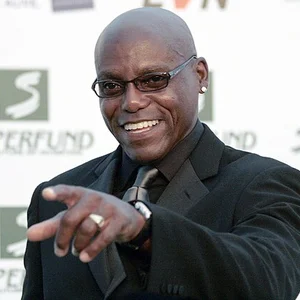

Carl Lewis is an American athlete who specialized in sprinting and the long jump. Regarded as one of the greatest athletes in history, he won nine Olympic gold medals between 1984 and 1996.
Carl Lewis(1961 — ?)
Carl Lewis
États-Unis
6 min read
Frequently asked questions
Key Facts
- Born on July 1, 1961, in Birmingham, Alabama (United States).
- Won 4 gold medals at the 1984 Los Angeles Olympic Games (100 m, 200 m, long jump, 4x100 m relay), matching Jesse Owens's feat from 1936.
- Unbeaten in the long jump for a decade, he claimed Olympic gold in this event at four consecutive Games (1984, 1988, 1992, 1996).
- Amassed a total of 9 Olympic gold medals and 8 world championship titles over the course of his career.
- Awarded the 100 m gold medal from Seoul 1988 after Ben Johnson was disqualified for doping.
Works & Achievements
Four gold medals (100 m, 200 m, long jump, relay), a feat matching that of Jesse Owens in 1936.
Set at the World Championships in Tokyo, this record confirmed Lewis as the fastest sprinter of his era.
Unmatched dominance of the event across four Olympic Games, from Los Angeles to Atlanta.
Ten years of unbeaten competition, one of the greatest winning streaks in the history of athletics.
In Helsinki, Lewis won the 100 m, the long jump and the relay, establishing himself as the star of the sport.
An account of his career and ambitions, in which he reflects on the legacy of Jesse Owens.
Recognition by the International Olympic Committee of his entire exceptional career.
Anecdotes
At the 1984 Los Angeles Olympic Games, Carl Lewis won four gold medals (100 m, 200 m, long jump and 4×100 m relay). In doing so, he matched the legendary feat of his idol **Jesse Owens**, achieved at the **1936** Berlin Games.
At the 1988 Seoul Games, Lewis finished second in the 100 m behind Canadian **Ben Johnson**. But Johnson was disqualified a few days later for doping, and Lewis was awarded the gold medal and the Olympic title.
In the long jump, Carl Lewis remained unbeaten in competition for ten years, from **1981** to **1991**, stringing together 65 consecutive victories. It is one of the longest unbeaten streaks in the history of athletics.
In **1996** in Atlanta, at nearly 35 years old, Lewis won his fourth consecutive Olympic title in the long jump, becoming one of the few athletes to dominate a single event across four Olympic Games.
After his sporting career, Carl Lewis tried his hand at singing and film, and even sang the American national anthem before some competitions. He later became a track and field coach at the **University of Houston**, where he had studied himself.
Primary Sources
“I wanted to be the best, just as Jesse Owens had been. Four gold medals in Los Angeles — that was my childhood dream come true.”
Carl Lewis (United States) wins the 100 m, the 200 m, the long jump and the 4×100 m relay, equalling Jesse Owens's tally of four titles in 1936.
Ben Johnson is disqualified after testing positive for stanozolol; the 100 m gold medal is reassigned to Carl Lewis.
Key Places
City in the southern United States where Carl Lewis was born in 1961, into a family of athletics coaches.
Texas institution where Lewis studied and trained under Tom Tellez; he would later return as a coach.
Stadium of the 1984 Olympic Games where Lewis won his first four gold medals, matching Jesse Owens.
Site of the 1988 Games where Lewis was awarded the 100 m title after Ben Johnson's disqualification for doping.
Venue of the 1992 Games where Lewis triumphed in the long jump and the 4×100 m relay.
Stadium of the 1996 Games where Lewis, at nearly 35, claimed his ninth and final Olympic gold.
Typical Objects

Lightweight shoes fitted with metal spikes under the sole, designed for grip on the track. Lewis used them for both sprinting and the long jump.

A hollow tube that runners pass to one another during the 4×100 m relay. Its fast, precise handoff is decisive for the team's victory.

The supreme reward given to the winner of an Olympic event. Carl Lewis won nine of them over the course of his career.

A fixed marker from which the athlete launches before landing in a sand pit where the length of the jump is measured. Lewis dominated here for more than ten years.

A timing device accurate to the hundredth of a second, connected to the photoelectric cells at the finish line. It made Lewis's records official, such as his 9.86 s in the 100 m.

Adjustable wedges fixed to the ground against which the sprinter braces at the start. They allow an explosive push off as soon as the starting gun fires.
School Curriculum
Vocabulary & Tags
Key Vocabulary
Tags
Daily Life
Morning
A top-level athlete's day, like Lewis's, began early with a muscle warm-up, stretching and a carbohydrate-rich breakfast. This was often followed by a first training session focused on running technique or speed work on the track.
Afternoon
The afternoon was set aside for strength training, long jump exercises and run-up repetitions on the takeoff board. Under the guidance of his coach Tom Tellez, every movement was filmed and analyzed to gain hundredths of a second.
Evening
In the evening, the focus shifted to recovery: massages, treatments, a balanced meal and rest. Lewis also pursued other passions, such as music and fashion, which took his mind off the pressure of competition.
Food
Throughout his career, Lewis followed a tightly controlled diet, rich in carbohydrates and lean protein. Toward the end of the 1980s, he even experimented with a largely vegan diet, which he felt benefited his performance.
Clothing
On the track, he wore the lightweight jersey and shorts of the United States team, along with his running spikes. Away from the stadiums, Lewis took care of his image and enjoyed elegant, fashionable clothing.
Housing
A professional athlete based in the United States, notably in the Houston area, he lived in modern comfort suited to the demands of training. His life was paced by travel to major meets and international competitions.
Historical Timeline
Period Vocabulary
Liens externes & ressources
Références
Œuvres
Quadruplé olympique de Los Angeles
1984
Record du monde du 100 m (9 s 86)
1991
Quatre titres olympiques consécutifs au saut en longueur
1984-1996
Série de 65 victoires consécutives en longueur
1981-1991
Triple titre aux premiers championnats du monde
1983
Autobiographie « Inside Track »
1990
Titre de « Sportif du siècle » (CIO)
1999