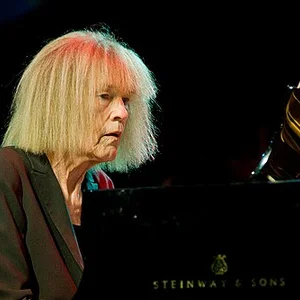

Carla Bley (1936-2023) was an American jazz composer, pianist, and bandleader. A leading figure of the avant-garde, she left her mark on free jazz and large-ensemble composition, notably with her jazz opera *Escalator over the Hill*.
Carla Bley(1936 — 2023)
Carla Bley
États-Unis
5 min read
Frequently asked questions
Key Facts
- Born on May 11, 1936, in Oakland, California, under the name Lovella May Borg
- Co-founded the Jazz Composer's Orchestra with Michael Mantler in 1964
- Composed *Escalator over the Hill*, a vast jazz opera, between 1968 and 1971
- Founded the WATT label and the New Music Distribution Service in the 1970s
- Died on October 17, 2023, in Willow, New York State
Works & Achievements
A composition that became a jazz standard, covered and reinterpreted by many musicians.
A “dark opera without words” suite written for vibraphonist Gary Burton, which revealed her talent as a composer.
Politically engaged arrangements written for bassist Charlie Haden, blending jazz with protest songs.
A monumental jazz opera set to a libretto by Paul Haines, a pinnacle of the avant-garde and Bley's most famous work.
An album under her own name blending jazz, funk and humor, asserting her own distinctive world.
A work for a very large orchestra, a testament to her mastery of big band writing.
Her final studio album, a trio with Andy Sheppard and Steve Swallow, of great restraint.
Anecdotes
Born Lovella May Borg in Oakland, California, Carla Bley grew up in a family where music was everywhere: her father was a piano teacher and church organist. Largely self-taught, she left school very young to devote herself to music and jazz.
As a teenager, she moved to New York and found a job selling cigarettes at Birdland, the city's most famous jazz club. Pacing the room every night, she listened to the greatest musicians of the era: a true street education in jazz.
Her stage name came from her first husband, the pianist Paul Bley, who was among the first to record and champion her compositions. Even after they separated, she kept the name, which had become a signature in the jazz world.
With “Escalator over the Hill,” she composed a vast “jazz opera” recorded over several years and released as a triple album in 1971. Bringing together dozens of musicians and singers, the work is one of the most ambitious in the history of jazz.
Refusing to depend on the major record labels, she co-founded her own independent label, WATT, as well as a distribution service for musicians. She wanted artists to keep control of their own music.
Primary Sources
“Escalator over the Hill,” subtitled “a chronotransduction”: music by Carla Bley set to a libretto by the poet Paul Haines, released as a three-record box set.
An album composed entirely by Carla Bley for vibraphonist Gary Burton, presented as “a dark opera without words.”
Carla Bley wrote the arrangements and several compositions for this politically committed album by bassist Charlie Haden, including the piece “Song for Che.”
Key Places
City where Lovella May Borg, the future Carla Bley, was born in 1936, into a family of musicians.
In New York, she started out as a cigarette girl at the Birdland club before establishing herself in the jazz avant-garde.
A hamlet in the Catskill Mountains where she lived and composed for many years, and where she died in 2023.
Home of the ECM label, which distributed her WATT label and with which she recorded and toured across Europe for decades.
Typical Objects

Carla Bley's instrument of choice, used both for composing and for performing within her ensembles.

She loved the electric organ, whose tones color many of her big band recordings.

A demanding composer and arranger, she wrote complex scores for large ensemble by hand.

“Escalator over the Hill” was released as a three-record box set, a rare and ambitious format.

At the head of her big bands, she led the musicians on stage like a true conductor.
School Curriculum
Vocabulary & Tags
Key Vocabulary
Tags
Daily Life
Morning
In the morning, Carla Bley devoted herself to composition, often alone at the piano, jotting her ideas down on music paper. She worked slowly and with exacting standards, endlessly refining her scores.
Afternoon
Afternoons could be spent on the meticulous writing of arrangements for large orchestra, or managing her independent label WATT and organizing tours.
Evening
Evenings were often shaped by concerts and rehearsals with her ensembles. On tour, she took to the stage to conduct her big band in front of festival audiences.
Food
Like many touring musicians, her eating habits depended on hotels, restaurants, and the backstage areas of concert halls. At home in the countryside, she returned to simpler, more regular cooking.
Clothing
She dressed in a relaxed and unconventional way, far removed from the strict dress codes of the classical stage. Her abundant, curly blonde hair had become a true visual signature.
Housing
She lived in Willow, a hamlet in the Catskill Mountains north of New York, in a house surrounded by nature. This peaceful setting served her both as a home and a composition studio.