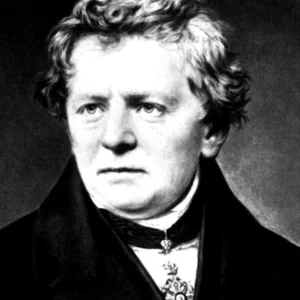

German physicist (1787-1854) who discovered the fundamental relationship between voltage, current, and electrical resistance. His law, formulated in 1827, became one of the foundational laws of electricity and bears his name.
Georg Ohm(1789 — 1854)
Georg Simon Ohm
royaume de Bavière
6 min read
Frequently asked questions
Key Facts
- 1787: Born in Erlangen, Germany
- 1827: Formulation of Ohm's Law (V = R × I), establishing the relationship between voltage, resistance, and current
- 1849: Appointed professor at the University of Munich
- 1854: Died in Munich
Works & Achievements
Foundational work in which Ohm states his law relating voltage, current, and resistance (U = R × I). This book is considered the birth of electric circuit theory.
Ohm's first major paper, presenting his experimental measurements on the conductivity of metals and laying the groundwork for his subsequent research.
Paper in which Ohm proposes a theoretical model of galvanic phenomena, an intermediate step toward the definitive formulation of his law.
Ohm's later work on molecular physics and crystallography, demonstrating the breadth of his scientific interests beyond electricity.
Physics textbook written by Ohm as a companion to his university lectures in Munich, synthesizing his knowledge of experimental physics.
Anecdotes
Georg Ohm published his famous law in 1827 in a work titled «Die galvanische Kette, mathematisch bearbeitet». Yet his work was largely ignored, even ridiculed, by the German scientific community of the time, which considered his approach too mathematical for experimental physics.
Disappointed by the lack of recognition in Germany, Ohm resigned from his professorship in Cologne in 1828 and lived for several years in near-poverty, giving private lessons to survive. It was not until 1841, when the Royal Society of London awarded him the Copley Medal, that his genius was finally recognized internationally.
To carry out his experiments on electrical resistance, Ohm manufactured his own conducting wires of various lengths and thicknesses. He used thermoelectric cells rather than voltaic cells, as they provided a more stable current, which allowed him to obtain precise measurements.
Georg Ohm's father, Johann Wolfgang Ohm, was a locksmith but a passionate self-taught learner. He personally taught mathematics and science to his sons Georg and Martin, the latter also becoming a recognized mathematician. This paternal education was decisive in shaping Georg's scientific vocation.
Ohm had to wait until 1852, just two years before his death, to finally obtain a chair in physics at the University of Munich. He was 65 years old by then and was only briefly able to enjoy this belated recognition in his own country.
Primary Sources
The electromotive force acting between the ends of any portion of a circuit is the product of the current intensity by the resistance of that portion of the circuit.
Ohm presents his first systematic measurements of the conductivity of different metals, laying the experimental foundations of his fundamental law.
In this article, Ohm proposes an initial theoretical model linking voltage to the electroscopic phenomena observed in galvanic circuits.
The Royal Society recognises the remarkable research of Mr. Ohm on the laws of electric current in circuits, works of fundamental importance to the science of electricity.
Key Places
Ohm's birthplace where he grew up, studied, and earned his doctorate at the university. It was here that his father passed on to him his passion for science.
Ohm taught there from 1817 to 1828 and conducted the foundational experiments that led to the formulation of his law in 1827.
The city where Ohm finally obtained a university chair in 1852 and spent his final years. He is buried there in the Southern Cemetery.
Ohm taught at the polytechnic school there from 1833, finding a degree of professional stability after his years of precarious employment.
The institution that recognised Ohm's genius before his own country did, awarding him the Copley Medal in 1841.
Typical Objects

Ohm used this type of pile to obtain a stable and reproducible current source, essential to the precision of his electrical measurements.

A measuring instrument used to detect and quantify the intensity of electric current flowing through a circuit. Ohm used it to verify his mathematical hypotheses.

Ohm manufactured and tested copper, silver, and other metal wires of varying lengths and diameters to measure their respective resistance.

A precision measuring device used in 19th-century physics laboratories to quantify small forces such as those related to electrical phenomena.

Ohm meticulously recorded all his measurements and calculations, translating his observations into rigorous mathematical formulas.

A common calculation tool among 19th-century scientists, used by Ohm to perform the mathematical operations required to develop his theory.
School Curriculum
Vocabulary & Tags
Key Vocabulary
Daily Life
Morning
Georg Ohm rose early, often before dawn, to prepare his mathematics and physics lessons. He would review his notes and prepare the experimental demonstrations he would present to his students. A frugal breakfast of black bread, butter, and coffee accompanied this morning preparation.
Afternoon
The afternoon was devoted to teaching at the secondary school and, later, at the university. After his classes, Ohm would retreat to his modest laboratory to conduct his experiments on electrical circuits, meticulously measuring voltages and currents with his hand-made instruments.
Evening
In the evenings, Ohm worked on writing up his theoretical work, translating his experimental observations into mathematical formulas. He also corresponded with other scientists and read recent publications. His social life was modest; he never married and lived very simply.
Food
Ohm's diet was that of a modest German academic of the 19th century: rye bread, potatoes, soups, sauerkraut, sausages, and Bavarian beer. His limited income, especially during his years of hardship after 1828, left little room for culinary indulgence.
Clothing
Ohm wore the plain attire of a German professor of the Biedermeier era: a dark frock coat, waistcoat, white high-collared shirt, and knotted cravat. In winter, he added a thick overcoat to face the Bavarian cold. His dress was neat but without any particular elegance.
Housing
Ohm lived for many years in modest lodgings, often rented rooms close to his places of work. In Cologne, he had a room serving as a laboratory on the premises of the Jesuit secondary school. Only late in life, in Munich, did he enjoy more comfortable accommodation tied to his university chair.
Historical Timeline
Period Vocabulary
Visual Style
Style d'illustration naturaliste évoquant les gravures scientifiques du XIXe siècle, avec des tons chauds de cuivre et de bois dans une atmosphère de laboratoire Biedermeier.
Sound Ambience
Ambiance feutrée d'un laboratoire de physique allemand du début du XIXe siècle, entre crépitements électriques, grattement de plume et bruits lointains d'une ville bavaroise.
Liens externes & ressources
Références
Œuvres
Die galvanische Kette, mathematisch bearbeitet
1827
Bestimmung des Gesetzes, nach welchem Metalle die Kontaktelektrizität leiten
1825
Versuch einer Theorie der durch galvanische Kräfte hervorgebrachten elektroskopischen Erscheinungen
1826
Beiträge zur Molekular-Physik
1849
Grundzüge der Physik als Compendium zu seinen Vorlesungen
1854