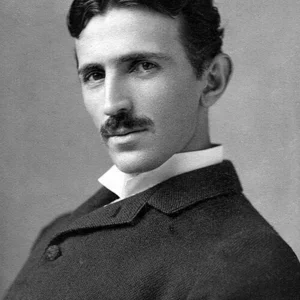

Serbian-American inventor and engineer (1856-1943), Nikola Tesla is one of the central figures of the electrical revolution. His work on alternating current and his technological innovations transformed modern electricity and energy transmission.
Nikola Tesla(1856 — 1943)
Nikola Tesla
États-Unis, empire d'Autriche, Pays de la Couronne de saint Étienne
8 min read
Frequently asked questions
Famous Quotes
« Energy in the universe is constant; it only changes form.»
« Imagination is more important than knowledge.»
« If you want to find the secrets of the universe, think in terms of energy, frequency and vibration.»
Key Facts
- 1887: invents the alternating current induction motor, revolutionizing industrial use of electricity
- 1891: patents the electrical transformer, essential for long-distance electricity distribution
- 1893: successfully demonstrates alternating current energy transmission at the World's Columbian Exposition in Chicago
- 1895: establishes the first hydroelectric power plant at Niagara Falls, a pioneer in industrial electricity generation
- 1901-1902: undertakes the Wardenclyffe Tower project for wireless energy transmission
Works & Achievements
Fundamental invention that made it possible to industrially harness alternating current to drive machines. This motor is the basis of nearly all modern electrical equipment.
A set of patents describing the production, transmission, and use of polyphase alternating current, acquired by Westinghouse. This system is still the one used in electrical grids worldwide.
A resonant transformer producing very high voltages at high frequency. Invented for his research on wireless transmission, it is used today in radio transmitters, medicine, and science education.
The world's first large-scale alternating current power plant, supplying the city of Buffalo 35 km away. Its commissioning in 1896 proved the viability of long-distance electrical energy transmission.
Tesla filed the first foundational patents on radio transmission before Marconi. The United States Supreme Court recognized in 1943 the priority of his patents over the invention of radio.
A giant experimental device built in Colorado Springs, capable of transmitting electrical energy wirelessly. Tesla successfully lit 200 light bulbs located 40 km away without any cables.
A titanic project aimed at creating a worldwide wireless communication and energy distribution system. Although never completed, it anticipated by several decades the idea of a global communications network.
Anecdotes
Tesla had an extraordinary photographic memory and could conceive and test his inventions entirely in his mind before building them. He claimed he never needed to draw his plans on paper, visualizing every mechanical detail with perfect precision.
During the 'War of Currents' against Thomas Edison in the 1880s–1890s, Tesla and his partner Westinghouse had to convince the public that alternating current was safe. Edison, seeking to discredit his rival, had animals publicly electrocuted using alternating current, but Tesla ultimately prevailed: it was indeed his system that powered the World's Columbian Exposition in Chicago in 1893.
In 1899, Tesla set up a laboratory in Colorado Springs and produced artificial lightning bolts over 30 meters long, accompanied by thunder audible 24 kilometers away. He managed to light 200 lamps wirelessly at a distance of 40 kilometers, demonstrating for the first time the wireless transmission of electrical energy.
Tesla developed an intense phobia of pearl earrings and an obsession with the number 3: he would always walk three times around a building before entering it, and demanded 18 clean towels (a multiple of 3) in his hotel room every day. These behaviors, now associated with obsessive-compulsive disorder, both fascinated and unsettled those around him.
Toward the end of his life, Tesla lived in relative poverty at the Hotel New Yorker, devoting his final years to feeding the pigeons of New York, which he cared for with an almost maternal dedication. He died alone in his room on January 7, 1943, leaving behind thousands of patents and a body of scientific work that continued to shape the modern world.
Primary Sources
My discoveries came to me intuitively. The experiments I conducted in my dreams were just as real to me as those I carried out in my laboratory.
All the energy available to man comes from the sun. Our existence depends on our food resources and on the way we harness the natural forces surrounding us.
I am able to transmit wireless messages to any point on the globe, to supply electrical energy to any location on Earth without the use of conducting wires.
While working with high-frequency alternating currents, I discovered phenomena of an entirely novel nature, opening a vast field of investigation for engineers and physicists.
Key Places
Nikola Tesla's birthplace, where he grew up in a Serbian Orthodox family. His father was a priest and his mother, a woman of great intelligence, encouraged his passion for science from an early age.
It was in his New York laboratories that Tesla developed most of his major inventions between 1887 and 1895. A devastating fire destroyed his Houston Street laboratory in 1895.
Site of the world's first alternating current hydroelectric power plant (1895), built using Tesla and Westinghouse's patents. This achievement definitively sealed the victory of alternating current.
Where Tesla set up an experimental laboratory in 1899 for his research on wireless energy transmission. His experiments produced spectacular artificial lightning and caused power outages throughout the city.
The site of Tesla's grand project: a 57-meter tower intended to transmit energy and communications wirelessly across the entire world. Due to lack of funding, the project was abandoned and the tower demolished in 1917.
Tesla's residence in his final years, where he lived in room 3327 from 1933. It was in this room that he died on January 7, 1943, alone and in poverty despite the immensity of his life's work.
Typical Objects

A high-frequency resonant transformer invented by Tesla in 1891, capable of producing very high voltages. It is one of his most iconic instruments, still used today in experimental physics.

A major invention by Tesla (1882-1888), this motor uses a rotating magnetic field to convert electrical energy into mechanical energy. It now powers the vast majority of industrial electrical appliances.

Tesla used vacuum tubes carrying high-frequency currents for his spectacular demonstrations. These experiments foreshadowed future work on fluorescent lamps and X-rays.

Electrical machines producing alternating current, at the heart of Tesla's invented system. The alternators at the Niagara power plant, designed according to his patents, were able to supply the city of Buffalo with electricity in 1896.

Tesla meticulously recorded his experiments in personal notebooks. These documents, partially preserved today, bear witness to the breadth and rigor of his scientific research.

A giant apparatus built in Colorado Springs, capable of transmitting electrical energy wirelessly over great distances. Tesla considered it his greatest invention.
School Curriculum
Vocabulary & Tags
Key Vocabulary
Tags
Daily Life
Morning
Tesla woke early and began his day with a series of rigorous physical exercises he practiced with great discipline. He ate a light breakfast, often warm milk and honey, before heading to his laboratory at dawn to take advantage of the morning silence conducive to reflection.
Afternoon
His afternoons were entirely devoted to experimentation in his laboratory, where he supervised his assistants and conducted tests on his electrical machines. Tesla was known to work relentlessly, sometimes 18 to 20 hours at a stretch, losing all track of time once an experiment had absorbed him.
Evening
In the evenings, Tesla often dined alone at Delmonico's restaurant in New York, where he was a creature of habit and always insisted on the same table. He spent his evenings writing scientific articles, corresponding with colleagues and financiers, or conceptualizing new inventions in his hotel room.
Food
Tesla was an extremely frugal and selective eater: he was particularly fond of milk, honey, vegetables, and fruit juices, and avoided red meat, which he considered harmful to longevity. Toward the end of his life, he subsisted almost exclusively on warm milk and vegetable juices, convinced that this austere diet sustained his intellectual vitality.
Clothing
Tesla always wore impeccably tailored three-piece suits, generally black or dark gray, with a tie and top hat. He placed great importance on his appearance and regarded elegant dress as a sign of respect for those he dealt with, even when working in his laboratory.
Housing
Tesla spent most of his adult life in New York hotels, preferring that independence to domestic life. He lived successively at the Waldorf-Astoria, the Hotel Marguery, and finally the Hotel New Yorker, where he resided until his death in a carefully organized room that grew increasingly sparse as his financial difficulties mounted.
Historical Timeline
Period Vocabulary
Visual Style
Un univers visuel dramatique d'obscurité industrielle percée par des éclairs électriques bleutés, associant la rigueur du portrait photographique de la Belle Époque à la majesté inquiétante de laboratoires remplis de machines à haute tension.
Sound Ambience
L'univers sonore de Tesla mêle le crépitement des étincelles électriques à haute tension, le bourdonnement des dynamos et des bobines résonnantes, dans des laboratoires industriels traversés par l'énergie brute de la révolution électrique.
Liens externes & ressources
Références
Œuvres
Moteur à induction à courant alternatif (brevet n°381 968)
1888
Système polyphasé de distribution d'électricité
1888
Bobine de Tesla (Tesla Coil)
1891
Centrale hydroélectrique du Niagara (conception)
1895
Système de radio (brevet fondateur)
1897
Magnifying Transmitter (émetteur amplificateur)
1899
Projet Wardenclyffe (tour mondiale de transmission d'énergie)
1901-1905