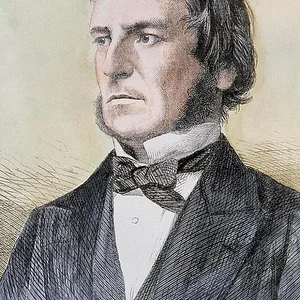

19th-century British mathematician and logician, founder of Boolean algebra. He revolutionized logic by translating it into a mathematical system, laying the foundations of modern computing.
George Boole(1815 — 1864)
George Boole
Royaume-Uni
6 min read
Frequently asked questions
Key Facts
- 1847: Publication of 'The Mathematical Analysis of Logic', the first work to formalize logic as a mathematical system
- 1854: Publication of 'An Investigation of the Laws of Thought', a landmark work establishing Boolean algebra
- Development of a logical system using AND, OR, and NOT operators, enabling logical propositions to be treated as equations
- 1849: Appointed Professor of Mathematics at Queen's College, Cork
- His algebra became the theoretical foundation for logic circuits and digital computing in the 20th century
Works & Achievements
First work in which Boole proposes to treat logic as a branch of mathematics, introducing an algebraic system to represent logical reasoning.
Boole's masterwork, in which he fully develops his logical algebra. This treatise lays the foundations of what is today called Boolean algebra, the basis of modern computing.
Article published in the Philosophical Transactions of the Royal Society, concerning the calculus of differential operators. This work earned him the Royal Medal of the Royal Society.
Influential university textbook on differential equations, widely used in British higher education for several decades.
Companion volume to the previous work, dealing with the calculus of finite differences, which was also a standard reference textbook in universities.
Anecdotes
George Boole was largely self-taught. Born into a modest shoemaker's family in Lincoln, England, he taught himself Latin, Greek, French and German as a teenager by borrowing books from the local library. At 16, he was already teaching at a school to support his family.
In 1849, Boole was appointed the first professor of mathematics at Queen's College in Cork, Ireland, despite holding no university degree. His reputation rested solely on his mathematical publications, which had been noticed by scholars such as Augustus De Morgan, who strongly encouraged him in his work.
Boole died at just 49 years old under circumstances often retold. In November 1864, he walked through the rain to Queen's College and delivered his lecture soaking wet. He contracted pneumonia. His wife Mary Everest Boole, an advocate of hydrotherapy, is said to have wrapped him in wet sheets, which reportedly worsened his condition.
Boolean algebra, regarded as an abstract curiosity during his lifetime, did not find its major application until nearly a century later. In 1937, Claude Shannon demonstrated in his master's thesis at MIT that Boolean algebra could be used to design electrical circuits, paving the way for modern computing.
Primary Sources
We might justly assign it as the definitive character of a true Calculus, that it is a method resting upon the employment of Symbols, whose laws of combination are known and general, and whose results admit of a consistent interpretation.
The design of the following treatise is to investigate the fundamental laws of those operations of the mind by which reasoning is performed; to give expression to them in the symbolical language of a Calculus.
De Morgan wrote to Boole to congratulate him on his 1847 work, acknowledging that his method of reducing logic to an algebraic system represented a major breakthrough in the field.
Key Places
George Boole's hometown where he grew up, taught himself, and opened his first school. He lived there until his appointment in Ireland.
Irish university where Boole was appointed its first professor of mathematics in 1849. He taught there until his death and produced his major works there.
Residential neighbourhood of Cork where Boole lived with his family. It was in his house in Ballintemple that he died in December 1864.
Burial place of George Boole, where his grave is still visible today and is the subject of commemorative visits.
Prestigious scientific institution that awarded Boole its gold medal in 1844, recognising his exceptional mathematical contributions.
Typical Objects

Boole's everyday tools for his mathematical demonstrations in class and for his personal research. He used them extensively at Queen's College Cork.

Writing instruments with which Boole drafted his treatises, scientific correspondence, and articles for mathematical journals.

Essential reference works for 19th-century mathematicians, which Boole consulted and used in his calculations.

Boole had taught himself these languages from adolescence. These classical works bear witness to his thirst for universal knowledge.

An everyday accessory that Boole should have taken on the fateful day in November 1864 when he walked through the rain to Queen's College.

Boole maintained an extensive correspondence with mathematicians such as Augustus De Morgan, exchanging ideas and proofs by letter.
School Curriculum
Vocabulary & Tags
Key Vocabulary
Tags
Daily Life
Morning
George Boole rose early in his house in Ballintemple, near Cork. After a frugal breakfast, he walked to Queen's College to deliver his mathematics lectures. He prepared his demonstrations carefully, mindful of the clarity of his teaching.
Afternoon
The afternoon was devoted to his personal research in logic and mathematics. Boole worked in his college office or at home, filling pages with calculations and reasoning. He also kept up his correspondence with other mathematicians, notably Augustus De Morgan.
Evening
In the evenings, Boole spent time with his family — his wife Mary and their five daughters. He read widely, both scientific works and philosophy and classical literature. He would sometimes work late into the night on his manuscripts by the light of an oil lamp.
Food
Boole's diet was typical of the Victorian middle class: porridge in the morning, roast meat or stew with vegetables at midday and in the evening, accompanied by bread and tea. Irish cuisine of the era remained simple and wholesome.
Clothing
Boole dressed according to the Victorian conventions expected of a university professor: dark frock coat, waistcoat, white shirt with a high collar and cravat, and wool trousers. He wore a top hat or bowler hat when going out.
Housing
The Boole family lived in a Georgian house in Ballintemple, a residential neighbourhood of Cork. The home included a study where Boole worked, a drawing room, and bedrooms for the family. Heating was provided by coal fireplaces.
Historical Timeline
Period Vocabulary
Visual Style
Un style visuel victorien académique, mêlant l'architecture néogothique du Queen's College de Cork, des intérieurs studieux éclairés au gaz, et l'atmosphère pluvieuse et verdoyante de l'Irlande du XIXe siècle.
Sound Ambience
L'ambiance sonore évoque l'atmosphère studieuse du Queen's College de Cork au milieu du XIXe siècle, entre cours magistraux, recherches solitaires et la vie quotidienne d'une ville irlandaise victorienne.
Liens externes & ressources
Références
Œuvres
The Mathematical Analysis of Logic
1847
An Investigation of the Laws of Thought
1854
A Treatise on Differential Equations
1859
A Treatise on the Calculus of Finite Differences
1860