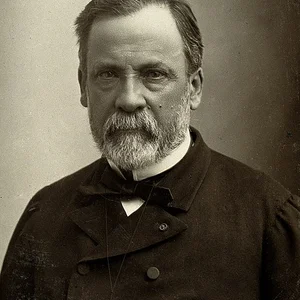

French chemist and biologist (1822–1895), founder of modern microbiology. He demonstrated the role of microorganisms in diseases and fermentation, revolutionizing medicine and hygiene. His discoveries led to the development of vaccines and pasteurization.
Louis Pasteur(1822 — 1895)
Louis Pasteur
France
7 min read
Frequently asked questions
Famous Quotes
« Chance favors the prepared mind.»
« There is no science without passion.»
Key Facts
- 1858: demonstrates that fermentation is caused by living microorganisms
- 1876: establishes the link between microbes and infectious diseases (germ theory)
- 1881: creates the first rabies vaccine and successfully tests its effectiveness
- 1885: vaccinates Joseph Meister, a child bitten by a rabid dog, saving him from death
- Develops pasteurization, a heating technique to eliminate microbes in food and drinks
Works & Achievements
By demonstrating that fermentations are caused by living microorganisms rather than purely spontaneous chemical processes, Pasteur laid the foundations of microbiology and modern medicine.
Pasteur definitively proved that a sterile liquid does not spontaneously spoil if the air entering it is filtered, putting an end to a scientific controversy several centuries old.
A moderate heating technique used to destroy pathogenic microorganisms in wine, beer, and milk. This method revolutionized food preservation and is still universally used today.
By discovering that an aged and weakened culture of the cholera bacillus immunized chickens against the disease, Pasteur generalized Jenner's principle of vaccination and opened the way for modern vaccinology.
Developed and publicly tested at Pouilly-le-Fort, this vaccine saved millions of livestock animals and spectacularly demonstrated the validity of the principle of vaccination using attenuated agents.
The first successful application of a rabies vaccine on a human, administered to Joseph Meister. This landmark discovery, celebrated worldwide, brought Pasteur international renown and led to the founding of the Institut Pasteur.
Anecdotes
In 1885, Joseph Meister, a 9-year-old boy bitten by a rabid dog, was brought to Pasteur. Although not a physician, Pasteur took the risk of administering his experimental rabies vaccine to the child. The boy survived, and this recovery made Pasteur famous throughout the world.
Pasteur was obsessed with hand cleanliness and systematically refused to shake anyone's hand, even dignitaries and ministers. This habit, considered strange by his contemporaries, was in fact consistent with his discoveries about the transmission of germs.
During a spectacular public experiment at Pouilly-le-Fort in 1881, Pasteur vaccinated a flock of sheep against anthrax in front of hundreds of witnesses. Twenty-four vaccinated animals survived, while the unvaccinated controls all died. The public was astounded.
After his first stroke in 1868, Pasteur remained partially paralyzed on his left side. Despite this disability, he continued his research with remarkable energy and made some of his greatest discoveries in this condition, dictating his observations to his assistants.
Pasteur harbored a fierce hatred toward Prussia following the war of 1870 and the loss of Alsace-Lorraine. He returned his honorary doctorate diploma to the University of Bonn and always refused to accept German honors, declaring that science had no homeland, but the scientist did.
Primary Sources
I have sought to demonstrate, through experiments I believe to be irrefutable, that spontaneous generation does not exist; that under present circumstances, inert matter never gives rise to life.
We have found that cultures of this microbe, after aging in air, lose their virulence while retaining their culture properties, and that animals inoculated with these attenuated cultures subsequently resist inoculation with virulent cultures.
Joseph Meister, aged 9, had been bitten on the hand, legs, and thighs in 14 places, so deeply that walking was difficult for him. The most serious bites were 60 hours old. The death of this child seemed inevitable; I resolved, not without acute and painful anxiety, to try on Joseph Meister the method that had consistently succeeded in dogs.
Heating wine to a temperature between 55 and 60 degrees Celsius destroys the ferments that cause its spoilage, without appreciably altering its taste qualities. This method constitutes a practical and effective means of preservation.
Key Places
Birthplace of Louis Pasteur, born on December 27, 1822. His childhood home is now a museum retracing his early years and beginnings.
Pasteur completed his higher studies there, then taught and set up his first major laboratory. It is here that he conducted his decisive research on spontaneous generation.
Founded in 1888 through an international public subscription, this institute is the crowning achievement of Pasteur's career. He spent his final years there and is buried in a magnificent crypt.
Village where Pasteur carried out his famous public vaccination experiment against anthrax on sheep in 1881, before the eyes of the press and the international scientific community.
Town where Pasteur grew up and to which he returned every summer to recharge. He owned a house there that is now a museum, and it is where he suffered his first stroke in 1868.
Typical Objects

A glass flask with a long curved neck designed by Pasteur to demonstrate that it is the dust in the air, not the air itself, that causes putrefaction. These sealed flasks still contain sterile broths preserved to this day at the Institut Pasteur.

A central tool in Pasteur's laboratory, it allowed him to observe yeasts, bacteria, and parasites. It was through the microscope that he identified the corpuscles responsible for silkworm diseases.

An instrument used to vaccinate animals and patients, which became a symbol of Pasteurian preventive medicine. The syringe used to treat Joseph Meister against rabies is preserved as a scientific relic.

A device for bringing liquids to a controlled temperature, essential to the development of pasteurization for milk, wine, and beer. It also allowed microbes to be attenuated in order to create vaccines.

Pasteur kept very detailed handwritten notebooks of all his experiments. His notebooks, held at the Bibliothèque nationale de France, reveal the rigor and method of his scientific work.

Pasteur studied alcoholic fermentation at the request of brewers and winemakers. Analysis of these liquids allowed him to demonstrate that fermentation is the result of the activity of living microorganisms.
School Curriculum
Vocabulary & Tags
Key Vocabulary
Daily Life
Morning
Pasteur rose early and devoted his mornings to reviewing the results of experiments started the day before. He would dictate his observations to his assistants while examining his cultures under the microscope. Methodological rigor guided his every action from the very start of the day.
Afternoon
Afternoons were dedicated to active experiments: inoculations, heat treatments, comparative observations. Pasteur personally supervised each protocol and intervened directly in the most delicate manipulations. He also received colleagues, journalists, and sometimes notable figures who came to visit his laboratory.
Evening
Evenings were often devoted to drafting memoirs and scientific papers for the Académie des sciences. Pasteur was deeply attached to his family and regularly dined with his wife Marie Laurent, who also assisted him in transcribing his work. He read extensively from foreign scientific publications.
Food
Pasteur led a sober bourgeois life, eating at fixed times a traditional regional French cuisine, with a preference for dishes from the Jura. He drank wine in moderation, which did not prevent him from scientifically studying wine diseases. After his stroke, his diet was simplified on medical advice.
Clothing
Pasteur wore the typical attire of a bourgeois scholar of the Second Empire and the Third Republic: a black or dark grey buttoned frock coat, dark tie, and white shirt with a stiff collar. In the laboratory, he wore a lab coat to protect his clothes. His appearance was neat and reflected the seriousness of his social standing.
Housing
Pasteur lived for many years in a service apartment at the École Normale Supérieure in Paris, with his family. His summers were regularly spent at his house in Arbois, in the Jura, which he cherished deeply. At the end of his life, he resided at the Institut Pasteur, in an apartment specially arranged for him, where he died in 1895.
Historical Timeline
Period Vocabulary
Visual Style
Peinture académique française réaliste du XIXe siècle, avec des tons chauds et sombres, des instruments scientifiques précis et une atmosphère de rigueur intellectuelle caractéristique du positivisme de l'époque.
Sound Ambience
L'atmosphère sonore feutrée d'un laboratoire parisien du XIXe siècle, mêlant tintements de verrerie, flammes de bec Bunsen et grattements de plumes, avec en fond le brouhaha de la ville haussmannienne.
Liens externes & ressources
Références
Œuvres
Théorie germinale des maladies infectieuses
1857-1863
Réfutation de la génération spontanée (expériences des fioles à col de cygne)
1859-1861
Pasteurisation
1863
Vaccin contre le choléra des poules
1880
Vaccin contre le charbon
1881
Vaccin contre la rage
1885