 flip
The Club's Green Jam (Powder-Free Version)
The Club's Green Jam (Powder-Free Version)
Why this dish? At the Hôtel Pimodan on the Île Saint-Louis, Baudelaire frequented the Club des Hachichins, where they tasted "dawamesk," a perfumed green jam. He described its effects in *Les Paradis artificiels*. Here, we evoke ONLY the treat — without any substance: a sweet almond and pistachio paste, to understand the imaginary of those evenings without reproducing the danger.
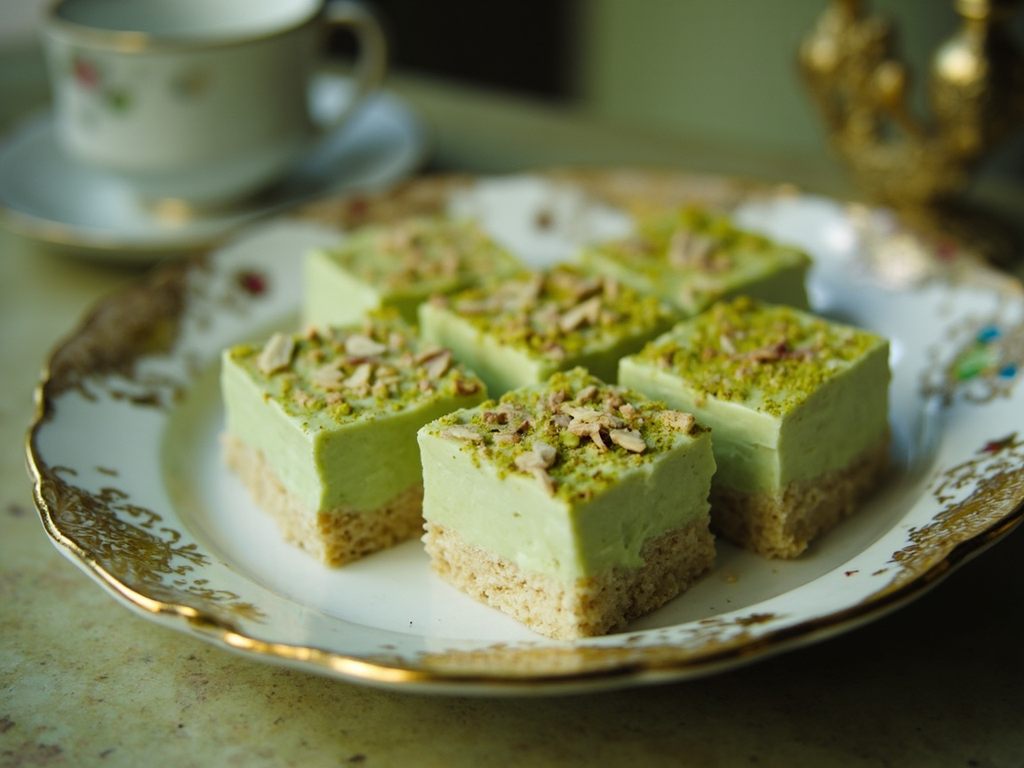
A sweet pale green paste of almond and pistachio, perfumed with orange peel, cinnamon, and nutmeg. A gourmet and harmless evocation of the famous "green jam" of the Romantic cenacles — without the original drug.
At the Hôtel Pimodan, we formed a cenacle of curious minds about artificial paradises. We were presented with a green jam, perfumed with orange and pistachio, in which the drug of dreams was hidden. Here, I give you the setting without the poison: the same sweetness of almond and cinnamon, the same emerald green, but which will carry you nowhere but to pure palate pleasure. Taste it from the tip of the spoon, dreaming of chimeras — it is wiser, and just as delectable.
- •Pistachio and almond paste — equal parts (green base)
- •Sugar — to bind (sweetness and preservation)
- •Fresh butter — a little (softness)
- •Candied orange peel — a few pieces (flavor)
- •Cinnamon, nutmeg — a pinch (spices)
- •Orange blossom water — a few drops (flavor (in place of musk))
The Club's Green Jam (Powder-Free Version)
A sweet pale green paste of almond and pistachio, perfumed with orange peel, cinnamon, and nutmeg. A gourmet and harmless evocation of the famous "green jam" of the Romantic cenacles — without the original drug.
Why this dish? At the Hôtel Pimodan on the Île Saint-Louis, Baudelaire frequented the Club des Hachichins, where they tasted "dawamesk," a perfumed green jam. He described its effects in *Les Paradis artificiels*. Here, we evoke ONLY the treat — without any substance: a sweet almond and pistachio paste, to understand the imaginary of those evenings without reproducing the danger.
At the Hôtel Pimodan, we formed a cenacle of curious minds about artificial paradises. We were presented with a green jam, perfumed with orange and pistachio, in which the drug of dreams was hidden. Here, I give you the setting without the poison: the same sweetness of almond and cinnamon, the same emerald green, but which will carry you nowhere but to pure palate pleasure. Taste it from the tip of the spoon, dreaming of chimeras — it is wiser, and just as delectable.
Ingredients (period version)
- Pistachio and almond paste — equal parts (green base)
- Sugar — to bind (sweetness and preservation)
- Fresh butter — a little (softness)
- Candied orange peel — a few pieces (flavor)
- Cinnamon, nutmeg — a pinch (spices)
- Orange blossom water — a few drops (flavor (in place of musk))
Ingredients
- Blanched unsalted pistachios — 100 g (green base and flavor)
- Almond powder — 100 g (binder)
- Powdered sugar — 120 g (sweetness)
- Softened unsalted butter — 30 g (softness)
- Candied orange peel, chopped — 40 g (flavor)
- Ground cinnamon — 1/2 tsp (spice)
- Grated nutmeg — 1 pinch (spice)
- Orange blossom water — 1 tsp (flavor)
Method
- Blend the pistachios into a fine powder (reserve a spoonful for decoration).
- Mix the pistachio powder, almond powder, powdered sugar, cinnamon, and nutmeg.
- Add the softened butter, chopped candied orange peel, and orange blossom water; knead until a homogeneous green paste forms (add a drop of water if needed).
- Roll out the paste to 1.5 cm thick, sprinkle with crushed pistachios, and let firm up in the fridge for 1 hour.
- Cut into small squares and serve in a small dish, from the tip of the spoon. No substance enters this recipe: it is simply a sweet treat.
How it was made : The historical dawamesk was a green paste mixing hashish, sugar, orange juice, pistachios, almonds, cinnamon, nutmeg, and musk, consumed at the Club des Hachichins (Hôtel Pimodan, 1840s) under the observation of Dr. Moreau de Tours. This educational version retains only the gourmet flavors and completely omits the drug: it serves to understand a page of literary history, not to relive it.
The contemporary twist : Roll the squares in crushed pistachios and present them under the name "Green Dreams" on a porcelain dish, like a curiosity from a Romantic cabinet.
Sources : Charles Baudelaire, *Les Paradis artificiels* (1860) · Théophile Gautier, "Le Club des Hachichins," *Revue des Deux Mondes* (1846)
Charles Baudelaire · Charactorium