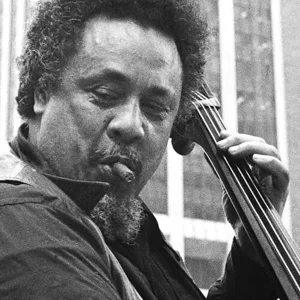

Charles Mingus (1922-1979) was an American jazz double bassist, composer, and bandleader. A major figure in modern jazz, he is renowned for his virtuoso playing and his ambitious compositions blending gospel, blues, and collective improvisation.
Charles Mingus(1922 — 1979)
Charles Mingus
États-Unis
6 min read
Frequently asked questions
Famous Quotes
« Making the simple complicated is commonplace; making the complicated simple, awesomely simple, that's creativity.»
Key Facts
- Born in 1922 in Nogales, Arizona, he grew up in Los Angeles
- Recorded the major album “Mingus Ah Um” in 1959, one of his masterpieces
- Composed “Goodbye Pork Pie Hat” (1959), a tribute to saxophonist Lester Young
- Committed to the civil rights struggle, he composed “Fables of Faubus” (1959), denouncing segregation
- Died in 1979 in Cuernavaca, Mexico, suffering from ALS (Lou Gehrig's disease)
Works & Achievements
An early composition recorded by Lionel Hampton's big band, already revealing Mingus's talent as a composer.
A recording of the Toronto concert bringing together the greatest names in bebop, released on Debut Records, the label co-founded by Mingus.
A manifesto album in which Mingus asserts his style; the title track tells in music the rise and then the fall of humankind.
His most famous record, which contains “Goodbye Pork Pie Hat,” a tribute to saxophonist Lester Young, and “Fables of Faubus,” a satire of a segregationist governor.
A vast composition for large ensemble, conceived as a ballet, regarded as one of the high points of orchestral jazz.
An unbridled, partly fictionalized autobiography in which Mingus recounts his life, his rages, and his contradictions.
An ambitious album blending jazz and orchestra, which Mingus considered his finest record.
Anecdotes
Charles Mingus is one of the very few musicians the great Duke Ellington ever fired from his orchestra. In 1953, a violent backstage quarrel with trombonist Juan Tizol — Mingus reportedly brandished a cleaver — hastened his departure after only a few weeks. Ellington dismissed him with an icy politeness that has remained famous.
In 1953, Mingus took part in a legendary concert in Toronto alongside Charlie Parker, Dizzy Gillespie, Bud Powell, and Max Roach, sometimes called “the greatest jazz concert in history.” Finding the sound of his double bass too faint on the tape, he re-recorded his own parts in the studio before releasing the record on Debut Records, the label he had just co-founded.
In 1959, Mingus composed “Fables of Faubus” to ridicule Orval Faubus, the governor of Arkansas who had opposed the admission of Black students to a high school in Little Rock. His record label, Columbia, refused to record the lyrics, deeming them too provocative: Mingus had to release a sung version the following year with another publisher.
Late in his life, Mingus was struck by amyotrophic lateral sclerosis (also known as “Lou Gehrig's disease”), which gradually paralyzed him and kept him from playing. Refusing to fall silent, he kept composing by humming his melodies, which assistants notated for him.
According to his wife Sue, on the day Mingus died in Mexico in January 1979, fifty-six whales beached themselves on a nearby shore. And the musician was exactly fifty-six years old. This unsettling coincidence has become one of the legends attached to his memory.
Primary Sources
“In other words, I am three. One man stands forever in the middle, unconcerned, unmoved, watching, waiting to be allowed to express what he sees to the other two.”
“Oh, Lord, don't let 'em shoot us! Don't let 'em stab us!” then, in dialogue form: “Name me someone who's ridiculous, Dannie. — Governor Faubus! Why is he so sick and ridiculous? — Because he won't permit integrated schools.”
“Let my children hear music.” — Mingus's call for living music, played by real musicians.
Key Places
Border town in the southern United States where Charles Mingus was born in 1922.
Working-class neighborhood where Mingus grew up and received his first music lessons.
Jazz capital where Mingus lived, composed, and performed in clubs such as the Five Spot and the Village Vanguard.
Venue where the legendary 1953 bebop concert took place, featuring Parker, Gillespie, Powell, and Roach.
Mexican city where Mingus, gravely ill, died on January 5, 1979.
Sacred river where his ashes were scattered, according to his wish.
Typical Objects

The instrument of his whole life; Mingus drew from it a powerful, singing tone that made him one of the greatest bassists in jazz.

Mingus alternated between pizzicato playing (plucked strings) and the bow to make his double bass sing like a human voice.

Mingus composed at the piano and even recorded a solo album, “Mingus Plays Piano,” in 1963.

The vinyl records of Debut Records, the label he co-founded in 1952, allowed him to release his music while staying in control of his artistic choices.

Mingus filled sheets of staff paper with complex compositions, even though he often passed his parts along by ear.

His autobiography, published in 1971, in which he lays out his turbulent vision of the world and of music.
School Curriculum
Vocabulary & Tags
Key Vocabulary
Tags
Daily Life
Morning
Having gone to bed late after his nighttime concerts, Mingus often woke up in the late morning. His first waking hours were devoted to composing: he would sit down at the piano in his New York apartment to search for themes and jot down ideas.
Afternoon
Afternoons were spent rehearsing with his “Jazz Workshop.” Rather than handing out sheet music, Mingus would sing or play the parts to his musicians so they could learn them by ear, constantly reworking the arrangements. He also had to run his label, Debut Records, and manage contracts with the clubs.
Evening
In the evening, Mingus took to the stage in New York jazz clubs such as the Five Spot or the Village Vanguard. His concerts, intense and unpredictable, could last for hours; he was known to stop a piece midway to scold an audience that was talking too much.
Food
Mingus had a hearty appetite and loved the rich cooking of the American South. His weight fluctuated dramatically throughout his life, swinging between indulgent eating and strict diets.
Clothing
On stage, like most jazzmen of his era, he wore a dark suit, shirt, and tie. Away from the concerts, his imposing figure was often recognizable by a hat and a more casual style of dress.
Housing
Mingus lived in apartments and lofts in Manhattan, depending on his sometimes precarious finances. In 1966, he was even evicted from his New York home, a scene captured in a documentary made about him.