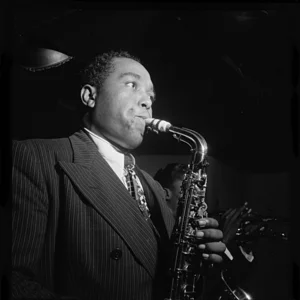

Charlie Parker, nicknamed “Bird,” was an American alto saxophonist and composer. With Dizzy Gillespie, he founded bebop in the late 1940s, revolutionizing jazz through his virtuosity and harmonic sense. His dazzling career was cut short by addiction.
Charlie Parker(1920 — 1955)
Charlie Parker
États-Unis
6 min read
Frequently asked questions
Famous Quotes
« Master your instrument, master the music, and then forget all that shit and just play.»
Key Facts
- Born on August 29, 1920, in Kansas City, Missouri, the cradle of a thriving jazz scene.
- In the 1940s, he founded bebop with Dizzy Gillespie—a fast, harmonically complex style of jazz.
- Recorded tunes that became standards, such as “Ornithology,” “Now's the Time,” and “Confirmation.”
- In 1949, the Birdland club opened in New York, named after his nickname “Bird.”
- Died on March 12, 1955, in New York, at just 34 years old, worn down by addiction.
Works & Achievements
A dazzling improvisation over the chord changes of “Cherokee,” often regarded as the birth of bebop on record.
An upbeat blues written by Parker, one of his most-covered tunes; it later inspired the hit “The Hucklebuck.”
A composition built on the chord progression of the standard “How High the Moon”; its title plays on his nickname “Bird.”
A melodic, refined tune, another nod to his nickname, which became a classic of the jazz repertoire.
A composition renowned for its crystal-clear melodic line despite its complex harmony, studied by every jazz musician.
A series of recordings in which Parker improvises backed by a string orchestra, broadening bebop's audience.
A recording of the Toronto concert that brought together the greatest names in bebop, often called “the greatest jazz concert ever given.”
Anecdotes
As a teenager in Kansas City, young Charlie joined a jam session alongside seasoned musicians. He lost the tempo, and the drummer Jo Jones, annoyed, threw a cymbal that crashed at his feet with a great clatter to make him stop. Humiliated, Parker spent the following summer working on his saxophone for hours on end: it was that shame that would forge his relentless drive.
The nickname “Bird” reportedly came to him on the road, while he was touring with Jay McShann's orchestra. The car is said to have run over a stray chicken (a “yardbird” in American slang); Parker insisted on stopping, picking up the fowl, and having it cooked for dinner. “Yardbird” became “Bird,” a name that stuck with him for the rest of his life.
In December 1939, in a small Harlem restaurant, Parker was improvising on the tune “Cherokee” with a guitarist. Suddenly, he realized that by leaning on the highest notes of the chords, he could finally play the music he heard in his head. “I came alive,” he would later recount: that night foreshadowed bebop.
In 1949, a jazz club opened in New York, near 52nd Street. It was named “Birdland” in Parker's honor: he was one of the very few musicians to have seen, in his own lifetime, a famous venue bear his nickname.
Parker died in 1955 at just 34 years old, his body worn out by addiction. The doctor who examined his remains estimated his age at between 50 and 60. Soon after, a now-legendary graffiti began appearing on the walls of New York: “Bird Lives.”
Primary Sources
I'd been getting bored with the stereotyped chord changes that were being used all the time. I found that by using the higher intervals of a chord as a melody line and backing them with appropriately related changes, I could play the thing I'd been hearing. I came alive.
I really did put a lot of work into the instrument, that's true. I used to put in at least eleven to fifteen hours a day, for three or four years.
An improvisation recorded over the chord changes of the standard “Cherokee,” played at an extremely fast tempo with Dizzy Gillespie and Max Roach; regarded as the sonic manifesto of bebop.
Key Places
The city where Parker grew up and made his debut in the clubs: a true jazz laboratory in the 1930s.
A Harlem club where, during late-night jam sessions, Parker and his companions developed bebop.
Nicknamed “The Street,” this avenue lined with jazz clubs was the heart of Parker's New York career.
The institution where Parker was committed for several months in 1946-1947 after a serious breakdown; he later composed “Relaxin' at Camarillo” there.
A jazz club opened in 1949 and named in his honor, which became one of the genre's shrines.
The place where Charlie Parker passed away in March 1955, in the apartment of a friend and patron.
Typical Objects

The instrument inseparable from Parker, from which he drew phrases of unheard-of speed and fluidity. It was on the alto that he invented the vocabulary of bebop.

An alto saxophone made of acrylic resin, a rare and recognizable object, which Parker notably played during the Massey Hall concert in 1953.

A small blade of cane fixed onto the mouthpiece that vibrates to produce sound; the saxophonist goes through many of them and takes great care in choosing them.

The format of Parker's first recordings for Savoy and Dial, which spread bebop across all of America.

Bebop musicians, Parker among them, took care with their elegance on stage, wearing fitted suits, neckties, and polished shoes.

The illuminated sign of the famous New York club named after his nickname, a symbol of his renown during his lifetime.
School Curriculum
Vocabulary & Tags
Key Vocabulary
Tags
Daily Life
Morning
Like many club musicians, Parker lived on a schedule opposite to everyone else's: he slept through much of the morning after concerts that ended at daybreak. His late awakening marked the start of a day centered on music.
Afternoon
The afternoon was devoted to rehearsals, studio recording sessions, and reunions among musicians. As a teenager, he had developed the habit of practicing his saxophone for hours, a discipline he never truly lost.
Evening
In the evening, it was time for the clubs of 52nd Street or Harlem: Parker played several sets in a row before an audience that came to listen, not to dance. Improvised jam sessions often carried on until dawn.
Food
His nocturnal, irregular life meant meals snatched at all hours in restaurants open through the night. He was said to have a hearty appetite, but his lifestyle was chaotic and seriously damaged his health.
Clothing
On stage, Parker displayed the elegance of the jazzmen of his time: a tailored suit, shirt and tie, polished shoes. This careful attire asserted the dignity and seriousness of an art that was finally being recognized as great music.
Housing
His itinerant life as a musician took him from New York apartments to hotel rooms, depending on tours and financial hardship. He often stayed near the neighborhoods where he played, in a New York buzzing with energy.