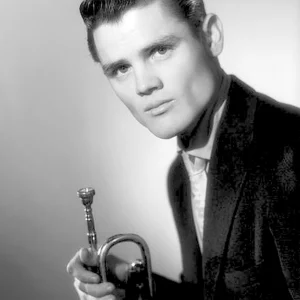

Chet Baker (1929-1988) was an American jazz trumpeter and singer, a major figure of West Coast cool jazz. His soft, lyrical trumpet tone and his fragile voice made him an icon, despite a life marked by addiction.
Chet Baker(1929 — 1988)
Chet Baker
États-Unis
6 min read
Frequently asked questions
Key Facts
- Born on December 23, 1929, in Yale (Oklahoma), he grew up in California
- Played in 1952 in Gerry Mulligan's piano-less quartet, which brought him to prominence
- Recorded the album “Chet Baker Sings” in 1954, popularizing his voice on “My Funny Valentine”
- His career was hampered by a long heroin addiction
- Died on May 13, 1988, in Amsterdam, after falling from a hotel window
Works & Achievements
Instrumental recording that launched his career; this standard would become his signature tune, which he played and sang throughout his life.
Album on which he sings himself in his fragile, androgynous voice; a record that became legendary, revealing a new side of the artist.
Standard he recorded in his intimate style; its title would give its name to the 1988 documentary.
Album of hushed ballads recorded with pianist Bill Evans for the Riverside label, a high point of cool jazz lyricism.
Album marking his comeback after difficult years, which revived public interest in his art.
Black-and-white portrait filmed just before his death, nominated for an Oscar, which cemented his image as a melancholy icon.
Anecdotes
In 1952, a young, almost unknown trumpeter auditioned for the legendary saxophonist Charlie Parker, nicknamed "Bird
who had come to play on the West Coast. Parker chose him for his California tour: Chet Baker, barely 22 years old, had just landed one of the most coveted spots in jazz. The story goes that Parker then warned Miles Davis and Dizzy Gillespie that a newcomer was about to put them in the shade.
That same year, Chet Baker joined Gerry Mulligan's quartet, a very unusual group because it had no piano at all. Their version of "My Funny Valentine" became a huge hit and established the "cool" sound: muted, relaxed, almost whispered, the opposite of the bubbling bebop of the East Coast.
In 1954, Chet Baker won the readers' poll of the famous magazine DownBeat in the best trumpeter category, beating out giants like Miles Davis and Dizzy Gillespie. With his matinee-idol looks, often compared to those of actor James Dean, he became a genuine star, as much for his music as for his appearance.
Around the mid-1960s, Chet Baker was violently assaulted and lost several teeth, which made playing the trumpet nearly impossible: a trumpeter needs his teeth to press against the mouthpiece. He had to wear dentures and patiently relearn how to play over several years before making his great comeback.
Chet Baker died on May 13, 1988, in Amsterdam, after falling from the window of his hotel room. That same year saw the release of the documentary "Let's Get Lost
filmed just before his death, which helped turn him into a legendary, melancholic figure of jazz.
Primary Sources
In it, Baker recounts his childhood and early days: his father, a musician, is said to have first given him a trombone, which was too big for him, before he took up the trumpet. The account speaks frankly about his life and his addiction.
The black-and-white film features long filmed interviews with Chet Baker shortly before his death, in which he talks about his music, his women, his tours and his years of drug use.
On this record, Baker himself sings standards like “My Funny Valentine” in his fragile, androgynous voice, which surprised people at a time when trumpeters almost never sang.
The poll named Chet Baker best trumpeter of the year, ahead of Miles Davis and Dizzy Gillespie, attesting to his meteoric fame in the mid-1950s.
Key Places
Small town where Chet Baker was born in 1929, in the heart of rural America hit hard by the Great Depression.
Town in the Los Angeles suburbs where Baker grew up after his family moved there in 1940.
Heart of the West Coast scene of the 1950s, with clubs like the Lighthouse, where Baker forged the sound of Californian cool jazz.
Tuscan city where Baker was imprisoned in 1960-1961 on drug charges.
One of the European capitals where he recorded and performed regularly during his long years of wandering across the Old Continent.
City where Chet Baker died in 1988 after falling from his hotel window; a commemorative plaque there keeps his memory alive.
Typical Objects

Chet Baker's instrument of choice, from which he drew a soft, round, lyrical tone that became a signature of cool jazz.

A small accessory placed in the bell of the trumpet to muffle and soften the sound, heightening the intimate atmosphere of his playing.

Baker sings in a very soft, almost whispered voice: the microphone is essential to capture this fragile thread of sound, as on “Chet Baker Sings.”

After losing his teeth in an assault, Baker wore a dental prosthesis and had to completely rebuild his embouchure in order to play again.

The LP that revealed to the public his dual identity as both trumpeter and singer, turning him into an icon.

An essential document for this wandering artist, expelled from several countries and spending most of his final years touring across Europe.
School Curriculum
Vocabulary & Tags
Key Vocabulary
Tags
Daily Life
Morning
A night musician, Chet Baker often sleeps late to recover from the previous evening's concerts. His mornings are quiet, sometimes spent working through a few muted phrases or sorting out questions of touring and contracts.
Afternoon
His afternoons may be taken up by recording sessions in the studio or rehearsals with his small group. On the West Coast of the 1950s, studios like those of Pacific Jazz capture his playing in very few takes, so immediate is his sense of melody.
Evening
The evening is the heart of his life: smoky jazz clubs and concerts that stretch late into the night, from the Lighthouse in Hermosa Beach to the cellars of Paris. It is onstage that he alternates between muted trumpet and whispered vocals before a captivated audience.
Food
His itinerant life and his addiction upend any regular eating habits. Meals are often grabbed on the go, between two concerts, in dressing rooms, bars, or hotel rooms.
Clothing
In the 1950s, his leading-man looks — a simple shirt, fitted trousers, sometimes a light jacket — and his face, compared to that of James Dean, feed his image as an icon. Later, his face marked by hardship contrasts with that lost youth.
Housing
From the 1960s onward, Baker no longer has a real permanent home. He lives at the mercy of his tours in hotel rooms across Europe, from Italy to the Netherlands, perpetually on the move.