
German pianist and composer
Clara Schumann(1819 — 1896)
Clara Schumann
royaume de Saxe
9 min read
Frequently asked questions
Key Facts
- Enfant prodige, Clara Wieck donne son premier concert public à Leipzig à l'âge de 9 ans (1828) et est considérée comme l'une des plus grandes pianistes de son époque.
- Elle épouse le compositeur Robert Schumann en 1840, après une longue bataille juridique contre son père qui s'opposait à cette union.
- Compositrice prolifique, elle écrit son Concerto pour piano en la mineur (op. 7) à seulement 14 ans, une œuvre exceptionnelle pour son âge.
- À la mort de Robert Schumann (1856), elle devient la principale interprète et promotrice de son œuvre, tout en élevant leurs sept enfants et en poursuivant sa carrière de concertiste.
- Elle enseigne au Conservatoire de Francfort (Hoch'sches Konservatorium) de 1878 jusqu'à la fin de sa vie, formant une génération entière de pianistes européens.
Works & Achievements
Composed when Clara was only sixteen years old, this concerto is a remarkably mature work that bears witness to her precocious genius. It was premiered at the Gewandhaus in Leipzig under the direction of Felix Mendelssohn.
These lyrical and intimate pieces reveal Clara's talent as a composer, blending virtuosity with emotional depth. They were dedicated to Robert Schumann and bear witness to their blossoming love.
A large-scale work, this sonata demonstrates Clara's mastery of classical musical forms. It was premiered privately and remained little known for a long time before being rediscovered and recorded in the 20th century.
Composed as a tribute to her husband, these variations form a loving dialogue between the two composers — Robert had himself written variations on the same theme. It is one of Clara's most personal and most touching works.
After her husband's death, Clara devoted decades to establishing the definitive edition of his scores, published by Breitkopf & Härtel. This monumental musicological undertaking made her the first recognized critical editor in the history of classical music.
These songs for voice and piano, published under Robert Schumann's name — who insisted on signing them jointly — were in fact composed by Clara. Their reattribution to Clara by 20th-century musicologists was an act of historical justice.
Anecdotes
Clara Schumann gave her first major public concert in Leipzig at the age of nine, in 1828, at the Gewandhaus — one of the most prestigious concert halls in Europe. Her father Friedrich Wieck had trained her with relentless rigor since she was four, imposing hours of daily exercises and an exceptional training regimen.
Robert Schumann, her future husband, had to take Friedrich Wieck to court to obtain the right to marry her in 1840. Clara's father fiercely opposed the union, going so far as to make slanderous accusations against Robert before the tribunal. Clara, aged twenty, courageously chose to support Robert against her father's wishes.
After Robert Schumann's death in 1856, Clara refused to remarry and devoted the rest of her life to promoting her husband's work. She edited his scores, organized his archives, and performed his compositions across Europe for forty years, becoming the foremost guardian of his musical legacy.
Clara Schumann was a close friend of Johannes Brahms, who deeply admired her and dedicated several of his works to her. Their friendship, which began in 1853 when Brahms was twenty and Clara thirty-four, lasted until the pianist's death in 1896 — Brahms himself died just a few months later, in 1897.
To finance her eight children and support her family during Robert's periods of illness, Clara undertook relentless concert tours across Europe, sometimes performing several evenings in a row in different cities. She was among the first artists to perform from memory on stage, without a score placed on the piano — a practice that was revolutionary at the time.
Primary Sources
«I cannot live without music; it is for me the air I breathe. Even in the darkest days, the piano remains my refuge and my truest language.»
«You are for me the most complete pianist I have ever heard, not only for your technique, but for the soul you put into every note. I love you as I love music itself.» — letter from Robert to Clara, 1838.
«Miss Wieck played her father's variations with a confidence and depth of expression that surpass anything one could expect from an artist of her age. She is already, at sixteen, an accomplished pianist.»
«You are for me the greatest living musician, and your judgment on my works is the one I respect most in the world. Without your support, I would not have had the courage to publish my first sonata.»
«Clara Schumann plays Bach with a severity and clarity that makes all other pianists seem superficial. She understands that music is architecture before it is feeling.»
Key Places
It was in this legendary concert hall that Clara gave her first major public concert in 1828 at the age of nine. The Gewandhaus was the temple of German classical music, and triumphing there meant entering the European musical elite.
Clara was born and grew up in Leipzig, the city of Bach and the musical capital of 19th-century Germany. Her birthplace at the Hohe Lilie is today a memorial site bearing witness to the musical ferment of that era.
Clara taught there from 1878 to 1892, training an entire generation of European pianists according to her rigorous principles. Her teaching was so influential that people spoke of a "Clara Schumann school" whose impact was felt well into the 20th century.
It was in this psychiatric institution that Robert Schumann was committed from 1854 until his death in 1856. Clara, whom doctors discouraged from visiting him for two years, was only able to see him in the very last hours of his life.
Clara triumphed there at the age of nineteen and was appointed Imperial Court Pianist in 1838, a title that few foreign musicians, and even fewer women, had ever received. Vienna represented her international consecration.
Typical Objects

Clara Schumann used Bechstein grand pianos for her concerts and rehearsals. The instrument was an extension of her artistic personality, and she insisted that concert halls provide her with one of impeccable quality.

Clara meticulously annotated her scores with fingerings, dynamics, and interpretive markings. These working scores are now preserved in music archives and bear witness to her exceptional pedagogical rigor.

Invented in the early 19th century, the metronome was an indispensable teaching tool for Clara. She used it to discipline her students' tempo while insisting on the need to eventually break free from it in order to allow room for living musical expression.

Like all women of the Victorian era, Clara wore crinoline and later bustle gowns at her concerts — elaborate outfits that did not prevent her from executing the most technically demanding passages. Concert attire was an important component of artistic presentation.

Clara composed and corresponded using a goose-quill pen dipped in ink, as evidenced by her preserved letters. Her correspondence with Robert Schumann and Johannes Brahms amounts to thousands of handwritten pages of major musicological importance.

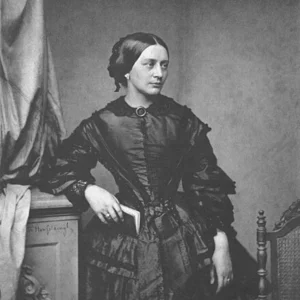
Clara Schumann lived through the invention of photography and was among the most photographed artists of her time. These portraits document her evolution, from the young prodigy with stern features shaped by her father to the mature and respected woman she became.
School Curriculum
Vocabulary & Tags
Key Vocabulary
Daily Life
Morning
Clara rose early and devoted the first hours of the morning to technical exercises at the piano — scales, arpeggios, work on difficult passages — before the children were awake. This morning discipline, instilled by her father from childhood, never left her. During the years when Robert was ill, she managed the family correspondence alone between these work sessions.
Afternoon
Afternoons were divided between rehearsing her concert repertoire, giving lessons to her private students, and maternal duties for her eight children. When on tour, afternoons were spent traveling by train or stagecoach, memorizing scores or writing letters. During her teaching years in Frankfurt, she corrected conservatory students with a demanding yet benevolent firmness.
Evening
Evenings were the time for concerts — either in public in grand halls, or in the private salons of the aristocracy and the educated bourgeoisie. At home, Clara and Robert loved playing four-hand pieces and hosting musician friends such as Brahms or Mendelssohn. After Robert's death, Clara's evenings became more solitary, devoted to reading and editing her scores.
Food
Clara's diet followed the habits of the 19th-century German bourgeoisie: rye bread, cold cuts, vegetable soups, potatoes, and meat in sauce. While on tour, she often ate frugally at inns or as a guest in private homes. Coffee was a central beverage in German intellectual life, and Clara consumed it regularly to sustain her long working days.
Clothing
Clara wore the fashions of her era: crinoline dresses in the 1840s–1860s, then bustle dresses in the 1870s–1880s, always in dark, austere fabrics reflecting her artistic seriousness. For concerts, she chose gowns in deep-colored silk or velvet — black, burgundy, dark green — with white lace collars. After Robert's death, she wore strict mourning dress for many years.
Housing
Clara lived in several cities throughout her life: Leipzig as a child, then Dresden, Düsseldorf, and finally Frankfurt. The Schumann households were spacious bourgeois apartments, with one or two pianos in the main drawing room. After her widowhood, Clara rented functional apartments near the Frankfurt conservatory — more modest but comfortable — surrounded by her scores, her portraits of Robert, and her voluminous correspondence.
Historical Timeline
Period Vocabulary
Visual Style
Esthétique romantique allemande du XIXe siècle, peinture académique aux tons chauds et profonds — salon bourgeois, lumière dorée, gravité élégante d'une femme artiste dans un monde d'hommes.
Sound Ambience
Atmosphère sonore du salon de concert romantique allemand du XIXe siècle, mêlant le piano à queue majestueux, les murmures du public cultivé et les bruits de rue de Leipzig ou Francfort.