
French composer and music critic
Hector Berlioz(1803 — 1869)
Hector Berlioz
France
8 min read
Frequently asked questions
Key Facts
- Hector Berlioz naît le 11 décembre 1803 à La Côte-Saint-André (Isère) et apprend la musique en autodidacte avant d'entrer au Conservatoire de Paris en 1826.
- Il compose la Symphonie fantastique en 1830, œuvre novatrice qui introduit le concept d'idée fixe et révolutionne la forme symphonique.
- Il remporte le prix de Rome en 1830, ce qui lui permet de séjourner en Italie et d'enrichir son inspiration musicale.
- Berlioz s'impose comme critique musical influent, collaborant notamment au Journal des débats pendant plus de trente ans, et publie son Traité d'instrumentation en 1844.
- Il meurt le 8 mars 1869 à Paris, laissant des œuvres majeures comme La Damnation de Faust (1846) et Les Troyens (1858), opéra monumental en cinq actes.
Works & Achievements
A masterpiece of musical Romanticism, this symphony in five movements depicts the hallucinations of a lovesick, desperate artist. It revolutionizes the symphonic form through the use of an 'idée fixe' and programmatic narrative.
A colossal work for orchestra and monumental choirs, commissioned by the State. It requires up to 400 performers and four brass orchestras positioned at the four corners of the performance space.
A symphony for solo viola and orchestra, inspired by Byron and the Italian landscapes. Commissioned by Paganini, it is a sonic tableau of dark and dreamy poetry.
A dramatic symphony for soloists, choirs and orchestra, freely adapted from Shakespeare. Brahms and Wagner were deeply influenced by it; Paganini hailed it as a masterpiece.
A dramatic legend in four parts for voices and orchestra, inspired by Goethe's Faust. Poorly received at its premiere, it became one of Berlioz's most performed works after his death.
A grand opera in five acts inspired by Virgil's Aeneid, Berlioz's most ambitious work. He was never able to see it performed in its entirety during his lifetime; Paris only staged the second part.
A landmark theoretical treatise on the expressive capabilities of each orchestral instrument. Translated throughout Europe, it remained a pedagogical reference still in use in the 20th century.
Anecdotes
At 22, Berlioz entered the Paris Conservatoire but immediately clashed with its director Luigi Cherubini, who barred him from the library for entering through the wrong door. This stormy encounter illustrates the persistent tensions between Berlioz and the Parisian musical establishment, which refused him the Prix de Rome four times before finally awarding it to him in 1830.
The Symphonie fantastique, composed in 1830, was inspired by Berlioz's obsessive passion for Irish actress Harriet Smithson, whom he had watched perform Shakespeare without ever having spoken to her. He transformed her into a musical 'idée fixe' running throughout the entire work. As fate would have it, he eventually married her in 1833, but the marriage proved a disaster.
Berlioz was a conductor of formidable standards: for the premiere of his Grande Messe des morts in 1837, he assembled more than 400 musicians and singers in the church of Les Invalides in Paris. When the guest conductor nearly missed a crucial entry, Berlioz leapt forward and took over the baton himself, saving the performance in extremis.
A great traveller, Berlioz was celebrated in Germany, Russia, and England long before gaining recognition in France. In Saint Petersburg in 1847, Tsar Nicholas I attended his concert and presented him with a diamond-set ring. Berlioz wrote that his European tours brought him more glory and money than his entire Parisian career combined.
Primary Sources
I saw Harriet Smithson for the first time in the role of Ophelia... It was a thunderbolt of unheard-of violence. I felt that my musical life was about to change course.
The orchestra can sing, pray, dream, weep. Each instrument has its own voice, a character, a soul that the composer must know as the painter knows his colours.
I want to make music such as has never been heard before. Not pleasant sounds, but true sounds, capable of expressing the most violent passions of the human soul.
Beethoven opened up a new world. After him, the symphony can no longer be mere entertainment: it must be a sonic drama, a confession, a cry of humanity.
Key Places
Berlioz's birthplace, where he spent his childhood and where his father, a physician, taught him music. Now home to the Festival Berlioz, founded in 1988.
Berlioz studied there from 1824 and experienced his first clashes with the institution. He won the Prix de Rome in 1830 after multiple failed attempts.
The main Parisian concert hall of the era, where several of his major works premiered, but also the stage of his many disappointments in the face of rejections or mutilations of his scores.
Residence of Prix de Rome laureates, where Berlioz stayed from 1831 to 1832. He was more captivated by the Italian landscapes than by academic life, drawing inspiration from these travels for Harold in Italy.
Site of the triumphant premiere of the Grande Messe des morts in 1837, with more than 400 performers assembled for a national ceremony honoring the victims of the Algerian War.
Typical Objects

Berlioz was one of the first French composers to conduct his own works with a baton, a practice still uncommon in France at the time. He theorized the role of the conductor as the sovereign interpreter of the score.

His manuscripts, covered in crossings-out and annotations, bear witness to an orchestral writing of unprecedented complexity for the era, with extremely precise dynamic and tempo markings.

Unlike most composers of his time, Berlioz did not play the piano but the guitar and the flute. He used the guitar to sketch his melodies and accompany his youthful songs.

A feared music critic at the Journal des Débats for thirty years, Berlioz wielded his pen with as much talent as his baton. His chronicles, often biting, earned him both admiration and enmity.

A regular attendee of opera and theatre performances, Berlioz observed stagings with close attention, seeking in visual drama inspirations for his compositions.

Won in 1830 after four attempts, this award allowed him to stay at the Villa Medici in Rome — a residency he nonetheless found disappointing, far from the effervescence of Paris.
School Curriculum
Vocabulary & Tags
Key Vocabulary
Daily Life
Morning
Berlioz rose early, often after restless nights due to his chronic insomnia. He devoted his mornings to composition, working at his desk covered in manuscripts in his Parisian apartment, frequently on rue de Calais. He drank strong coffee and smoked a pipe to sharpen his concentration.
Afternoon
His afternoons were often taken up by orchestral rehearsals, sometimes lasting six to eight hours at a stretch, during which his demanding standards exhausted the musicians. On days without rehearsals, he would make his way to the offices of the Journal des Débats to deliver his music criticism columns, which were his main steady source of income.
Evening
Evenings were for premieres, dinners at patrons' homes, or salons where Chopin, Liszt, Paganini, Victor Hugo, and Théophile Gautier would cross paths. Berlioz shone there through his passionate conversation, yet could sink into deep melancholy between bursts of enthusiasm.
Food
Berlioz ate frugally during periods of composition, frequently forgetting meals altogether. He appreciated simple bourgeois cooking — soups, braised meats, cheeses — and drank wine in moderation. During his time in Rome, he had developed a fondness for Italian wines and fresh pasta.
Clothing
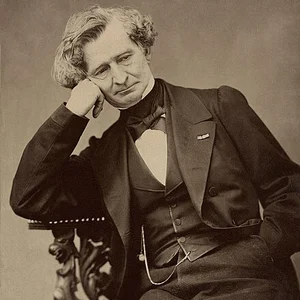
Berlioz wore the typical Romantic attire of his generation: dark frock coat, colourful waistcoat, lavallière cravat, top hat. He had an abundant, unruly head of hair that struck his contemporaries. When travelling, he favoured more practical clothing, including a large travelling cape.
Housing
He lived successively in several Parisian apartments, often modest despite his renown. His lodgings were cluttered with scores, books, instruments, and correspondence. In the final years of his life, he resided on rue de Calais in the 9th arrondissement, in an apartment he shared with his second wife Marie Recio.
Historical Timeline
Period Vocabulary
Visual Style
Le style visuel de l'univers Berlioz s'inscrit dans le romantisme de Delacroix : clair-obscur dramatique, couleurs profondes (grenat, bleu nuit, ocre), atmosphère de passion et de tourment.
Sound Ambience
L'univers sonore de Berlioz est celui des grandes salles parisiennes du XIXe siècle — orchestres massifs, cuivres puissants, timbales tonnerres — contrastant avec le bruissement feutré du public bourgeois et romantique.