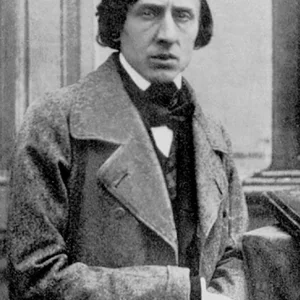

French-Polish composer and pianist
Frédéric Chopin(1810 — 1849)
Frédéric Chopin
duché de Varsovie, royaume du Congrès, Empire russe, France
7 min read
Frequently asked questions
Key Facts
- Né en 1810 dans le duché de Varsovie, Frédéric Chopin est considéré comme un enfant prodige : il donne ses premiers concerts publics dès l'âge de 8 ans.
- En 1830, il quitte définitivement la Pologne pour Paris, où il s'installe et devient l'un des pianistes et compositeurs les plus célèbres des salons romantiques.
- Il compose exclusivement ou presque pour le piano seul : préludes, nocturnes, mazurkas, polonaises et études, qui renouvellent profondément le répertoire pianistique.
- Sa relation avec l'écrivaine George Sand, de 1838 à 1847, marque durablement sa vie personnelle et créatrice ; ils séjournent notamment à Majorque en 1838-1839.
- Mort de la tuberculose à Paris en 1849, à l'âge de 39 ans, il est enterré au cimetière du Père-Lachaise, mais son cœur est rapporté en Pologne selon sa volonté.
Works & Achievements
A collection of twenty-four short pieces, one in each major and minor key. Regarded as a pinnacle of piano music, they synthesize the full expressive range of Chopin's art.
The first of four piano ballades, inspired by the epic Polish poetry of Adam Mickiewicz. It is one of the most dramatic and celebrated works in the Romantic repertoire.
Some twenty nocturnal pieces, dreamy and melancholic, that defined a musical genre. Chopin develops a unique pianistic lyricism of unparalleled expressiveness.
Dances of Polish patriotic inspiration, by turns heroic and melancholic. The Polonaise Op. 53 in A-flat major is nicknamed the "Heroic" and embodies the resilience of the Polish spirit.
More than fifty pieces inspired by Polish folk dances. They form Chopin's personal diary, steeped in nostalgia for his lost homeland.
This sonata contains the famous Funeral March, one of the most recognizable melodies in the world. It was played at Chopin's own funeral.
Anecdotes
Chopin gave only about thirty public concerts throughout his entire career, preferring to play in Parisian salons before small, carefully selected audiences. He suffered from acute shyness and fragile health that made large concert halls unbearable for him. Yet his private recitals dazzled the greatest minds of the era.
Upon his final departure from Poland in 1830, his friends presented him with an urn containing soil from his homeland. Chopin carried this precious vessel with him everywhere until his death, and Polish earth was scattered over his grave in Paris, in accordance with his last wishes.
Chopin had a turbulent and passionate relationship with the writer George Sand, who dressed as a man and smoked cigars — a provocation for the time. They lived together for nearly nine years, and it was during the winters in Majorca and the summers at Nohant, in the Berry region, that Chopin composed some of his most celebrated works.
Chopin was a highly sought-after piano teacher in Paris, giving lessons to high society to secure his income. He demanded impeccable technique from his students but detested gratuitous virtuosity and mechanical playing, always insisting on musical expression and subtlety of touch.
At his death in 1849, at only 39 years of age, Chopin requested that his heart be returned to Poland after his burial in Paris. His sister Ludwika fulfilled this wish: the composer's heart has since been preserved in a pillar of the Holy Cross Church in Warsaw, an eternal symbol of his attachment to his homeland.
Primary Sources
I am determined to leave, but when? That is what I do not yet know. Here I do nothing, there perhaps I will do something.
I am sick as a dog. Despite everything, my Prelude is almost finished. You will be pleased with the Ballade, the Scherzo, and the Preludes.
He had an exquisite nature, an incomparable genius, and angelic kindness; but his health was so delicate, his nerves so irritable, that he suffered from everything.
His playing was like a whispered confidence, of infinite gentleness, yet of absolute precision; each note seemed a sonorous pearl falling into silence.
The goal is not to play loudly or quickly, but to play with soul. The hand must adapt to the music, not the music to the hand.
Key Places
Chopin's birthplace in 1810, now converted into a museum. The family home, surrounded by a park, hosts open-air concerts every summer.
Chopin spent his final years at 12, Place Vendôme, one of the most elegant neighborhoods in Paris. He died there on October 17, 1849.
George Sand's estate where Chopin spent many summers between 1839 and 1846. It was there, in peaceful surroundings, that he composed the majority of his major works.
Chopin and George Sand spent the winter of 1838–1839 there under difficult conditions. Chopin completed his 24 Preludes there despite severely declining health.
Chopin is buried here, but his heart rests in Warsaw as per his wishes. His grave is one of the most visited in the cemetery and is always adorned with flowers.
Typical Objects

Chopin preferred pianos from the Parisian manufacturer Pleyel for their soft and velvety tone, ideal for his intimate style. He owned several and taught exclusively on these instruments.

Upon leaving Poland in 1830, his friends gave him an urn filled with soil from his homeland. Chopin kept it preciously until his death, a symbol of his exile and his unwavering attachment to his native country.

Chopin tirelessly corrected his manuscripts, scratching out, crossing over, and rewriting. His scores bear witness to an extreme perfectionism and a constant search for the right note.

Afflicted with tuberculosis since adolescence, Chopin lived surrounded by doctors, medicines, and the ineffective treatments of the era. His illness profoundly influenced his way of life and his work.

Chopin liked to compose at night, by candlelight, in the quiet and darkness. This habit of nocturnal work nourished the melancholic and introspective atmosphere of his music.

A Parisian dandy, Chopin wore white gloves and carefully attended to his appearance in order to blend into the high society of the salons. His sartorial elegance was renowned throughout Paris.
School Curriculum
Vocabulary & Tags
Key Vocabulary
Daily Life
Morning
Chopin rose late, often after 9 o'clock, due to his fragile health and his nights spent composing. He would have a light breakfast — hot chocolate and brioche — then receive his first students from 10 o'clock onwards, sometimes teaching six or seven consecutive lessons.
Afternoon
The afternoon was devoted to visits in Parisian salons and carriage rides through the Bois de Boulogne when the weather permitted. He would meet friends such as Liszt, Berlioz, or Heine, and took part in the intellectual and artistic circles of the capital.
Evening
In the evenings, Chopin would often compose until dawn by candlelight, tirelessly searching for the perfect musical phrase. He also regularly attended soirées in the private mansions of the aristocracy, where he played for small circles of intimates.
Food
Chopin ate very little due to his illness and chronic lack of appetite. He appreciated light French cuisine, broths, poultry, and fine pastries. George Sand watched over his diet during their years together, preparing nourishing dishes to compensate for his thinness.
Clothing
Chopin was an elegant dandy, always impeccably dressed in made-to-measure frock coats, embroidered waistcoats, and carefully knotted cravats. He wore white gloves when going out and paid particular attention to his appearance, which allowed him to blend into Parisian high society.
Housing
In Paris, Chopin lived in fine bourgeois apartments, often on rue Saint-Lazare or square d'Orléans, surrounded by pianos, scores, and Polish trinkets. These bright, tastefully decorated lodgings served at once as a composition studio, a private teaching room, and a refined living space.
Historical Timeline
Period Vocabulary
Visual Style
Style portrait romantique parisien : clair-obscur à la bougie, couleurs profondes (bleu nuit, bordeaux, ivoire), atmosphère intimiste et mélancolique, influencée par la peinture de Delacroix.
Sound Ambience
L'univers sonore de Chopin mêle le toucher délicat du piano Pleyel dans un salon feutré, le murmure des conversations artistiques parisiennes et le bruit lointain des calèches sur les pavés.