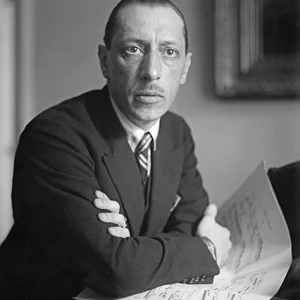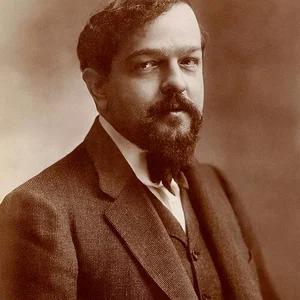

French composer (1862–1918) and founder of musical impressionism. He revolutionized classical music by rejecting traditional harmonic conventions to create a suggestive and colorful music inspired by sensations and poetic imagery.
Claude Debussy(1862 — 1918)
Claude Debussy
France
7 min read
Frequently asked questions
Famous Quotes
« Music should humbly seek to give pleasure»
Key Facts
- 1884: wins the Prix de Rome at age 22 for his cantata L'Enfant prodigue
- 1888–1889: discovers traditional Indonesian music at the Paris World's Fair, profoundly influencing his style
- 1894: premieres Prelude to the Afternoon of a Faun, a founding work of modern music
- 1900–1902: composes the opera Pelléas et Mélisande, subversive in its approach to harmony and musical drama
- 1905–1910: writes his most celebrated piano pieces, including Clair de lune and The Sunken Cathedral
Works & Achievements
A symphonic poem inspired by Mallarmé, considered the starting point of modern music. It breaks with classical thematic development in favor of a fluid and sensual atmosphere.
Debussy's only completed opera, based on the play by Maeterlinck. It revolutionizes the lyric genre by replacing declamatory singing with a prosody closer to natural speech.
Three symphonic sketches evoking the sea in its different aspects. An orchestral masterpiece, this score demonstrates Debussy's ability to translate the forces of nature into sound.
One of the most celebrated piano pieces in the classical repertoire. Its delicate melody and nocturnal atmosphere make it a symbol of Debussy's art.
Twenty-four pieces with evocative titles such as "The Sunken Cathedral" and "Footprints in the Snow". They explore every sonic possibility of the piano.
A suite of six piano pieces dedicated to his daughter Claude-Emma, nicknamed Chouchou. These pieces, full of tenderness and humor, evoke the world of childhood with great refinement.
An orchestral triptych comprising "Ibéria", "Gigues", and "Rondes de printemps". These pieces demonstrate Debussy's mastery of the art of colorful orchestration.
Anecdotes
As a child, Debussy never attended ordinary school. He entered the Paris Conservatoire at just 10 years old, in 1872, where his teachers quickly noticed his talent but also his rebellious attitude toward academic rules.
In 1884, Debussy won the prestigious Prix de Rome with his cantata "L'Enfant prodigue". Yet his stay at the Villa Medici in Rome made him deeply unhappy: he hated the isolation and wrote desperate letters to his Parisian friends, almost begging to be allowed to return.
At the 1889 Universal Exhibition in Paris, Debussy discovered the Javanese gamelan, a percussion ensemble from Southeast Asia. This music with its unprecedented timbres fascinated him and lastingly influenced his compositions, particularly his use of pentatonic scales and unusual tonal colors.
Debussy was a highly superstitious man. He had an irrational fear of the number 13 and regularly consulted fortune tellers. He also carried small talismanic objects on his person, which he considered lucky charms.
The premiere of "Pelléas et Mélisande" at the Opéra-Comique in 1902 caused a genuine scandal. Part of the audience and critics found the work incomprehensible and tedious, while others saw it as a musical revolution. The rehearsals themselves were chaotic, with singers struggling to memorize music so unlike anything they had ever known.
Primary Sources
I am too jealous of my freedom, I love my own ideas too much. Any music that is not written according to a formula is not understood here.
Music is a sum of scattered forces expressed in a sonic process that includes: the instrument, the instrumentalist, the creator, and a creative state of mind.
I am working on things that will only be understood by the grandchildren of the 20th century.
I want to sing of inner landscapes, truer than reality. Rules do not exist outside of individual works.
Key Places
Debussy's birthplace, where he spent his early years before his family moved to Paris. His childhood home is today a museum dedicated to his memory.
Debussy studied here from 1872 to 1884, honing his technique while rebelling against academic teaching. It was here that he won the Prix de Rome.
The mandatory residence for Prix de Rome laureates. Debussy lived here from 1885 to 1887 but struggled with being away from Paris and left Rome before the end of his stay.
Debussy's final home in Paris, at 80 avenue du Bois-de-Boulogne, where he composed his last works and died on 25 March 1918.
The site of the turbulent premiere of 'Pelléas et Mélisande' in 1902, an event that divided critics but established Debussy as a major composer.
Typical Objects

Debussy owned a Blüthner grand piano that he cherished greatly. It was on this instrument that he composed many of his most celebrated works.

Debussy collected Japanese woodblock prints, particularly those by Hokusai. "The Great Wave" directly inspired the cover of his score for "La Mer".

His musical manuscripts reveal numerous crossed-out passages and corrections, bearing witness to his obsessive perfectionism in the pursuit of the right sound.
A heavy smoker, Debussy was rarely seen without a cigarette. This habit likely contributed to the deterioration of his health.

Debussy often wore a lavallière tie, a accessory typical of artists and intellectuals of the Belle Époque, underscoring his belonging to the Parisian bohemian world.

The works of Mallarmé, Verlaine, and Baudelaire were constantly on his writing desk. Symbolist poetry was a major source of inspiration for his music.
School Curriculum
Vocabulary & Tags
Key Vocabulary
Daily Life
Morning
Debussy generally rose late, rarely before 10 o'clock. He began his day with coffee and cigarettes, going through his mail and the press. He would then sit at the piano to work on his compositions, often in his dressing gown, in a state of intense concentration.
Afternoon
In the afternoon, Debussy would receive visitors or call on his publishers and the Parisian literary salons. He frequented the cafés of the neighborhood, notably the Café Riche or the Weber, where he met up with other artists and writers. He could also spend hours rereading and correcting his manuscripts.
Evening
Evenings were devoted to concerts, theatrical performances, or dinners with friends. Debussy was a dinner guest appreciated for his caustic wit and his sharp musical judgments. He often came home late and could still work on his compositions in the silence of the night.
Food
Debussy appreciated fine French cuisine and the pleasures of the table. He enjoyed refined dishes, oysters, and fine wines. However, his illness forced him to adopt a stricter diet in his later years, which he experienced as a painful deprivation.
Clothing
Debussy dressed elegantly in the fashion of the Belle Époque: dark frock coat, bowler or top hat, gloves, and a cane. He readily wore the lavallière cravat favored in artistic circles and took particular care of his appearance, sporting his famous fringe across his forehead.
Housing
Debussy lived in several Parisian apartments, always decorated with taste. His last residence, on the avenue du Bois-de-Boulogne, was adorned with Japanese prints, knick-knacks, and books. He favored warm and refined interiors, reflections of his artistic sensibility.
Historical Timeline
Period Vocabulary
Visual Style
Style visuel impressionniste et Art nouveau, évoquant les salons parisiens de la Belle Époque avec des teintes aquatiques, des lignes organiques et une lumière diffuse rappelant les paysages de Monet.
Sound Ambience
Atmosphère d'un salon parisien de la Belle Époque, entre musique de piano impressionniste, bruits feutrés de la ville et intimité d'un espace de création artistique.