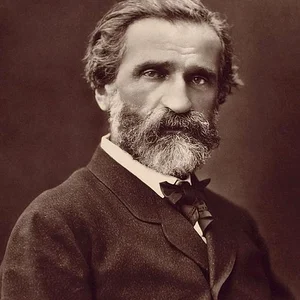

Giuseppe Verdi (1813-1901) was a major Italian composer of the Romantic era, creator of world-famous operas such as Rigoletto, La Traviata, and Aida. His musical work accompanied the unification of Italy and remains at the heart of the European operatic repertoire.
Giuseppe Verdi(1813 — 1901)
Giuseppe Verdi
royaume d'Italie
8 min read
Frequently asked questions
Key Facts
- 1842: Premiere of Nabucco at La Scala in Milan, which made him famous across Italy and Europe
- 1851: Premiere of Rigoletto, a groundbreaking opera for its dramatic structure and characters
- 1853: Back-to-back premieres of La Traviata and Il Trovatore, cementing his international success
- 1871: Composition of Aida, commissioned for the inauguration of the Cairo Opera House, a spectacular and majestic opera
- 1887: Premiere of Otello, a musical adaptation of Shakespeare's masterpiece, demonstrating his artistic modernity
Works & Achievements
Opera in four acts inspired by the Old Testament, whose famous chorus 'Va, pensiero' became the anthem of the Italian unification movement, propelling Verdi to the status of national composer.
Tragic opera in three acts based on Victor Hugo (Le roi s'amuse), a masterpiece of Verdian psychological drama featuring the unforgettable aria 'La donna è mobile', premiered despite Austrian censorship.
Opera in four acts of extreme dramatic complexity, immensely popular in the 19th century for the power of its arias and the darkness of its plot.
Opera in three acts inspired by La Dame aux camélias by Dumas fils, a deeply moving portrait of a woman sacrificed by social conventions, today one of the most performed operas in the world.
Grand opera in four acts commissioned by the Khedive of Egypt, the pinnacle of monumental lyric spectacle combining Orientalist exoticism with dramatic depth.
Requiem composed in homage to the writer Alessandro Manzoni, a choral and orchestral work of such dramatic intensity that it transcends the strictly liturgical framework to reach the universal.
Opera in four acts based on Shakespeare, composed after sixteen years of operatic silence; considered the pinnacle of mature Verdian drama, with a libretto by Arrigo Boito of rare excellence.
Verdi's only comic opera, composed at the age of 79 after Shakespeare (The Merry Wives of Windsor and Henry IV), a work of astonishing lightness and modernity hailed as a brilliant artistic testament.
Anecdotes
Verdi was rejected by the Milan Conservatory in 1832: the examiners judged that he had exceeded the age limit and that his piano playing lacked technique. Far from being discouraged, he studied privately in Milan and became one of the most celebrated composers of the 19th century.
At the premiere of Nabucco in 1842 at La Scala in Milan, the chorus 'Va, pensiero' was encored by an audience in tears. This song of the Hebrew slaves became a symbol of Italian resistance against Austrian domination, and Verdi was hailed as the musician of the Risorgimento.
Verdi's name was used as a political acronym by supporters of Italian unification: 'Viva VERDI' stood for 'Viva Vittorio Emanuele Re D'Italia', meaning 'Long live Victor Emmanuel King of Italy'. The Austrians could not censor shouts of enthusiasm for the composer without making themselves look ridiculous.
Verdi endured a terrible personal tragedy between 1838 and 1840: he lost his daughter, his son, and his wife Margherita Barezzi in less than two years. Devastated, he wanted to abandon music, but his friend the impresario Merelli handed him the libretto of Nabucco, and composing that opera saved him from despair.
At over 74 years of age, Verdi composed Otello (1887) and then Falstaff (1893), his only comic opera. His contemporaries were astonished that a man of such advanced age could produce works of such modernity and vitality. Falstaff remains one of the most admired comic operas in the world repertoire.
Primary Sources
"I am a peasant... I was raised in the countryside and I have never been able to shed certain rustic habits, a certain roughness of manner that perhaps shocks people of the world."
"I want the opera to be great, splendid; I want magnificence in the sets and costumes, but above all I want truth in the situations and in the characters."
"Copying reality may be a good thing, but inventing reality is better, far better. It does not seem that Falstaff ever existed, and yet he is truer than truth."
"Verdi worked every morning with an energy and a joy I had never seen in him before. He laughed as he composed; he had become young again."
"Music is a universal language; it speaks to the heart of all people, regardless of nation or rank."
Key Places
Tiny village in the Duchy of Parma where Verdi was born on October 10, 1813; he took his first musical steps there on the organ of the parish church.
Italy's most prestigious opera house, where Verdi enjoyed his greatest triumphs with Nabucco (1842), Otello (1887), and Falstaff (1893).
Agricultural estate acquired in 1848 near Busseto, Verdi's main residence for more than fifty years, where he composed most of his works.
Legendary theatre where Rigoletto (1851) and La Traviata (1853) had their world premieres — two of the most performed operas in the global repertoire.
Site of the world premiere of Aida on December 24, 1871, commissioned to celebrate the inauguration of the Suez Canal in a context of triumphant Orientalism.
Retirement home for elderly musicians founded and entirely funded by Verdi in 1899; he died there in 1901 and rests there alongside his wife Giuseppina Strepponi.
Typical Objects

Verdi composed at an upright or grand piano in his apartments; he owned several instruments and worked daily at the keyboard to develop his vocal scores.

Verdi wrote his scores himself with a quill pen, correcting and crossing out extensively; his manuscripts, preserved at the Casa Ricordi and the archives of Parma, bear witness to his perfectionist demands.

Verdi attached paramount importance to the libretto and worked closely with his librettists Temistocle Solera, Francesco Maria Piave, and Arrigo Boito to obtain dramatically powerful texts.

Richly embroidered costumes and sumptuous sets were essential elements of the Verdian spectacle; Verdi himself supervised their design during major premieres.

As a prosperous bourgeois of the Victorian era, Verdi wore a top hat in the city, a symbol of social respectability, although he preferred the rural life of Sant'Agata to the bustle of large cities.

Verdi was a passionate landowner; at his villa in Sant'Agata (Piacenza), he personally oversaw the crops and livestock, claiming that the land restored him between operas.

The Ricordi music publishing house in Milan was the indispensable intermediary between Verdi and theatres around the world; hundreds of letters and telegrams stand as testament to this fruitful collaboration.
School Curriculum
Vocabulary & Tags
Key Vocabulary
Tags
Mouvement
Daily Life
Morning
Verdi rose early, a peasant habit he never lost. At Sant'Agata, he inspected his fields and stables at dawn, checking the crops and giving instructions to his farm workers. He ate a frugal breakfast before settling at the piano to compose for several hours of intense concentration.
Afternoon
The afternoon was devoted to correspondence — Verdi received and replied to dozens of letters from publishers, theaters, and librettists. During rehearsal periods in Milan or Parma, he attended hall sessions to oversee the work of singers and conductors, never hesitating to interrupt in order to correct an interpretation.
Evening
Verdi dined with family or a few close intimates; he disliked socializing and frequently declined invitations to Milanese salons. Evenings at the villa were spent reading — Shakespeare, Schiller, and Hugo were his bedside authors — or in musical discussions with his wife Giuseppina Strepponi, a former soprano who had become his artistic adviser.
Food
Verdi's cuisine was simple and rustic, reflecting his peasant origins: pasta, risotto, farm meats, local cheeses, and wines from the Parma region. He grew his own vegetables at Sant'Agata and took pride in the oil and wine produced on his land. He rejected the ostentatious gastronomy of official banquets.
Clothing
In the city, Verdi wore the attire of a respectable bourgeois: a black frock coat or dress coat for evening occasions, a top hat, tie, and waistcoat. In the countryside, he favored simpler, more practical clothing without ostentation. In his later years, he sported an impressive white beard that gave him the bearing of a patriarch.
Housing
The Villa Sant'Agata, acquired in 1848 and gradually enlarged, was the heart of Verdi's life: a large agricultural estate surrounded by an English-style park he designed himself, with ponds, greenhouses, and avenues of plane trees. In Milan, he stayed at the Hotel de Milan near La Scala during his professional visits, in a comfortable apartment but without flashy luxury.
Historical Timeline
Period Vocabulary
Visual Style
Le style visuel de l'univers de Verdi convoque le Romantisme pictural italien — portraits bourgeois sobres, paysages lombards brumeux — mêlé à la splendeur théâtrale des grandes scènes lyriques du XIXe siècle.
Sound Ambience
L'univers sonore de Verdi oscille entre la splendeur dramatique des grandes salles d'opéra italiennes et la quiétude rurale de sa villa de Sant'Agata, entre fanfares triomphales et sons champêtres de la plaine du Pô.