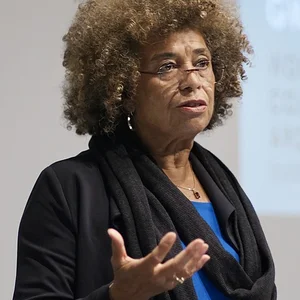

African-American civil rights activist, philosopher, and university professor born in 1944 in Birmingham, Alabama. An iconic figure of the Black Power movement and intersectional feminism, she was imprisoned in 1970 before being acquitted. She remains a leading voice against systemic racism and social inequality.
Angela Davis(1944 — ?)
Angela Davis
États-Unis
8 min read
Frequently asked questions
Famous Quotes
« I am no longer accepting the things I cannot change. I am changing the things I cannot accept.»
« Freedom is a constant struggle.»
« We must extend ourselves beyond the borders of the nation-state.»
Key Facts
- 1944: born in Birmingham, Alabama, in a neighborhood nicknamed "Dynamite Hill" due to racist bombings
- 1969: dismissed from her position at UCLA by Governor Ronald Reagan because of her membership in the Communist Party
- 1970: placed on the FBI's Most Wanted list, arrested, and imprisoned for 16 months
- 1972: acquitted of all charges following a highly publicized international trial
- 1981: publication of "Women, Race & Class", a foundational work in intersectionality
Works & Achievements
An autobiographical account covering her childhood under segregation, her political activism, and her imprisonment. Translated into many languages, this book has become an essential document on the civil rights struggle.
A groundbreaking work analyzing the interplay of racism, sexism, and capitalism throughout American history. Considered one of the founding texts of intersectional feminism.
A collection of speeches and essays on women's rights, peace, and economic inequality. Davis extends her feminist analysis to questions of foreign policy and international solidarity.
A manifesto for the abolition of the American prison system, now a cornerstone of the abolitionist movement. Davis demonstrates how prisons perpetuate racial and economic inequality.
An essay examining the connections between slavery, democracy, and the prison system in the United States. The work extends the argument of Are Prisons Obsolete? by proposing concrete alternatives to incarceration.
A collection of interviews and essays connecting the historical civil rights struggles to contemporary movements such as Black Lives Matter. It demonstrates the continuity of the fight against systemic racism.
Anecdotes
In 1969, Angela Davis was appointed professor of philosophy at UCLA. As soon as the FBI and Governor Ronald Reagan learned she was a member of the Communist Party USA, she was immediately dismissed. Her forced reinstatement by the courts became a symbol of the fight against political repression.
In August 1970, Jonathan Jackson, brother of activist George Jackson, attempted to free Black prisoners during a hostage-taking at the Marin County courthouse. Firearms registered in Angela Davis's name were found at the scene. She was arrested and placed at the top of the FBI's Most Wanted list, triggering a worldwide solidarity campaign under the slogan 'Free Angela Davis'.
During her sixteen months of pretrial imprisonment, Angela Davis received thousands of letters of support from around the world, including from the Soviet Union. In June 1972, an all-white jury found her not guilty on all charges — murder, kidnapping, and conspiracy — after deliberation.
In 1980 and 1984, Angela Davis ran for Vice President of the United States on the Communist Party USA ticket alongside Gus Hall. Though symbolic, her candidacy made history as one of the first Black women to seek that office at the national level.
Angela Davis was one of the first intellectuals to theorize the concept of intersectionality in her book 'Women, Race & Class' (1981), demonstrating how racism, sexism, and capitalism mutually reinforce one another. This concept would go on to become foundational in feminist studies worldwide.
Primary Sources
I was a Communist, and I was proud of it. For me, this was not merely an intellectual exercise but a commitment to struggle alongside the most exploited people of our society.
You have to be the vanguard, the leadership of this struggle. The masses are waiting, Angela. The revolution needs people like you who can think and act at the same time.
The demand for the right to vote was not an end in itself but rather a means toward the larger goal of achieving economic and social equality for Black women and men alike.
I am innocent of all charges brought against me. This trial is a political persecution designed to silence those who fight for the liberation of Black people and all oppressed people in this country.
The prison industrial complex is not a conspiracy to keep Black people enslaved. It is the predictable result of a set of social and economic priorities, none of which include the well-being of poor communities of color.
Key Places
Angela Davis's hometown, nicknamed 'Bombingham' due to the numerous bombings targeting the Black community. It was here that she grew up under segregation and where four of her friends were killed in the 1963 church bombing.
Angela Davis taught philosophy here in 1969 before being fired under pressure from Governor Reagan due to her membership in the Communist Party. Her case became a symbol of academic repression.
Angela Davis was held here for sixteen months between 1970 and 1972 while awaiting trial. Her detention conditions sparked an unprecedented wave of international solidarity.
It was in this courthouse that Angela Davis was tried and acquitted of all charges in June 1972. The verdict was celebrated as a victory by civil rights movements around the world.
Angela Davis studied philosophy here under Herbert Marcuse and Theodor Adorno in the 1960s. This training in Critical Theory profoundly shaped her political and philosophical thinking.
Liens externes & ressources
Références
Œuvres
Angela Davis: An Autobiography
1974
Women, Race & Class
1981
Women, Culture & Politics
1989
Are Prisons Obsolete?
2003
Abolition Democracy
2005
Freedom Is a Constant Struggle
2015