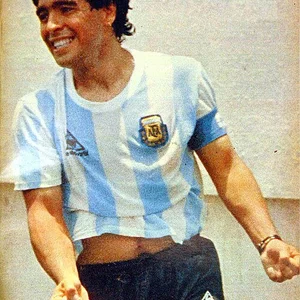

Argentine footballer considered one of the greatest players in history. An exceptional playmaker, he led Argentina to victory at the 1986 World Cup. He became a worldwide popular icon, and his career was marked by both genius and excess.
Diego Maradona(1960 — 2020)
Diego Maradona
Argentine
6 min read
Frequently asked questions
Key Facts
- Born on October 30, 1960, in Lanús, near Buenos Aires (Argentina)
- Won the 1986 World Cup with Argentina, scoring the “Hand of God” goal and the “Goal of the Century” against England
- Led SSC Napoli to two Italian league titles (1987, 1990), a historic achievement for the club
- His career was tarnished by positive doping tests and addiction problems
- Died on November 25, 2020, in Tigre (Argentina), prompting national mourning
Works & Achievements
Captain and best player of the tournament, he almost single-handedly carried Argentina to the world title in Mexico.
A 60-metre slalom past five opponents, voted the greatest goal in World Cup history by FIFA.
He gave the Naples club its first Italian championship title, a historic achievement for the south of the country.
A second Italian championship title that sealed his status as an absolute legend in Naples.
Victory in the UEFA Cup, the first European trophy and only continental title of the Naples club.
He led a weakened Argentina all the way to the final, narrowly beaten by West Germany.
An account of his life in which he openly recounts his rise, his glory, and his personal struggles.
Anecdotes
On 22 June 1986, in the World Cup quarter-final against England, Maradona scored two goals in four minutes that would become legendary. The first, illegal, was scored with his fist: he would later call it “the Hand of God.” The second, in which he dribbled past half the English team over 60 metres, would be voted “Goal of the Century” by FIFA.
A poor child from the Villa Fiorito neighbourhood, on the outskirts of Buenos Aires, little Diego was given a leather ball at the age of three and never let go of it. As a teenager, he was already juggling a ball at half-time during professional matches to dazzle the crowd.
When he signed for Naples in 1984, nearly 75,000 supporters welcomed him to the San Paolo stadium just for his presentation. There he became a true demigod, giving the club its only two Italian championship titles (1987 and 1990), in a southern Italy long looked down upon by the wealthy north.
His career was overshadowed by excess: he tested positive for cocaine in 1991 and then for ephedrine at the 1994 World Cup, and was suspended and expelled. He battled addiction for the rest of his life, becoming a tragic symbol of genius broken by fame.
When he died on 25 November 2020, Argentina declared three days of national mourning. Millions of people wept for the man nicknamed “El Pibe de Oro” (“the Golden Boy”), and his coffin was laid out at the Casa Rosada presidential palace.
Primary Sources
The goal was scored a little with Maradona's head and a little with the hand of God.
With what a heart you played, my God... The ball, I had it glued to my foot, I felt it as a part of myself.
I made mistakes and I paid for them, but the ball is never to blame.
Key Places
A poor neighborhood in the southern suburbs of Buenos Aires where Maradona grew up in hardship. It was there, on the vacant lots, that he honed his talent.
The stage of his feats during the 1986 World Cup, including the quarter-final against England. It was here that he lifted the world trophy.
Home of SSC Napoli, where he became a revered idol of southern Italy. The stadium was renamed in his honor after his death in 2020.
The legendary stadium of Boca Juniors, the club closest to his heart, where he played his debut and his final match. A vibrant place of grassroots Argentine football.
A town in the northern suburbs of Buenos Aires where Maradona passed away on November 25, 2020. His death sent shockwaves around the world.
Liens externes & ressources
Références
Œuvres
Victoire à la Coupe du monde 1986
1986
Le « but du siècle » contre l'Angleterre
22 juin 1986
Premier Scudetto du SSC Naples
1987
Second Scudetto avec Naples
1990
Coupe UEFA avec Naples
1989
Finale de la Coupe du monde 1990
1990
Autobiographie « Yo soy el Diego »
2000